By Renovation Guide HQ | Updated October 2026
Quick Answer: How Much Does Attic Insulation Cost in 2026?
Attic insulation costs $1.00 to $5.00 per square foot installed in 2026, depending on the material. For a typical 1,000 sq ft attic, expect $1,500-$3,500 for blown-in cellulose or fiberglass, $1,000-$3,000 for fiberglass batts, and $3,000-$6,500+ for spray foam. Blown-in fiberglass is the best value for most homeowners: it’s affordable, fast to install, and covers obstructions like wiring and junction boxes that batts can’t seal around.
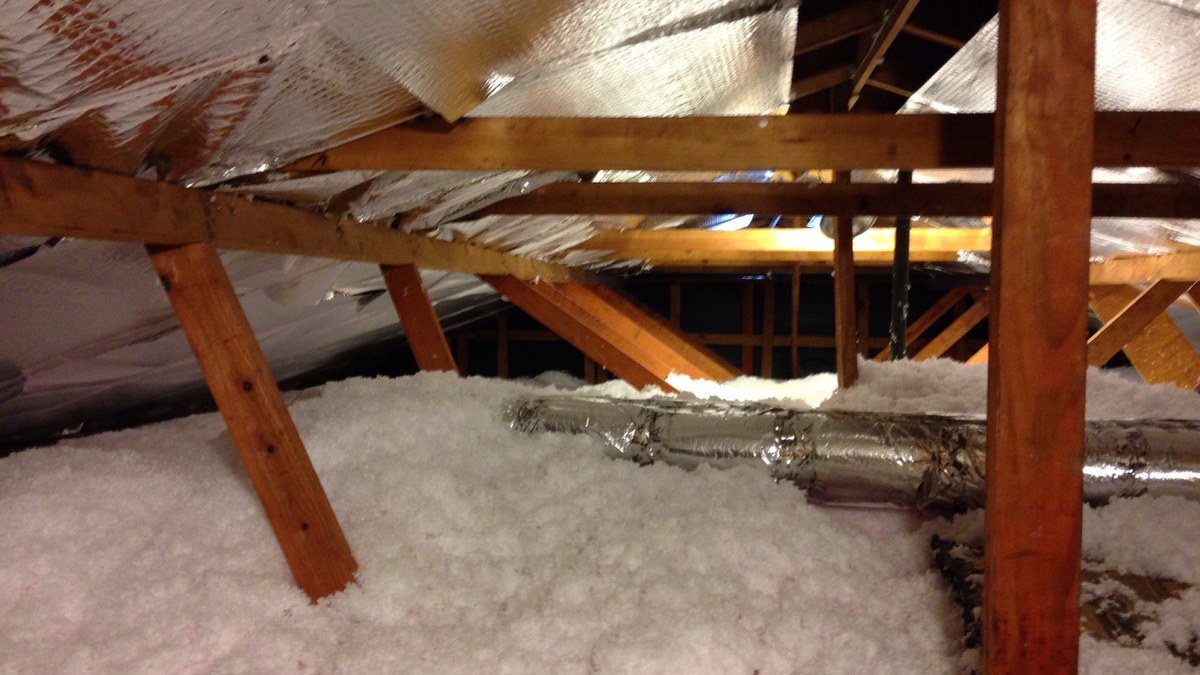
The single biggest cost driver is material choice. Labor, attic size, existing insulation removal, and air-sealing work all add to the total. A well-insulated attic is one of the highest-ROI upgrades in a home — the EPA estimates homeowners can save an average of 15% on heating and cooling costs through air sealing and added insulation.
Attic Insulation Cost by Type: 2026 Comparison
Every insulation type has a different cost, thermal performance, and installation method. Here’s how they compare for open attic floors:
| Insulation Type | Installed Cost / Sq Ft | R-Value per Inch | Best For | DIY Friendly? |
|---|---|---|---|---|
| Fiberglass batts / rolls | $0.80-$2.60 | R-3.1-R-4.3 | Open joists with few obstructions; knee walls; hatch covers | Yes — easiest DIY |
| Blown-in fiberglass | $1.00-$2.80 | R-2.2-R-2.9 | Topping up existing insulation; attics with wiring and obstructions | Yes — with a rented blower |
| Blown-in cellulose | $1.20-$2.80 | R-3.1-R-3.8 | Eco-friendly choice (recycled paper); dense coverage around obstructions | Yes — with a rented blower |
| Open-cell spray foam | $2.60-$4.40 (at 6 in.) | R-3.7 | Underside of roof deck in unvented attics; superior air sealing | No — pro only |
| Closed-cell spray foam | $3.00-$6.40 (at 3 in.) | R-6.5 | Cold climates; maximum R-value in tight spaces; doubles as vapor barrier | No — pro only |
Pricing ranges reflect 2026 contractor data from HomeGuide and HomeAdvisor. Per-inch R-values are industry-standard ratings; installed cost for spray foam is often quoted per board foot ($1-$2.50) and converted here to per-square-foot equivalents for comparison.
Fiberglass batts: the familiar, budget-friendly option
Batts cost roughly $0.50-$1.50 per sq ft for materials alone, making them the cheapest material. They fit neatly between joists in new construction or open attics. The catch: they leave gaps around wiring, plumbing stacks, and recessed lights — and gaps leak heat. Compression kills performance, so batts stuffed into too-small cavities underperform.
Blown-in fiberglass and cellulose: best value for existing homes
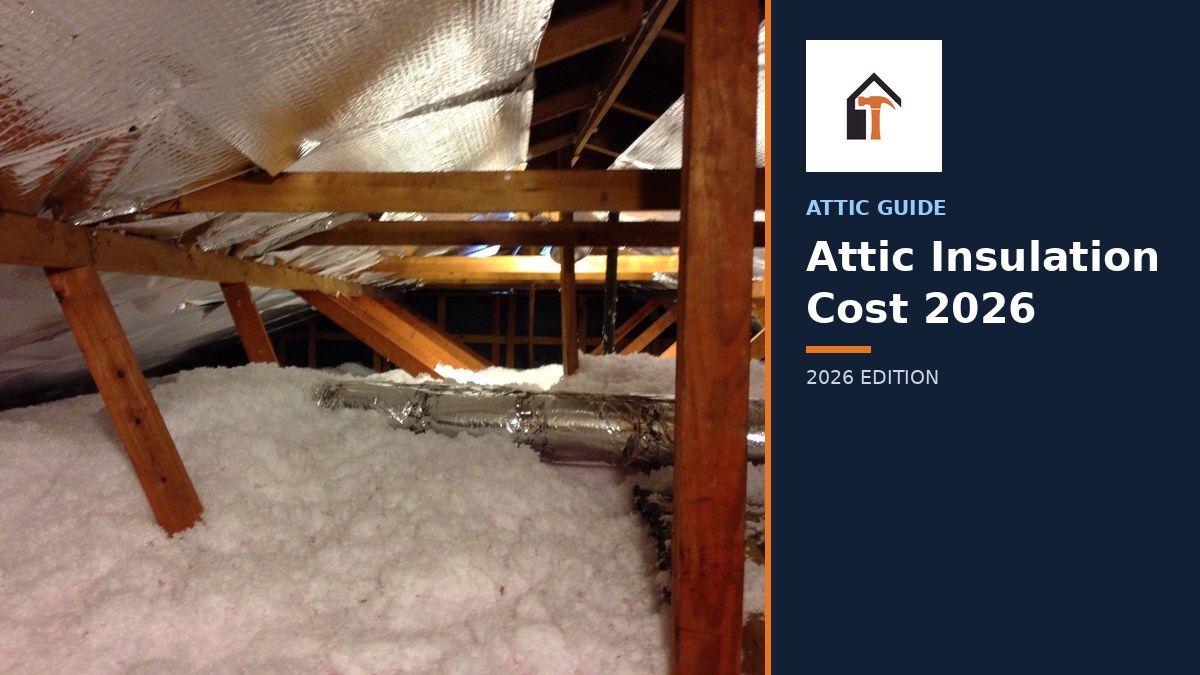
Blown-in insulation is the go-to for topping up existing attics. A hose blows loose insulation across the attic floor, filling around every obstruction. Cellulose (made from recycled newspaper treated with fire retardants) delivers slightly more R-value per inch; fiberglass is lighter and settles less over time. Both land in the same price band, so the choice usually comes down to contractor preference and local availability.
Spray foam: premium air sealing at a premium price
Spray foam does something the others can’t: it air-seals and insulates in one step. Applied to the underside of the roof deck, it turns a vented attic into an unvented (conditioned) attic — great for HVAC equipment or ductwork located up there. The price is steep, especially closed-cell, but in cold climates or moisture-prone attics it can be worth it.
R-Value Guide: How Much Insulation Do You Need?
R-value measures resistance to heat flow — higher is better. ENERGY STAR’s national retrofit guidance recommends these attic levels based on your climate zone:
| Climate Zone | Attic (No Existing Insulation) | Attic (3-4 in. Existing) |
|---|---|---|
| Zone 1 (South Florida, Hawaii) | R-30 | R-25 |
| Zone 2 (Gulf Coast, S. Texas) | R-49 | R-38 |
| Zone 3 (Southeast, S. California) | R-49 | R-38 |
| Zones 4A / 4B (Mid-Atlantic, Pacific NW) | R-60 | R-49 |
| Zones 5, 6, 4C (Midwest, Northeast) | R-60 | R-49 |
| Zones 7, 8 (Upper Midwest, Alaska) | R-60 | R-49 |
These reflect current ENERGY STAR recommendations for existing homes (they were revised upward in recent years — the old R-38 rule of thumb is no longer the target for most of the country). To figure out your zone, check the IECC climate zone map for your county, or ask a local contractor.
How to measure what you already have
Grab a tape measure and check insulation depth in several spots. Multiply depth by the material’s R-value per inch: roughly R-3.5 per inch for cellulose, R-2.5 per inch for loose fiberglass, and R-3.2 per inch for batts. If you have 6 inches of settled cellulose, you’re at about R-21 — well short of an R-49 or R-60 target. Uneven coverage, compressed spots, and visible joists all signal it’s time to add more.
Attic Insulation Cost by Attic Size
Here’s what total projects typically cost in 2026, installed by a pro:
| Attic Size | Batts | Blown-In (Fiberglass/Cellulose) | Spray Foam (Closed-Cell) |
|---|---|---|---|
| 500 sq ft (small ranch) | $600-$1,500 | $1,200-$1,800 | $2,000-$3,500 |
| 1,000 sq ft (typical) | $1,000-$3,000 | $1,500-$3,000 | $3,000-$6,500 |
| 1,500 sq ft (large) | $1,500-$4,500 | $2,000-$4,200 | $4,500-$9,500 |
Two things inflate these numbers: removal of old insulation ($1-$2 per sq ft if it’s damaged, wet, or contaminated) and minimum charges — some companies won’t roll a blower truck for less than $1,500-$2,000, which punishes small attics. Air sealing (caulking top plates, sealing can lights, weatherstripping the hatch) typically adds $300-$800 but boosts the payoff of every inch of insulation.
What about topping up vs. starting fresh?
If your existing insulation is dry, clean, and pest-free, blowing new insulation over it is standard practice — there’s no reason to remove it. Removal is only warranted for water damage, mold, heavy pest contamination, or old vermiculite insulation (which may contain asbestos and requires professional testing and abatement).
DIY vs. Pro: What’s Worth Doing Yourself?
Attic insulation is one of the more DIY-friendly projects — with caveats.
DIY blown-in: the sweet spot
DIY blown-in insulation costs $0.35-$1.50 per sq ft (materials only), or roughly $500-$1,200 for a typical attic. Blower rental runs $100-$200 per day, and many home improvement stores loan the blower free with a purchase of 10-20+ bags. It’s a two-person job: one feeds the blower, one directs the hose. A weekend is realistic for most attics.
DIY batts: simplest, but tedious
Rolling out batts takes no special equipment — just a utility knife, gloves, respirator, and patience. Watch for: never compress batts into smaller cavities (use the right thickness), keep insulation away from non-IC-rated recessed lights, and don’t block soffit vents — install vent baffles at the eaves first so airflow from the soffits isn’t choked off.
When to hire a pro
- Spray foam — always pro. The chemicals, equipment, and technique aren’t DIY territory.
- Air sealing — worth paying for. A pro finds leaks you’d miss (top plates, wire penetrations, chimney chases), and air sealing multiplies insulation performance.
- Vermiculite or suspected asbestos — get it tested before touching anything.
- Pest contamination or moisture damage — removal and remediation first.
- Steep or hard-to-access attics — the labor savings of DIY evaporate when the job takes three weekends.
Labor is typically 50-70% of a pro install. If you’re comfortable with the work, DIY blown-in can cut your total cost roughly in half.
Energy Savings and Payback
The EPA estimates that air sealing plus adding insulation to attics, floors, and crawl spaces saves homeowners an average of 15% on heating and cooling bills. For a household spending $2,000 a year on energy, that’s ~$300/year back. On a $2,000 blown-in job, the simple payback is around 6-7 years — faster in extreme climates where heating and cooling dominate the bill.
Why payback beats most remodels
Unlike a kitchen remodel, insulation pays you every month on the utility bill, and it never wears out or goes out of style. The U.S. Department of Energy consistently ranks attic insulation among the top ten most cost-effective efficiency improvements for American homes.
Rebates can cut the cost
Many utilities and states offer $150-$400+ rebates for qualifying attic insulation upgrades, and some programs require reaching a specific R-value (often R-49) to qualify. Federal incentives have shifted in recent years, so check current programs at the Database of State Incentives for Renewables & Efficiency (DSIRE) and your utility’s website before buying — rebate rules change, and what’s available in 2026 may differ from prior years.
Attic Ventilation: The Part Most People Skip
More insulation without proper ventilation can cause moisture problems. Warm indoor air leaking into a cold attic condenses on the roof deck, and if moist air can’t escape, you get mold, rotted sheathing, and ruined insulation. Insulation and ventilation are a package deal.
Soffit baffles are non-negotiable
When you blow insulation into the eaves, it can block the soffit vents that feed fresh air into the attic. Vent baffles (cardboard or foam channels stapled to the roof deck at each rafter bay) keep an air path open from the soffits up past the insulation. They cost a few dollars each and take minutes to install — but skipping them is one of the most common and costly attic mistakes. Every pro includes baffles in a blown-in quote; if yours doesn’t, ask why.
The 1:300 venting rule
Building codes generally require 1 sq ft of net free vent area for every 300 sq ft of attic floor (split between intake at the soffits and exhaust at the ridge or roof vents). Before adding insulation, walk the attic and confirm your vents are clear and balanced. If bath fans or the dryer vent into the attic — a shockingly common defect — reroute them through the roof or gable wall first. Insulating over an exhaust problem just traps the moisture you’re trying to avoid.
Insulation Costs in Other Parts of the House
This guide prices attics, but searchers asking about “insulation renovation cost” usually want the whole house picture. The attic is the highest-return area — heat rises, and the attic needs the highest R-values — but it is rarely the only under-insulated part of a home. HomeGuide’s 2026 installed ranges for other areas:
| Area to insulate | Installed cost | Notes |
|---|---|---|
| Basement | $600–$4,600 | Spray foam and rigid foam board work best; they insulate and block moisture |
| Crawl space / under floor | $500–$3,700 | Vented: insulate subfloor and rim joists; unvented: walls and rim joists |
| Garage | $600–$3,400 | Only the exterior walls of an attached garage need insulation |
| Exterior walls (whole house) | $1,400–$8,500 | Blown-in or injection foam for existing walls; batts or foam for open cavities |
| Interior walls (whole house) | $5,100–$47,400 | Usually a soundproofing or room-by-room project, not an energy play |
| Ceilings (whole house) | $2,400–$7,500 | Batts, blown-in, loose-fill, spray foam, or rigid foam |
| Whole house (average) | $1,600–$8,000 | National average about $4,400; material $0.50–$2.80 per sq ft plus labor $0.50–$1.70 per sq ft |
The practical order for most homes: attic first, then air sealing (below), then basement rim joists and crawl space, then walls. Walls are the most disruptive to retrofit — existing finished walls need drill-and-fill holes — so they usually come last unless a renovation already has them open.
Blown-In Insulation Cost in Depth: Bags, Depth, and R-Value
Blown-in is the best value for most existing attics, but its pricing confuses homeowners because it is sold by the bag and rated by depth, not just by square footage. Here is how the math actually works.
How many bags do you need?
Bag counts come from the manufacturer’s coverage chart for the product you buy — never from a rule of thumb, because bag weights and coverage differ sharply by brand. Two manufacturer charts for a bare attic (no existing insulation) show the spread:
| Target R-value | Cellulose bags per 1,000 sq ft (GreenFiber) | Fiberglass bags per 1,000 sq ft (Owens Corning AttiCat) |
|---|---|---|
| R-30 | 46.1 | 14.6 |
| R-38 | 61.1 | 19 |
| R-49 | 83.5 | 25 |
| R-60 | 108.1 | 31.5 |
Cellulose needs far more bags because each bag is lighter and covers less area — that is not a defect, it is just how the products are packaged. What matters is the total material cost, and there the two land close together: for a 1,000 sq ft bare attic at R-38, DIY cellulose runs roughly $812–$1,276 in materials (about 58 bags with a 10% overage buffer), while fiberglass AttiCat runs roughly $735–$1,050 (about 21 bags). At R-49, the same attic costs roughly $1,092–$1,716 in cellulose or $980–$1,400 in fiberglass, materials only, blower rental free under most stores’ bag-minimum threshold.
Depth, settling, and topping up
Depth is what delivers R-value: cellulose at about R-3.5 per inch needs 14 inches for R-49 and 17.1 inches for R-60; loose fiberglass at about R-2.5 per inch needs roughly 19.6 inches for R-49. Cellulose settles — GreenFiber’s own chart shows R-38 installed at 11.97 inches settling to 10.77 inches, about 10% — which is why installers blow it thicker than the settled target and why depth markers matter (see the quote checklist below).
If you already have insulation, run the math backwards instead of buying the full bare-attic count. Measure the old layer in several spots and price it at roughly R-2.2–R-2.7 per inch for old loose fiberglass or R-2.9–R-3.4 for old cellulose: 8 inches of old loose fiberglass is roughly R-18–R-22, so an attic targeting R-60 needs roughly R-40 more — close to the R-38 row of the chart. On cost per unit of insulation, blown-in installed at $1.00–$2.80 per sq ft for R-38–R-49 works out to roughly 3–6 cents per sq ft per R-point; spray foam costs several times more per R-point, which is why it wins on air sealing, not on R-value per dollar.
Other Insulation Types Worth Knowing
The comparison table above covers the five attic workhorses. Four more types show up in contractor quotes and competitor guides, and knowing their price bands stops quote shock:
| Type | Installed cost per sq ft | Where it fits |
|---|---|---|
| Mineral wool (rockwool) loose-fill | Material $1.00–$2.50; installed in the blown-in range | Fire-resistant, sound-dampening; batts and loose-fill for walls, floors, and attics |
| Rigid foam board | $1.20–$3.70 | Basement walls, rim joists, roof decks, and unvented attics; doubles as a moisture check |
| Reflective / radiant barrier | $0.30–$2.00 | Hot climates; blocks radiant heat but adds only R-3–R-21 as reflective insulation — it is not a substitute for bulk insulation |
| Structural insulated panels (SIPs) | $7–$12 materials only (panels alone) | New construction only — prefabricated foam-core panels for walls and roofs, not an attic retrofit option |
SIPs deserve the warning: they are sometimes quoted alongside retrofit insulation, but you cannot blow or staple a SIP into an existing attic. If a quote lists SIPs for an existing home, it is describing a rebuild, not an insulation upgrade.
Air Sealing Cost: What It Includes and Why It Comes First
Air sealing gets one passing mention in the size section above — $300–$800 as a job add-on — but it deserves its own numbers, because it changes what the insulation itself can do. Insulation slows heat transfer; it does not stop air movement. A thick sweater in a windstorm is the usual analogy, and it is accurate: unsealed gaps let conditioned air bypass the insulation entirely.
HomeGuide’s 2026 ranges: attic air sealing $350–$3,000, whole-house air sealing $1,000–$5,000. The $300–$800 figure in this guide’s size section is the basic version — caulking top plates, sealing can lights, weatherstripping the hatch — bundled into an insulation job. A standalone pro package runs higher because it covers the leaks a crew finds with a blower door: top plates, wire and pipe penetrations, chimney chases, duct chases, exhaust fan housings, and dropped soffits. Do air sealing before the insulation goes in, not after — once the attic floor is buried under 14 inches of cellulose, every leak is that much harder to reach.
Insulation Replacement Costs: Removal and Remediation
Most attics do not need removal — blowing new insulation over dry, clean, pest-free material is standard practice, as the topping-up section above notes. Removal is for damaged material, and it has its own price ladder (HomeGuide 2026):
| Item | Cost |
|---|---|
| Old insulation removal | $1.00–$2.00 per sq ft |
| Total replacement (removal + new insulation) | $2.00–$8.00 per sq ft |
| Mold removal | $15–$30 per sq ft |
| Asbestos removal (vermiculite) | $10–$25 per sq ft, plus testing $250–$850 |
| Pest inspection (before reinsulating) | $40–$150 for the initial visit |
The asbestos line is the one that stops a job cold: if your attic has vermiculite (pebble-like, gray-brown granules), get it tested before anyone touches it. A $250–$850 test is cheap insurance against a five-figure abatement bill and a genuine health risk.
Labor Costs: What the Crew Charges
Labor is typically 50–70% of a pro install, as the DIY section notes. HomeGuide’s 2026 labor breakdown shows where that money goes:
| Job type / location | Labor per sq ft |
|---|---|
| Attic | $0.50–$1.30 |
| Crawl space | $0.50–$1.30 |
| Batt / roll | $0.50–$1.30 |
| Blown-in | $0.70–$1.70 |
| Radiant barrier | $0.20–$1.40 |
| Spray foam | $0.60–$1.10 |
Overall labor runs $0.20–$1.70 per sq ft depending on type, size, and site conditions, and contractors charge $40–$80+ per hour. Blown-in labor sits at the top of the band because it is a two-person job with a machine; batt labor is lower but slower per square foot in obstructed attics. Small, steep, or hard-to-access attics push labor up regardless of material — access is a cost driver quotes rarely itemize.
How to Read an Insulation Quote (and What Quotes Leave Out)
Two quotes for the “same” attic can differ by thousands because of what each one quietly excludes. Before you compare prices, check every quote for these line items — the ones competitors flag as surprise add-ons:
- Disposal fees — removal and dump fees for old insulation, often billed separately from the $1.00–$2.00 per sq ft removal rate.
- Ventilation and decking upgrades — soffit baffles, roof vents ($200–$700 installed), and attic decking or walkways are frequently excluded from the insulation price.
- Minimum project fees — many companies charge a $1,500–$2,000+ minimum, which is why small-attic quotes can look expensive per square foot (see below).
- Air sealing scope — is it the basic $300–$800 bundle or a full blower-door package? Get the leak list in writing.
- R-value verification — for blown-in, the quote should state installed depth, settled R-value, and bag count, and the crew should leave depth markers (at least one per 300 sq ft, facing the attic access) plus a signed, dated certificate listing installed and settled thickness, settled R-value, installed density, coverage area, and bags used. Depth on its own proves nothing; the bag count checked against the manufacturer’s chart is the real verification.
- Warranty terms — material warranty versus workmanship warranty, and whether settling below the target R-value is covered.
Quote-comparison checklist
Use this on every bid: material and type, target R-value, installed depth, bag count and brand, air sealing scope, removal and disposal, ventilation work, decking, minimum fee, rebate paperwork, warranty, and cleanup. A quote missing three or more of these is not cheaper — it is incomplete.
Minimum Fees and Prep Costs That Surprise Homeowners
Three numbers catch homeowners off guard because they appear nowhere in per-square-foot pricing. First, the minimum: many insulation companies charge a $1,500–$2,000+ minimum project fee, so a 500 sq ft attic that “should” cost $600–$1,500 on paper can quote at the minimum anyway — small attics pay a mobilization penalty. Second, prep and add-ons (HomeGuide 2026): roof vent installation $200–$700, attic cleaning $100–$500, a home energy audit $100–$700, weatherstripping $100–$500. Third, the one discount worth asking about: bulk pricing runs 15–30% below retail when buying 15–30+ bags or rolls, which is also how most stores’ free blower-loan thresholds work. If you are DIYing, the bag count for R-49 on a 1,000 sq ft attic already clears that threshold — ask for the bulk price before you pay shelf price.
Frequently Asked Questions
How much does it cost to insulate a 1,000 sq ft attic?
About $1,500-$3,000 for blown-in fiberglass or cellulose installed by a pro, or $1,000-$3,000 for fiberglass batts. Spray foam runs $3,000-$6,500+ for the same area. DIY blown-in drops the cost to roughly $500-$1,200 in materials.
Is blown-in or batt insulation better for an attic?
Blown-in wins for most existing attics. It fills around wiring, pipes, and framing where batts leave gaps, and it’s faster to install at scale. Batts are fine for open attics with few obstructions, knee walls, and attic hatch covers. For pure thermal performance per dollar, blown-in is the best value.
Can I put new insulation over old insulation?
Yes, as long as the old insulation is dry, clean, and pest-free. Blowing new cellulose or fiberglass over existing material is standard practice and saves the cost of removal. Remove old insulation only if it’s wet, moldy, heavily contaminated, or vermiculite (get it tested for asbestos first).
How much does spray foam attic insulation cost?
Open-cell spray foam costs roughly $2.60-$4.40 per sq ft at typical thickness, while closed-cell runs $3.00-$6.40 per sq ft. For a 1,000 sq ft attic, budget $3,000-$6,500+. You’re paying for air sealing plus insulation in one step — worth it for unvented attics, roof-deck applications, and homes with HVAC or ductwork in the attic.
How do I know if my attic needs more insulation?
Look for: visible floor joists (insulation should cover them), uneven or settled coverage, rooms that are hard to heat or cool, ice dams in winter, and rising energy bills. Measure depth with a tape measure — if you’re below your climate zone’s ENERGY STAR R-value target (R-49 to R-60 for most of the U.S.), adding insulation will pay for itself.
How much does it cost to insulate a whole house?
HomeGuide’s 2026 average is $1,600–$8,000 installed, with a national average around $4,400. The range is wide because “whole house” can mean attic-only plus rim joists or every wall, floor, and ceiling. Start with the attic ($1,000–$2,700 on its own), then add basement ($600–$4,600) and crawl space ($500–$3,700) as budget allows — walls are the most disruptive and usually come last.
How many bags of blown-in insulation do I need?
It depends on the product and the target R-value — always check the bag label or the manufacturer’s coverage chart, because bag counts differ sharply by brand. For a bare 1,000 sq ft attic: cellulose needs about 61 bags for R-38, 84 for R-49, and 108 for R-60 (GreenFiber chart); fiberglass needs about 19 bags for R-38, 25 for R-49, and 32 for R-60 (Owens Corning AttiCat chart). If you already have insulation, measure its depth, estimate its current R-value, and buy only the shortfall — and confirm the crew leaves depth markers and a certificate with the bag count.
What does air sealing cost, and should I do it before insulation?
Attic air sealing runs $350–$3,000 as a standalone pro package (whole house $1,000–$5,000); a basic caulk-and-weatherstrip bundle during an insulation job is typically $300–$800. Yes, do it first — sealing top plates, wire and pipe penetrations, and chimney chases before the insulation goes in is far cheaper than digging through 14 inches of cellulose to reach the same leaks later.
What will my insulation quote leave out?
The usual exclusions: disposal fees for old insulation, ventilation work (soffit baffles, roof vents at $200–$700), attic decking or walkways, and the company’s $1,500–$2,000+ minimum project fee. Ask for each in writing, and for blown-in jobs insist on the installed depth, settled R-value, and bag count on the quote — depth markers plus a signed certificate are how you verify you got the R-value you paid for.
How We Estimated These Costs
Cost ranges in this guide are 2026 U.S. national planning estimates compiled from Angi’s attic and insulation cost data, HomeGuide’s insulation pricing research (including its 2025 updates referenced throughout 2026 contractor guides), HomeAdvisor’s per-square-foot installation bands, Home Depot’s published 2026 material pricing for batts and blown-in bags, and manufacturer coverage charts for R-value-per-inch figures. R-value targets come from ENERGY STAR’s national retrofit recommendations for existing homes, and the 15% average heating-and-cooling savings figure comes from the EPA. Regional labor rates vary 20-40% above or below national averages — always get 2-3 written estimates from local insulation contractors before committing. These are planning ranges, not quotes.
By Renovation Guide HQ — October 2026. Renovation Guide HQ researches U.S. home renovation costs using publicly cited contractor data, federal energy guidance, and industry pricing databases.
Related guide: Insulating below grade too? The basement finishing cost guide explains how insulation and moisture control factor into the budget.