Transparency note: This guide contains no affiliate links. Renovation Guide HQ currently earns no commissions from any product or service mentioned — every figure is cited so you can verify it yourself.
By Renovation Guide HQ · Updated October 8, 2026
Quick Answer
Bathroom tile installation in 2026 costs $7–$25 per square foot installed for most ceramic and porcelain jobs, according to Angi’s 2026 bathroom tile data, with a typical whole-project range of $400–$6,500 and a national average of about $2,000. A standard 50 sq ft bathroom floor in ceramic or porcelain typically runs $500–$1,500 all-in, while a full tiled shower surround averages about $2,700. Your per-square-foot price depends mostly on two choices: the tile material and where it goes — shower walls cost more than bathroom floors because waterproofing is mandatory.
This guide breaks tile installation into its real per-square-foot costs, shows where the money goes line by line, and flags the prep and waterproofing details that separate a tile job that lasts 25 years from one that fails in five.
2026 Bathroom Tile Installation Cost per Square Foot
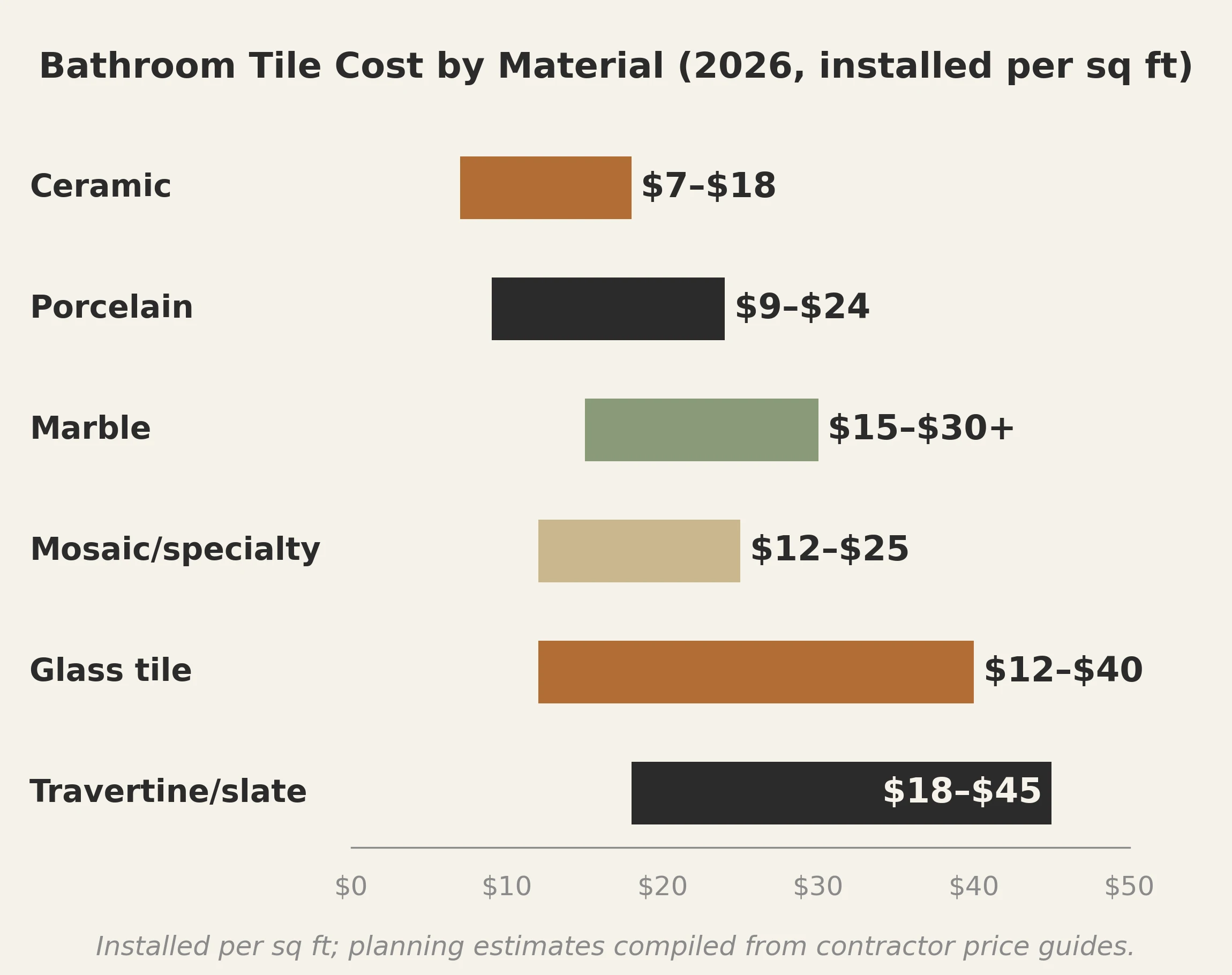
The table below combines Angi’s 2026 bathroom tile data, 2026 installed-price tiers, and 2026 material/labor splits.
| Tile material | Material per sq ft | Labor per sq ft | Installed per sq ft |
|---|---|---|---|
| Ceramic | $1–$8 | $4–$10 | $7–$18 |
| Porcelain | $3–$12 | $6–$12 | $9–$24 |
| Travertine / slate | $8–$25 | $10–$20 | $18–$45 |
| Marble | $10–$25 | $5–$8 | $15–$30+ |
| Mosaic / specialty | $7–$15 | $5–$10 | $12–$25 |
| Glass tile | $7–$30 | $8–$20 | $12–$40 |
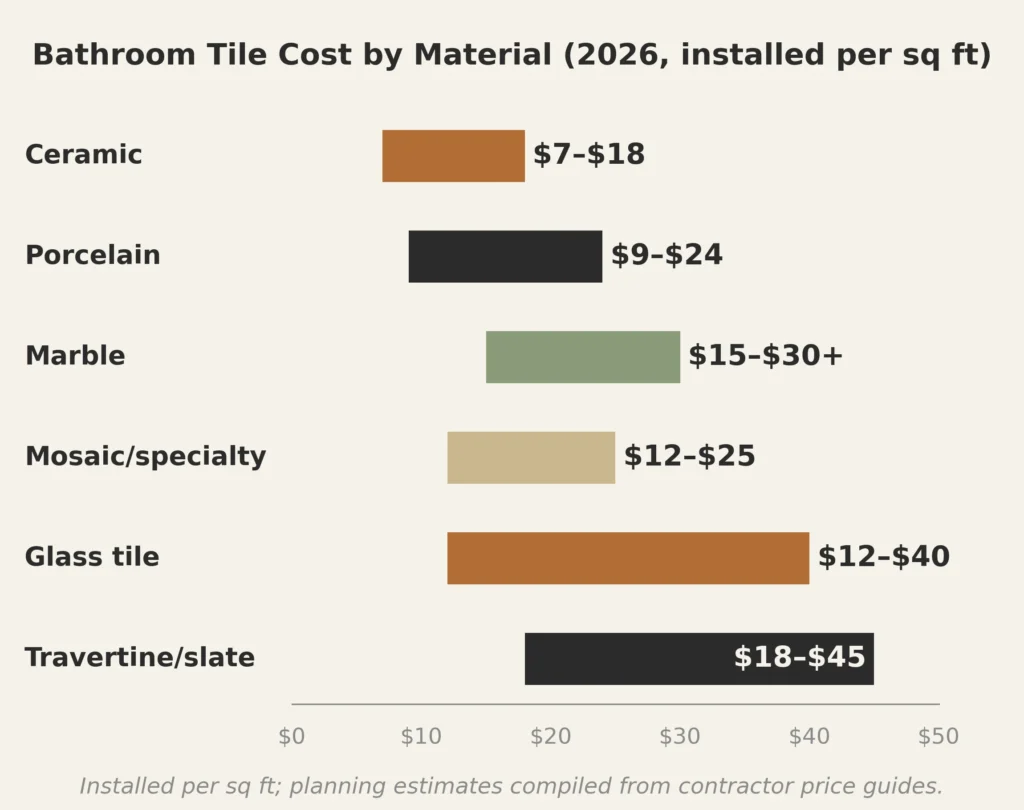
Labor runs 40–60% of the total, averaging $5–$15 per square foot, per 2026 installed pricing — which is why the cheapest $3 porcelain tile still lands near $35 per square foot installed once backer board, thinset, grout, and labor are included. As a broad planning rule, midrange porcelain in a straightforward layout lands at $15–$35 per square foot installed.
Cost by Location: Floor vs. Wall vs. Shower
Where the tile goes matters almost as much as what it is. Shower work costs more than floor work for three specific reasons: a mandatory waterproofing membrane, more precision cuts around valves and niches, and tighter watertight tolerances, per 2026 shower tile data.
| Location | Installed per sq ft | Typical project total | Why |
|---|---|---|---|
| Bathroom floor | $7–$25 | $800–$7,000 | Simplest layout; fewer cuts than walls |
| Bathroom wall | $7–$25 | $800–$8,000 | Gravity work; slower than floors |
| Shower floor | $5–$25 | $500–$1,000 | Small area, but sloped to drain + waterproofed |
| Shower walls | $5–$25 | $800–$2,600 | Waterproofing membrane adds $450–$750 with labor |
| Walk-in shower (all tile) | $5–$25 | $800–$3,000 | Most technically demanding; premium tile pushes to $50+/sq ft |
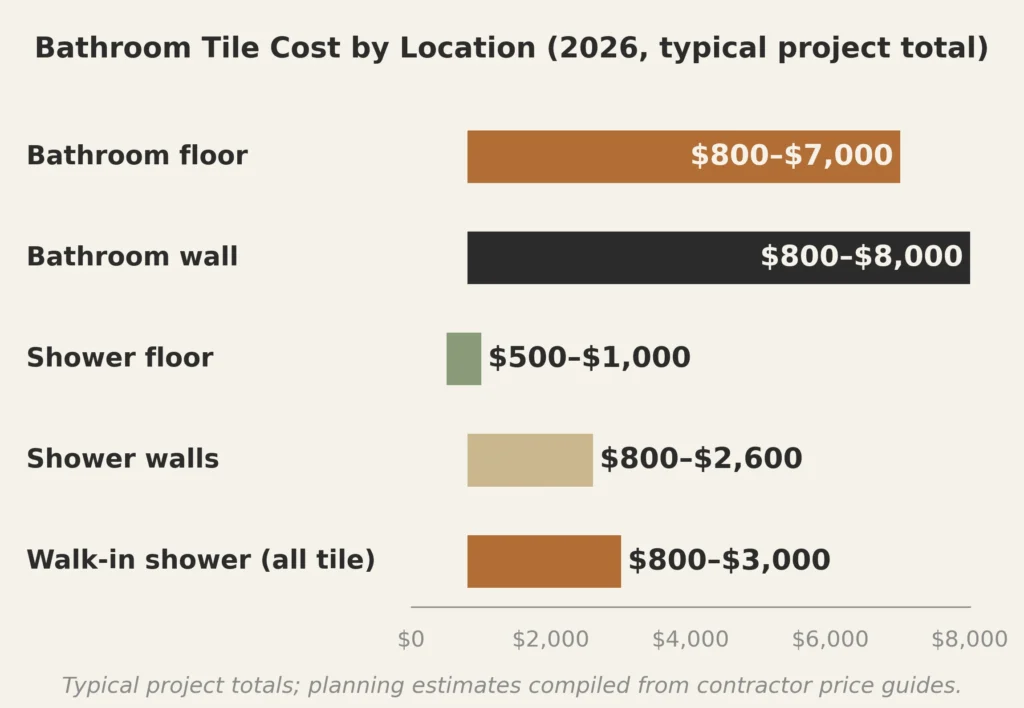
Location figures are from Angi’s 2026 data; shower totals and the waterproofing membrane range are from tilehub’s 2026 guide. A standard shower surround averages about $2,700, with a typical range of $1,800–$5,000.
What $1,500, $5,000, or $12,000 Actually Buys
What three common budgets cover (all planning estimates):
$1,500: the floor-only refresh
A standard 40–60 sq ft bathroom floor in ceramic or porcelain, same layout, old tile removed. One day of work. No wall tile, no shower, no pattern complexity.
$5,000: floor + shower walls, midrange porcelain
Floor plus a standard shower surround (about 80 sq ft of walls), 12×24 porcelain, waterproofing membrane, new grout — pro installed over about 3–5 days. This is where most homeowners land.
$12,000+: the full-tile premium bath
Floor, full-height walls, walk-in shower with frameless-glass niche, natural stone or large-format tile, heated floor mat, intricate pattern. Custom work, longer timeline.
Rule of thumb: the membrane decides the budget jump. Anything in a wet area needs waterproofing under the tile — that invisible layer is the main reason shower tile costs more per square foot than floor tile.
A Worked Example: 60 Sq Ft Floor + 80 Sq Ft Shower Walls
Here is what a mid-range porcelain tile job can look like as a line-item budget. Every line below is anchored to the published ranges cited in this guide; the total is the point — it sums correctly so you can sanity-check contractor quotes against it. All figures are planning estimates.
| Line item | Cost |
|---|---|
| Porcelain tile, 140 sq ft + 10% waste (planning estimate) | $700 |
| Backer board + thinset + grout + sealant (planning estimate) | $350 |
| Waterproofing membrane, shower walls (planning estimate) | $600 |
| Old tile demo + disposal, 140 sq ft (planning estimate) | $560 |
| Floor installation labor, 60 sq ft (planning estimate) | $480 |
| Shower wall installation labor, 80 sq ft (planning estimate) | $960 |
| Trim, edging, transitions (planning estimate) | $150 |
| Subtotal | $3,800 |
| Contingency (15%) | $570 |
| Total | $4,370 |
The 15% contingency is not padding — subfloor damage, out-of-plumb walls, and cracked old tile beds are discovered after demo, not before. Budget 10–20% on every quote (planning estimate).
7 Factors That Move Your Tile Price Most
1. Tile material
Material is the first lever. Ceramic runs $1–$5 per square foot and porcelain $3–$10, while natural stone jumps to $7–$20 and glass tile $7–$30, per 2026 glass tile pricing and the installed-price tiers above. Porcelain is the sweet spot for most bathrooms: denser and less porous than ceramic, priced between ceramic and stone.
2. Tile size and format
Large-format tiles (24×48) can add $1–$3 per square foot in labor because of handling difficulty and the flat substrate they demand, per 2026 per-sq-ft data. Tiny mosaics go the other way on labor too — more grout lines, more time. Mid-size tiles (12×24) are usually the cheapest to install.
3. Pattern complexity
Pattern is the second lever. Straight set runs $3–$30 per square foot installed, while diagonal and herringbone run $4–$36 — the intricate layouts cost more because every tile needs cutting and the work is slower, per Angi’s 2026 pattern table. Elaborate patterns generally add 10–40% to the base price.
4. Floor vs. wall vs. shower
Shower tile is the most technically demanding tile in a home — waterproofing membrane ($450–$750 with labor), precision cuts around valves and niches, and watertight tolerances all stack up, per 2026 shower data. Wall tile installs slower than floor tile because of gravity. Floor work over a sound, level surface is the cheapest per square foot.
5. Surface prep and old tile removal
Prep is the budget surprise. Removing old tile runs $2–$7 per square foot, subfloor leveling and wall repair add $2–$30 per square foot, and underlayment adds $1–$3 per square foot, per Angi and 2026 data. A tile job over an uneven or damaged substrate can cost 20–50% more than the same tile over a ready surface (planning estimate).
6. Region and contractor minimums
Region shifts everything: the Northeast and West Coast run $12–$40+ per square foot installed, while the Midwest and South run $8–$30, per 2026 regional data. Bay Area 2026 planning allowances put combined material + labor at $17–$35 per square foot before demo and repairs. Small jobs also hit contractor minimums — many pros charge a $500–$1,000 minimum even for a tiny bathroom floor (planning estimate), which is why small baths have the highest cost per square foot.
7. Sealing and grout upgrades
Natural stone must be sealed (several times over its life); grout and sealant add $0.50–$1.50 per square foot, per 2026 data. Epoxy grout costs more upfront but resists staining and mold far better than standard cement grout — a common upgrade in showers (planning estimate for the upgrade premium).
Labor vs. Materials: Where the Money Goes
Labor is the biggest slice of any tile job — 40–60% of the total at $5–$15 per square foot, per 2026 data. For ceramic and porcelain specifically, expect $4–$8 per square foot for installation labor; natural stone runs $6–$15+ per square foot because it needs specialized tools and expertise, per Angi’s 2026 data. Shower labor specifically averages $4–$14 per square foot. Intricate patterns like herringbone and diagonal add 10–40% to labor because of the extra cutting.
That labor share is also the whole DIY argument: supplying the tile yourself and doing the work can remove the labor slice entirely, cutting a $4,370 job like the worked example roughly in half — but only if the prep, layout, and waterproofing are done right (planning estimate for the halving).
DIY vs. Hiring a Pro
Bathroom tile installation sits at skill level 4 out of 5 for DIY. A straight-laid ceramic floor over a level subfloor is the most DIY-friendly tile project; a shower with waterproofing, sloped pan, and niches is firmly pro territory — a failed waterproofing job rots the subfloor silently for years.
Realistic DIY math: materials alone for a 50 sq ft bathroom floor run roughly $300–$800 (tile, thinset, grout, backer board — planning estimate), versus $500–$1,500 for the same job pro-installed, per 2026 data. The saving is real, but so is the risk: lippage (uneven tile edges), cracked grout from a flexing subfloor, and slow leaks behind shower walls are the classic DIY failure modes.
Where DIY is flatly a bad idea: shower waterproofing systems (flood-test failures void manufacturer warranties), any subfloor structural repair, and anything involving suspected mold, lead paint (pre-1978), or asbestos (pre-1980). A safe middle path: DIY the demo and old-tile removal ($2–$7/sq ft saved), hire a pro for the waterproofing and the actual tile setting.
Step-by-Step: How Tile Installation Actually Proceeds
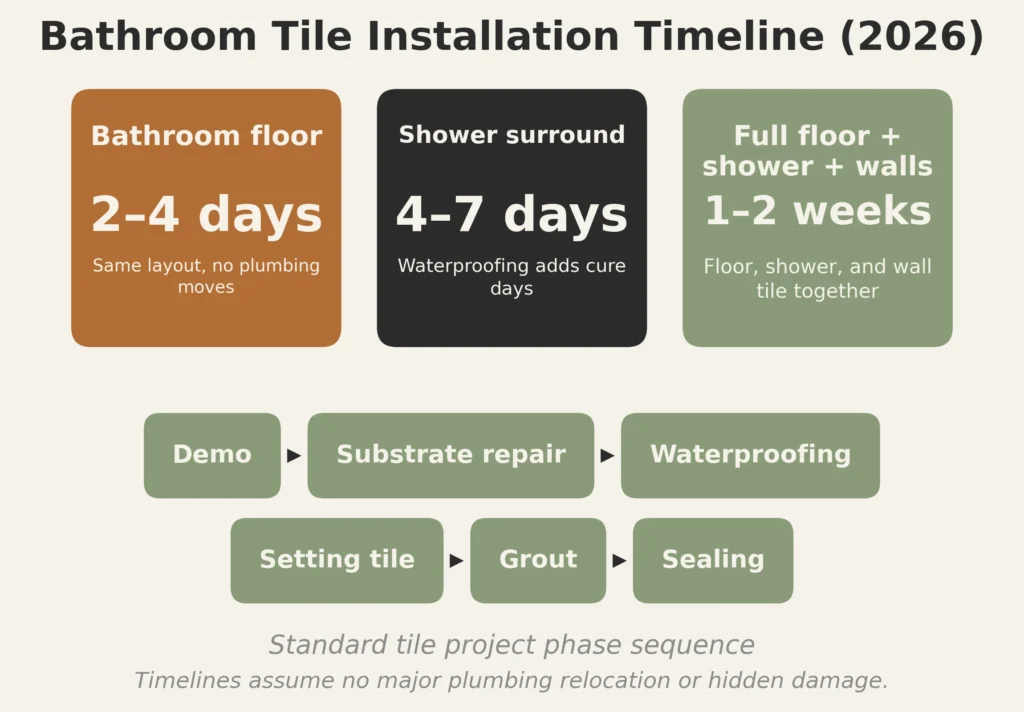
Timelines below are planning estimates — a standard 200 sq ft bathroom floor takes 2–3 days of installation alone, per 2026 data.
- Demo and disposal (1 day). Old tile, backer board, and trim come out. Disposal runs $100–$300 for the debris, per 2026 data.
- Substrate repair (1 day). Subfloor leveled, rotted sections replaced, walls checked for plumb. This is where hidden damage surfaces — budget for it.
- Waterproofing (1–2 days + cure time). Membrane over shower walls and pan; liquid membranes need 12–24 hours to dry. Non-negotiable in wet areas.
- Layout and dry-fit (half day). Tile lines snapped, cuts planned around drains and fixtures. Good layout is what separates a pro-looking job from an amateur one.
- Setting tile (1–3 days). Thinset, tile, spacers. Floors go faster than walls; mosaics and large formats go slowest.
- Grout (1 day + cure time). Grout applied after thinset cures (usually 24 hours). Grout needs 24–48 hours to cure before the shower sees water.
- Sealing and trim (half day). Natural stone sealed, silicone at corners and penetrations, edge trim and transitions installed ($3–$10 per linear foot, per 2026 data).
Realistic total timeline: a bathroom floor, 2–4 days start to finish; a shower surround, 4–7 days with curing time; a full floor + shower + walls job, 1–2 weeks.
Materials & Tools: What Goes Into the Project
- Tile: $1–$30+ per sq ft depending on material (see the per-material table above); order 10% extra for cuts and waste.
- Backer board / underlayment: $1–$3 per sq ft for moisture barriers, per 2026 data.
- Thinset mortar: buy the polymer-modified thinset the membrane manufacturer specifies — mixing systems voids warranties.
- Grout + sealant: $0.50–$1.50 per sq ft; epoxy grout costs more but resists stains and mold.
- Waterproofing membrane: $450–$750 for membrane + labor in a shower, per 2026 data.
- Edge trim and transitions: $3–$10 per linear foot, per 2026 data.
- Tools (DIY): wet saw, tile cutter, notched trowels, spacers, level, grout float — rental runs roughly $50–$100/day for a wet saw (planning estimate).
5 Mistakes That Blow Up Tile Budgets
- Skipping the waterproofing. Tile and grout are not waterproof — the membrane is. A shower without one fails from the inside out, and the repair costs more than the original job.
- Tiling over a bad substrate. Flexing subfloors crack grout; out-of-plumb walls make lippage unavoidable. Level first, tile second.
- Buying exactly the square footage. Cuts, breakage, and pattern matching eat 10% on a straight layout and up to 15–20% on diagonal or herringbone (planning estimate). Running short mid-job means a dye-lot mismatch on the second box.
- Choosing the wrong grout. Unsanded grout in wide joints crumbles; sanded grout scratches polished marble. Match the grout to the joint width and tile type.
- Forgetting the contractor minimum. A tiny powder-room floor can quote at $500–$1,000 simply because of the minimum charge (planning estimate) — bundle small tile jobs together if you can.
Permits & Codes
Tile-only work (replacing tile without touching plumbing or electrical) typically does not require a permit in most US municipalities — but never assume, because local rules vary. Permits for the broader bathroom work tile usually accompanies run $100–$1,000, per Angi’s 2026 data. The moment the project touches a drain, valve, or new circuit, it becomes permitted work with inspections.
Lead paint: if your home was built before 1978, federal law requires contractors to be lead-safe certified when their work disturbs painted surfaces — that’s the EPA’s Renovation, Repair, and Painting (RRP) rule. Ask your contractor for their RRP certification.
Asbestos: homes built before 1980 may contain asbestos in old vinyl flooring, mastic, or insulation under the tile. Get certified testing before you demo — never cut into suspect materials yourself.
How to Hire a Tile Installer: 6 Questions to Ask
- Is demo, disposal, backer board, waterproofing, tile setting, and grout each itemized in this quote — or bundled?
- What waterproofing system do you use in showers, and will you flood-test the pan for 24 hours before tiling?
- How do you handle lippage — do you use a leveling system, and is that in the price?
- Who buys the tile, and how much overage are you ordering for cuts and waste?
- What happens if you find subfloor damage or mold once the old tile is up — how is that priced?
- What warranty do you provide on the installation and the waterproofing, in writing?
Red flags: a quote with no waterproofing line item for shower work, pressure to skip prep (“we can tile right over it”), a price far below the $7–$25 per square foot typical band with no explanation, or no written warranty. Get at least three written quotes and compare itemized breakdowns, not just totals. Verify the license through your state’s contractor license lookup page.
Getting quotes? Tell us about your project and we will point you toward the right questions to ask local pros — contact Renovation Guide HQ.
Tile ROI: Does New Tile Pay Back?
Tile is one of the highest-visibility, lowest-regret upgrades in a bathroom: it reads as “new bathroom” to buyers at a fraction of a full remodel’s cost. For context, a midrange bathroom remodel recoups 80.0% nationally per Zonda’s 2025 Cost vs Value data (see our bathroom remodel cost guide). A tile-only refresh costs far less than a full remodel while delivering most of the visual impact — which is why flippers and pre-sale sellers tile first. For the full-room picture, see our small bathroom remodel cost guide, and for shower-specific tile work, our walk-in shower cost guide and tub-to-shower conversion cost guide.
Bathroom Tile Installation FAQ
How much does it cost to tile a bathroom floor in 2026?
A standard 50 sq ft bathroom floor in ceramic or porcelain typically costs $500–$1,500 all-in, at $7–$25 per square foot installed, per Angi’s 2026 data. Natural stone floors run higher — $20–$45+ per square foot installed. Small bathrooms cost more per square foot because of contractor minimums and detailed cuts around fixtures.
How much does it cost to tile a shower in 2026?
A standard tiled shower surround averages about $2,700, with a typical range of $1,800–$5,000, at $7–$25 per square foot installed (premium materials push to $50+), per 2026 shower tile data. The waterproofing membrane alone adds $450–$750 with labor — it is mandatory, not optional.
What is the cheapest tile for a bathroom?
Ceramic is the cheapest bathroom tile: $1–$5 per square foot for the material, $7–$18 installed. It is durable, water-resistant, and comes in every style imaginable. Porcelain costs a bit more ($3–$12 material) but is denser and better for high-moisture areas — for most bathrooms, basic porcelain is the best value per dollar of lifespan.
How much does tile labor cost per square foot?
Tile installation labor runs $4–$8 per square foot for ceramic and porcelain and $6–$15+ per square foot for natural stone, per Angi’s 2026 data — roughly 40–60% of the total job. Shower labor specifically averages $4–$14 per square foot. Intricate patterns like herringbone and diagonal add 10–40% to labor because of the extra cutting.
How long does it take to tile a bathroom?
A standard 200 sq ft bathroom floor takes 2–3 days of installation alone, per 2026 data. Add 1 day for demo, 1–2 days for waterproofing (plus cure time), and 24–72 hours for grout to cure. Realistic totals: 2–4 days for a floor, 4–7 days for a shower surround, 1–2 weeks for a full floor + shower + walls job.
Should I remove old tile myself to save money?
Yes — demo is the safest DIY slice of a tile project. Old tile removal costs $2–$7 per square foot pro-done, so doing it yourself on a 140 sq ft job saves roughly $280–$980 (planning estimate). Wear a respirator and eye protection, and stop and get testing if the home predates 1980 and you suspect asbestos in old flooring or mastic.
The Bottom Line
Budget $7–$25 per square foot installed for bathroom tile in 2026 — roughly $1,500 for a floor-only ceramic refresh, $4,000–$7,000 for a typical floor plus shower walls in midrange porcelain (planning estimate), and $10,000–$15,000+ for premium natural stone or a fully tiled bath (planning estimate). Spend the money where it is invisible — waterproofing, substrate prep, and a flat layout — and economize on the visible part: mid-size porcelain in a straight set delivers 90% of the look at the lowest installed price. Get three itemized quotes, confirm the membrane and prep are line items (not assumptions), and never tile a shower without waterproofing. For the bigger picture, see our 2026 bathroom remodel cost guide.
How We Estimated These Costs
Cost figures in this guide come from published 2026 industry sources: Angi’s bathroom tile installation data, tilehub’s 2026 tile installation guide, 2026 installed-price tier data, 2026 per-square-foot material/labor data, 2026 Bay Area installation allowances, and 2026 pricing citing Fixr and Homewyse. Ranges explicitly marked “(planning estimate)” are our synthesis of multiple published ranges, not quotes from any single source. Figures are national; your market will differ. Last updated October 2026.
Related guide: Tile is usually the biggest material cost in the room; see how it stacks up against labor and fixtures in our bathroom remodel cost guide.
Related guide: Sometimes the tile itself is fine and only the joints have failed — our guide to regrouting shower tile covers that repair in detail.