Disclosure: Renovation Guide HQ earns nothing from the contractors or products mentioned here. Prices below are national planning figures, not quotes. Contractor referrals on this site go to our own contact page, not to paid partners.
By Renovation Guide HQ · Updated October 31, 2026
Updated: October 2026
Quick Answer
A new roof is usually needed when three or more warning signs appear together, or when one serious sign, like a sagging deck, shows up. A typical replacement averages $9,610 and most asphalt shingle jobs take 1 to 3 days on site. Use the 9-sign checklist below before you pay for another repair.
If your roof is failing, start with our full pricing guide: Roof Replacement Cost in 2026. It covers every material, roof size, and timeline in detail. This guide answers the question that comes first: is it time?
Roof Replacement Cost at a Glance
| Tier | Total cost | Timeline |
|---|---|---|
| Low | $5,903 | 1 to 2 days on site |
| Average | $9,610 | 1 to 3 days on site |
| High | $13,378 | 2 to 5 days on site |
Installed cost runs about $4 to $11 per square foot of roof surface. Labor is typically around half to three-fifths of the total (planning estimate), with materials making up most of the rest. Tear-off, disposal, permits, and decking repairs fill the remainder. Roof surface is larger than your home’s floor area, because pitch, overhangs, and the garage all add surface.
Worked Budget Example: 1,800 Square Foot Roof, Architectural Asphalt
This example is a typical single-story home with a simple gable roof and one layer of old shingles to remove. All line items are (planning estimate) figures.
| Line item | Cost |
|---|---|
| Tear-off and disposal of one shingle layer | $1,800 (planning estimate) |
| Architectural shingles, underlayment, and ridge cap | $5,400 (planning estimate) |
| Installation labor | $4,200 (planning estimate) |
| Flashing, vents, and pipe boots | $900 (planning estimate) |
| Permit and dumpster | $600 (planning estimate) |
| Total | $12,900 (planning estimate) |
The math checks out: $1,800 plus $5,400 plus $4,200 plus $900 plus $600 equals $12,900. That works out to about $7.17 per square foot of roof surface (planning estimate), which sits inside the national $4 to $11 range above. Steep pitches, multiple layers, or rotted decking push the total higher, which is why a written quote always beats a phone estimate.
Regional Differences
Roofing prices are local, and the figures in this guide are national averages. Treat the regional notes below as illustrative, not as quotes for your town.
Labor rates run highest in coastal metro areas and the Northeast, where crew wages and disposal fees are steepest. The South and parts of the Midwest often price below the national average for the same shingle roof. Mountain and high-wind coastal zones add cost through stricter fastening and underlayment rules, plus impact-rated shingles in hail country. Snow country adds ice-and-water shield along the eaves, which is cheap insurance against ice dams. Wherever you live, get three local quotes. Two quotes from the same town tell you more than any national table.
The 9 Signs You Need a New Roof
Walk through these in order. Check each sign you can confirm, then use the score at the end of this section.
Sign 1: Your Roof Is Near the End of Its Lifespan
Asphalt shingle roofs typically last 20 to 30 years, metal roofs 40 to 70 years, tile 50 to 100 years, and slate 75 years or more. Age alone does not condemn a roof, but an asphalt roof past 20 years with any other sign on this list is living on borrowed time. If you do not know the install date, check your closing papers, a past permit, or ask a roofer to read the shingle brand and style.
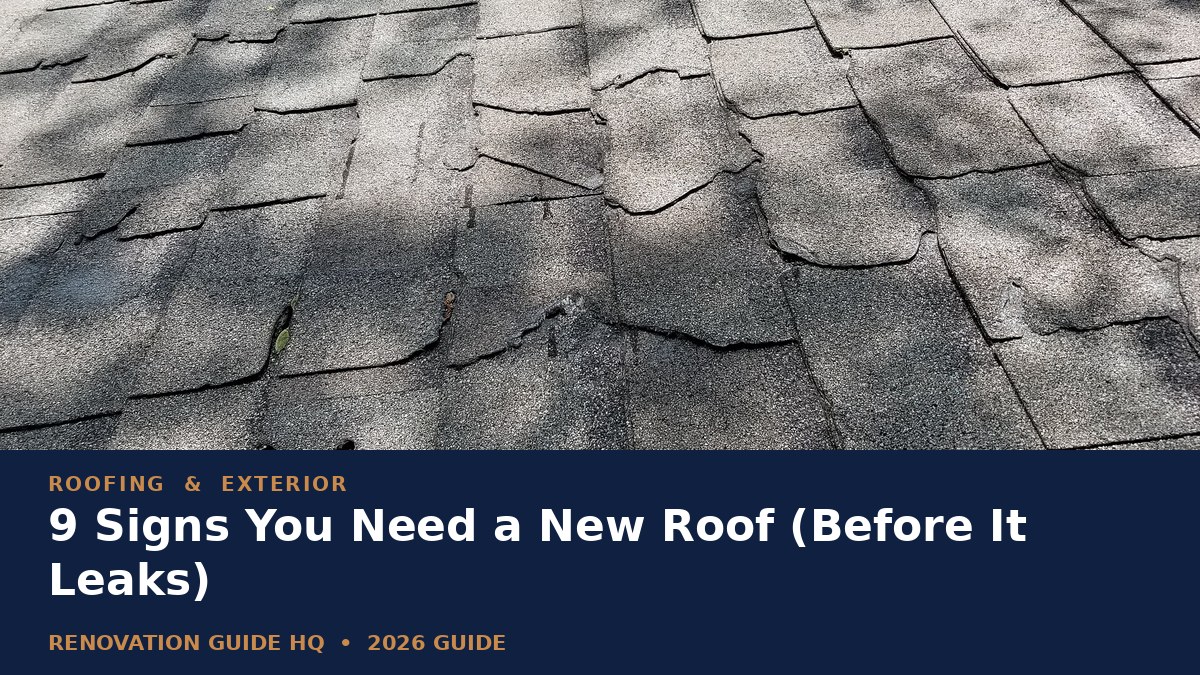
Sign 2: Shingles Are Curling, Cupping, or Clawing
Heat and age dry out asphalt shingles until they lose flexibility. Cupping means the edges turn upward. Clawing means the center rises while the edges stay flat. Either pattern across whole slopes means the waterproofing layer is failing, not just one shingle. A few curled shingles after a storm can be repaired. Widespread curling cannot.
Sign 3: Shingles Are Missing Across Multiple Slopes
One missing shingle after high wind is a repair. Shingles going missing in moderate wind, or bare patches on two or more slopes, point to failed adhesive strips across the whole roof. Each gap exposes underlayment to sun and rain, and underlayment alone is not a roof.
Sign 4: Granules Are Filling Your Gutters
Asphalt shingles shed their mineral granules as they age. A handful of grit in a downspout after a new roof is normal. Gutters full of sand-like granules on an older roof, or bald patches you can see from the ground, mean the shingles have lost their sun and fire protection. Once the asphalt mat is exposed, deterioration speeds up.
Sign 5: Leaks, Ceiling Stains, or Peeling Paint Keep Coming Back
One leak traced to a single flashing detail is usually repairable. Leaks appearing in different rooms, stains that return after a repair, or paint peeling on top-floor ceilings all suggest the system is failing in several places at once. Water travels along rafters before it shows indoors, so the stain you see is rarely directly below the entry point. Roof repairs average about $1,100, with a typical range of $150 to $7,800. If you are paying repair prices every year, add them up before you pay again.
Sign 6: Daylight Shows Through the Roof Boards
On a sunny day, switch off the attic lights and look up. Pinpricks of light through the deck can mean fastener holes or gaps, and larger beams of light mean missing boards or failed sections. Small gaps between boards are normal in older plank decking, but light plus water stains or warped wood around it is a failure signal. Never walk on a deck that looks soft or daylighted from below.
Sign 7: The Roofline Is Sagging
A visible dip or wave in the roofline is the one sign that skips the scoring system. Sagging means the decking or rafters underneath are weakened, often by long-term moisture and rot. This is a structural problem, not a cosmetic one. Call a roofing contractor or structural engineer promptly, keep people out from under the affected area, and do not load that section with stored items in the attic.
Sign 8: Moss, Algae, or Rot That Keeps Returning
Dark streaks are usually algae and are mostly cosmetic on their own. Thick moss is different: it holds moisture against the shingles, lifts their edges, and speeds decay. If moss or soft, spongy decking returns after cleaning, moisture is getting trapped in the system, often through failed flashing or poor ventilation. Cleaning the surface without fixing the moisture source just resets the clock.
Sign 9: Energy Bills Climb and Repairs Never Stop
A failing roof often brings failing ventilation and wet, compressed attic insulation. Both push heating and cooling bills up and make upstairs rooms harder to keep comfortable. On its own, a high bill proves little. Combined with two or three other signs, or with repair bills two years running, it is strong evidence the roof system, not one component, is done.
Your Score: Repair, Plan, or Replace?
| Signs you checked | What it usually means | Timeline |
|---|---|---|
| 0 to 1, no sagging | Monitor and maintain; fix the single issue | Repair within weeks; re-inspect yearly |
| 2 signs | Get a professional inspection and a repair quote | Inspection within 2 weeks |
| 3 or more signs | Replacement is usually cheaper than repeated repairs | Get 3 replacement quotes within a month |
| Sagging, any count | Structural evaluation first, then replacement | Call a pro within days |
Two rules of thumb back up the score. First, the damage rule: if 30 percent or more of the roof surface is damaged, replacement usually beats repair, a guideline published by GAF. Second, the money rule: if a repair quote tops 30 percent of a full replacement quote, replacement is usually the better long-term spend. Both rules assume the roof is older; a young roof with one damaged slope is still a repair candidate.
What Three Budgets Actually Buy
A targeted repair at about $1,100 buys a flashing fix, a small shingle section, or a vent boot replacement on an otherwise healthy roof. It buys time, not a new roof. A full replacement at the national average of $9,610 buys a complete architectural asphalt system on a typical home, with new underlayment, flashing, and ventilation. A premium budget near $20,000 buys designer shingles or an entry-level metal roof, upgraded underlayment, and a longer warranty. Match the budget to how long you plan to stay: under 10 years favors a solid asphalt system, while 20-plus years is where metal starts to earn its premium. See the full comparison in Metal Roof Cost vs. Shingles and Asphalt Shingles vs. Metal Roof.
7 Cost Factors, With Dollar Impact
- Roof size. Roofing is priced by the square, one square equals 100 square feet. Expect roughly $400 to $1,100 per square installed for common materials. Measure the roof surface, not the floor plan.
- Pitch and complexity. Steep pitches slow crews and need extra safety gear. Valleys, dormers, hips, and skylights add flashing work. Complex roofs add $1,000 to $3,000 (planning estimate) over a simple gable of the same size.
- Number of old layers. Most codes allow no more than two roofing layers. Removing a second layer adds $1,000 to $2,500 (planning estimate) in labor and disposal.
- Decking condition. Rotten or soft sheets must be replaced before new shingles go on. Budget $50 to $100 per sheet (planning estimate), and expect the quote to list a per-sheet allowance rather than a fixed total, since hidden rot is only found during tear-off.
- Material choice. Asphalt is the budget baseline, while metal, tile, and slate climb steeply. National installed ranges run about $5,800 to $20,000 for asphalt and $5,700 to $25,000 for metal on typical homes.
- Ventilation and flashing upgrades. Ridge vents, intake vents, and new flashing at chimneys and walls are small lines with big leak-prevention value. Allow $500 to $1,500 (planning estimate) for a full ventilation and flashing refresh.
- Local labor and disposal. Crew rates, landfill fees, and permit costs vary by town and season. Storm-season demand after a big hail event can lift local prices for months. Booking outside peak storm season sometimes saves money, but never delay a sagging or actively leaking roof to chase a discount.
DIY vs. Hiring a Pro
| Task | Skill (1 to 5) | Time | Who should do it |
|---|---|---|---|
| Ground and attic inspection | 1 | 30 to 60 minutes | Homeowner, with binoculars and a flashlight |
| Gutter cleaning and granule check | 2 | 1 to 2 hours | Homeowner, only on a low, safely reached roof edge |
| Single flashing or shingle repair | 4 | 2 to 4 hours | Experienced DIYer or pro; fall risk is real |
| Full replacement | 5 | 1 to 5 days for a crew | Licensed pro only |
Roof work is one of the least forgiving DIY jobs in the house. Falls, hidden rot underfoot, and voided manufacturer warranties are the three big risks. A homeowner inspection from the ground and the attic is free and genuinely useful. Climbing onto a steep, wet, or aging roof to save on labor is not. Also note the legal line: structural decking repairs, and any work that changes the roof structure, belong to licensed pros, and most towns require a permit and inspection for a full replacement. Ask whether a contractor’s inspection fee is waived if you hire them, and get the answer in writing.
Step-by-Step: From First Sign to New Roof
- Emergency triage, same day. For active leaks, place buckets, move belongings, photograph damage, and call a roofer for a temporary tarp if rain continues. For sagging, call a pro within days and stay off that roof section.
- Ground and attic inspection, 30 to 60 minutes. Walk the perimeter with binoculars. Check gutters for granules. In the attic, lights off, look for daylight, stains, and damp insulation.
- Professional inspection, 1 to 2 hours on site. A good inspector walks the roof, photographs problem areas, checks flashing and ventilation, and gives a written report with repair and replacement options.
- Three written quotes, 1 to 2 weeks. Quotes should list material brand and line, underlayment type, tear-off layers, decking allowance per sheet, flashing scope, ventilation plan, warranty terms, and cleanup.
- Insurance and permit check, days to weeks. Storm damage may be an insurance claim; age and wear almost never are. Your contractor usually pulls the permit, but confirm whose name is on it.
- Tear-off and install, 1 to 3 days typical, up to 2 weeks for large or complex roofs. Expect noise, a dumpster, and a magnet sweep for nails at the end of each day.
- Final inspection and warranty paperwork, half a day. Walk the roofline from the ground, check that vents and flashing look finished, confirm the town inspection passed, and file both the manufacturer and workmanship warranties.
Materials and Tools for Your Own Inspection
For the homeowner inspection you need binoculars, a bright flashlight, a tape measure, a camera phone, a notepad, and sturdy shoes for attic joists. Step ladders and attic boards help, but only if you are steady on them. For a replacement itself, the crew brings tear-off tools, nail guns, compressors, underlayment, shingles, flashing metal, vents, and a dumpster. You do not need to buy any of it. Your job is the checklist, the photos, and the quotes.
9 Mistakes Contractors See Homeowners Make
- Paying for a third repair on a roof that already shows three or more signs from this guide.
- Choosing the cheapest quote without checking what underlayment, flashing, and ventilation it actually includes.
- Roofing over a second layer to save tear-off money, hiding rot underneath.
- Reusing old flashing at chimneys and walls, where most leaks start.
- Skipping ventilation upgrades, which cooks new shingles from below and voids some warranties.
- Signing a contract that does not state the decking replacement price per sheet.
- Paying most of the total upfront instead of a staged schedule tied to progress.
- Ignoring the attic, where stains and daylight reveal problems the outside hides.
- Waiting through another rainy season after a sagging section appears.
Permits and Safety
Most US towns require a permit for a full roof replacement under the International Residential Code (IRC), which covers roof covering, underlayment, flashing, and ventilation requirements. Your contractor normally pulls the permit and schedules the town inspection. For homes built before 1978, tell your contractor before work starts: EPA Renovation, Repair and Painting (RRP) lead-safe rules can apply when painted surfaces are disturbed, and asbestos testing applies to some older roofing and siding materials. Never let a crew start without confirming who holds the permit, and never climb onto a roof that is wet, steep, or visibly sagging. Electrical work for powered vents or attic fans must meet the National Electrical Code (NEC) and belongs to a licensed electrician.
Hiring a Contractor: 6 Questions, Red Flags, License Check
Ask every bidder these six questions, and compare answers side by side:
- Are you licensed and insured in this state, and can I see the certificates?
- What exact shingle brand and line, underlayment, and flashing are in this quote?
- What is your decking replacement price per sheet, and how will you document it?
- What workmanship warranty do you offer, separate from the manufacturer warranty?
- Who pulls the permit, and what inspections are included?
- What is the payment schedule, and what happens if hidden damage is found?
Red flags: no license or insurance proof, a quote far below the others with vague materials, pressure to sign today for a storm discount, full payment upfront, no local address or references, and a request to sign over an insurance check. Before you sign, look up the contractor on your state contractor licensing board website and your state attorney general or consumer protection site. A license number that does not verify is a walk-away signal.
Financing a New Roof
A roof is often a five-figure, unplanned expense, so it helps to know the general options before a salesperson frames them for you. A home equity line of credit (HELOC) and a home equity loan both borrow against your home’s equity, with different draw and repayment structures. A cash-out refinance replaces your mortgage with a larger one and takes the difference in cash, which only makes sense if the overall loan terms work for you. A personal loan needs no home equity but usually carries a shorter term. This is general information, not financial advice, and no specific rates are quoted here because rates change constantly. Compare total cost, monthly payment, and risk to your home before choosing, and be wary of any contractor financing that hides fees in the project price.
Frequently Asked Questions
How do I know if I need a new roof or just a repair?
Count the signs. One isolated problem on a younger roof is usually a repair. Three or more signs, damage across 30 percent or more of the surface, or a repair quote above 30 percent of replacement cost all point to replacement.
How long does a roof replacement take?
Most asphalt shingle replacements take 1 to 3 days on site for a typical home. Large, steep, or complex roofs can take up to 2 weeks. Quotes, permits, and material delivery add 1 to 4 weeks before work starts.
What does a new roof cost in 2026?
The national average is about $9,610, with most projects falling between $5,903 and $13,378. Your roof size, material, pitch, and local labor move the final number.
Can I stay in my home during a roof replacement?
Yes, in most cases. Expect daytime noise, vibration, and a dumpster in the driveway. Keep cars out of the drop zone, cover attic belongings against dust, and keep children and pets away from the work area.
Does homeowners insurance pay for a new roof?
Insurance typically covers sudden storm damage, like hail or a fallen tree, not age and wear. Document damage with photos, file promptly after a storm, and read your policy’s roof schedule before assuming full replacement value.
Should I replace my roof before selling?
If the roof shows three or more signs from this guide, a replacement usually returns value in sale price and buyer confidence, and it removes the most common inspection objection. If the roof is young and healthy, a documented inspection report is usually enough.
Bottom Line
Do the 30-minute ground and attic check this weekend. If you count three or more signs, or any sagging at all, stop paying for patches and get three written replacement quotes. A new roof is expensive, but a failed roof quietly damages everything underneath it: decking, insulation, drywall, and framing. For full pricing by material and size, read Roof Replacement Cost in 2026, then compare materials in Metal Roof Cost vs. Shingles. Ready for quotes? Get 3 quotes through our contact page and bring your sign count to the first conversation.