Transparency note: This guide contains no affiliate links. Renovation Guide HQ currently earns no commissions from any product or service mentioned — every figure is cited so you can verify it yourself.
By Renovation Guide HQ · Updated October 8, 2026
Quick Answer
A tub-to-shower conversion in 2026 costs $3,000 on average, with a typical range of $1,200–$15,000, according to Angi’s 2026 cost data. This Old House’s 2026 survey of 1,000 homeowners puts the range at $2,000–$12,000. A basic prefab swap can finish in 2–4 days; a custom tiled shower takes 1–3 weeks. Your final price depends mostly on one choice: prefab kit or custom tile.
This guide breaks the project into its real cost tiers, shows where the money goes line by line, and flags the plumbing and waterproofing details that separate a good conversion from a future leak.
2026 Tub-to-Shower Conversion Cost by Type
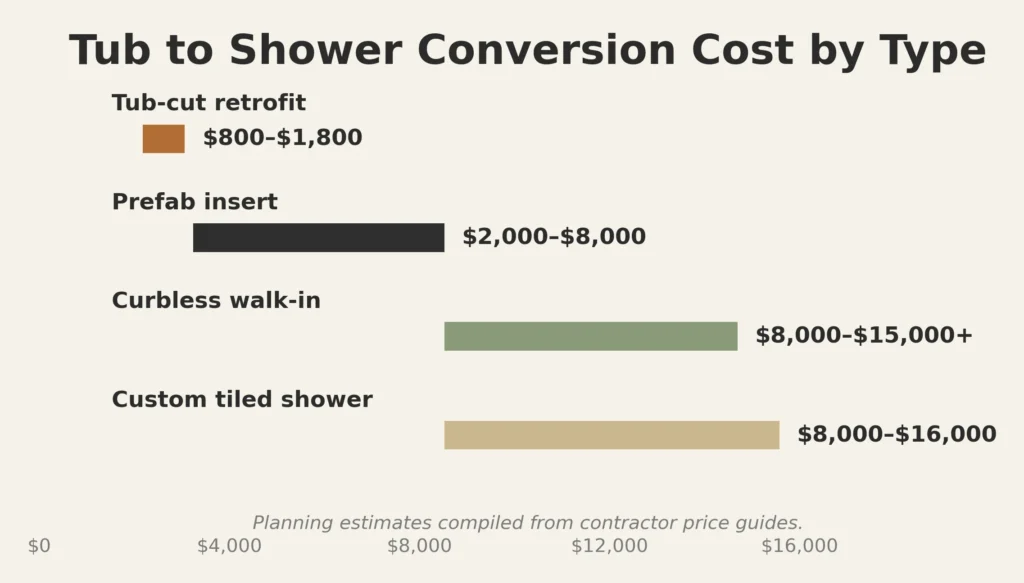
The table below uses Angi’s 2026 data, This Old House’s 2026 homeowner survey, and Fixr’s 2026 cost data, with typical timelines added.
| Conversion type | Typical cost | What’s included | Typical timeline |
|---|---|---|---|
| Tub-cut (low-threshold retrofit) | $800–$1,800 | Front wall of tub cut down to a low step-in edge; tub stays in place | 1 day |
| Prefab shower kit | $2,000–$8,000 | Tub removed; acrylic/fiberglass base + wall panels in the same footprint | 2–4 days |
| Shower stall replacement | $1,000–$8,000 | Kit varies by shape: alcove $500–$2,300, neo-angle $450–$1,200 (Angi 2026); install extra | 2–4 days |
| Walk-in shower | $5,000–$12,000 | New base, waterproofing, valve, glass; Angi’s custom tiled range is $3,500–$15,000 | 1–2 weeks |
| Custom tiled shower | $8,000–$16,000 | Full custom tile, niche, bench, premium fixtures; ~$500–$1,000 extra for demo + drain work | 1–3 weeks |
| Curbless / barrier-free | $8,000–$15,000+ | Zero-threshold entry; floor recessed or ramped — the accessibility gold standard | 2–3 weeks |
The tub-cut and prefab figures are planning estimates compiled from contractor price guides; the stall, walk-in, and custom ranges come from the published sources above. Before comparing any two quotes, ask which of these six scopes each one actually covers — a “$2,500 conversion” and a “$9,000 conversion” are usually different projects, not different prices for the same one.
What $3,000, $6,000, or $12,000 Actually Buys
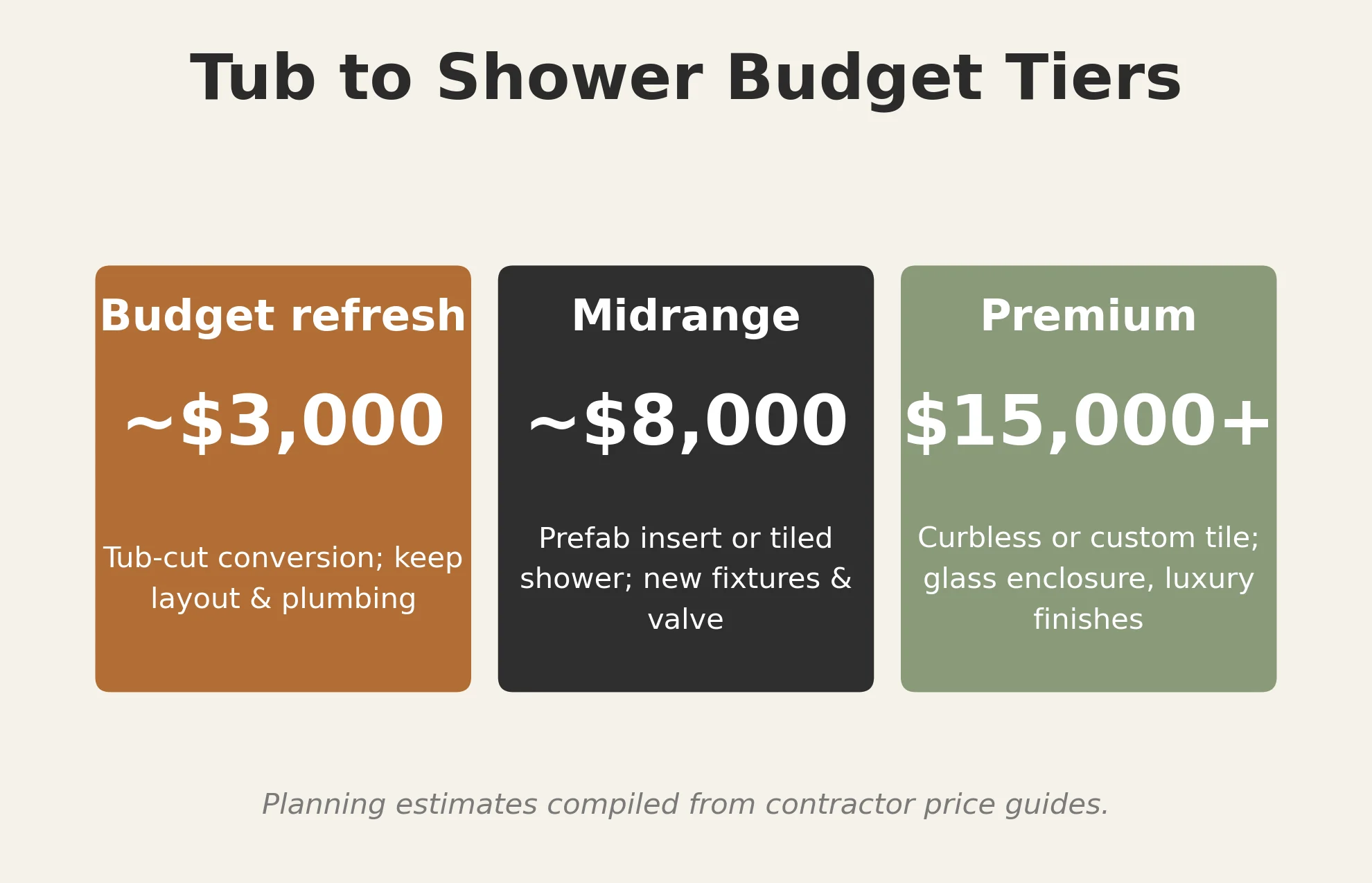
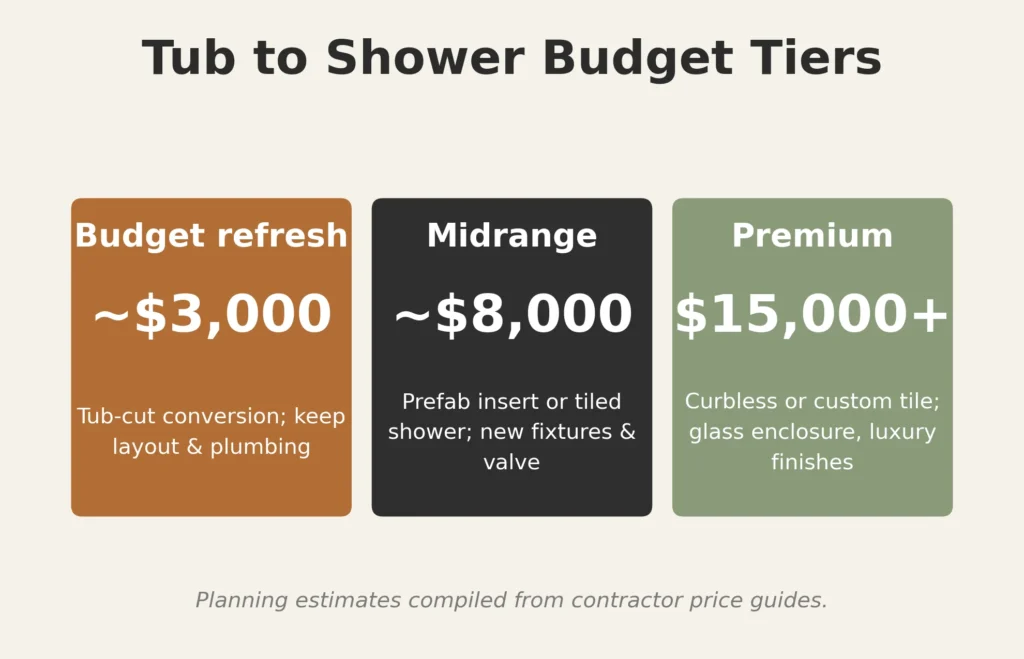
What three common budgets cover in a standard 60-inch alcove (all planning estimates):
$3,000: the straightforward prefab swap
Tub removal, acrylic base + three-wall kit, new valve and trim — same footprint, drain untouched. No tile, no glass door, no drain moves.
$6,000: the upgraded prefab or basic walk-in
As above, plus low-threshold base, glass door, upgraded showerhead, recessed niche, fresh paint and trim. No custom tile or plumbing moves.
$12,000: the custom tiled walk-in
Tub and walls to the studs, membrane and sloped pan, tile surround, glass door, bench, niche — pro installed. Drain relocation and curbless entry extra.
Rule of thumb: the drain decides the budget. Shower drains are 2 inches; tub drains are 1½ — so even a “simple” swap means upsizing the drain line. Keep the drain where it is and your money goes twice as far.
Where the Money Goes: Component Costs
Component ranges below mix verified 2026 figures with planning estimates. Use them to sanity-check bids, not as quotes.
| Component | Typical range (installed) | Notes |
|---|---|---|
| Tub removal + disposal | $200–$1,000 | Fixr 2026; cast iron costs more to haul |
| Drain upsizing + plumbing changes | $500–$2,000 (planning estimate) | More if the drain moves to a new location |
| Shower base / pan | $300–$1,500 | Acrylic low end; tile-ready foam and mud-set pans higher (planning estimate) |
| Waterproofing membrane | $200–$600 | Sheet or liquid-applied; non-negotiable on tile (planning estimate) |
| Wall tile + installation | $900–$10,000 | Angi 2026; ceramic low, natural stone high |
| Shower valve + trim + showerhead | $150–$600 | Pressure-balance minimum; thermostatic more (planning estimate) |
| Glass door | $650–$2,600 | Frameless or semi-frameless; a curtain is under $50 |
| Prefab wall surround kit | $600–$1,800 | Premade acrylic/fiberglass, per Angi’s 2026 shower data |
| Permits | $200–$2,000 | Angi 2026; most conversions need one |
| Labor (all trades) | 40–60% of total (planning estimate) | Demo, plumbing, tile, glass — the biggest slice |
Prefab vs. Custom: An Honest Comparison
This is the decision that sets your budget. (A middle path also exists: acrylic liner systems — new panels over the old surround with a new base — land mid-range, but cover old walls instead of inspecting behind them.)
| Prefab kit | Custom tiled shower | |
|---|---|---|
| Typical total | $2,000–$8,000 | $8,000–$16,000 |
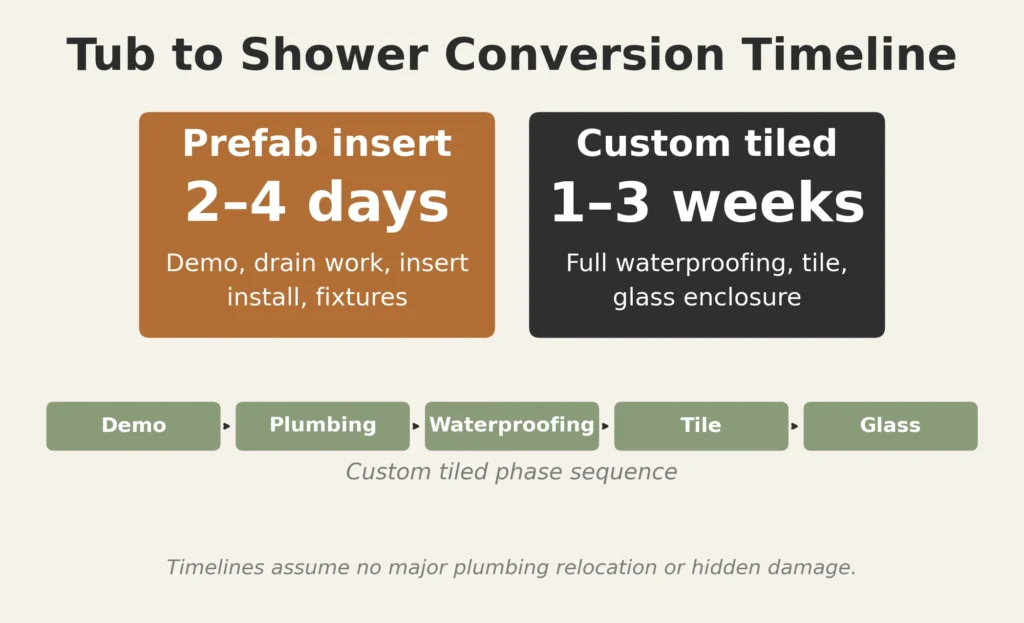
| Timeline | 2–4 days | 1–3 weeks |
| Waterproofing | Built into the unit | Separate membrane + sloped pan |
| Design flexibility | Fixed sizes and colors | Any size, tile, niche, or bench |
| Best for | Tight budgets, rentals, fast turnarounds | Forever homes, accessibility, design control |
6 Factors That Move Your Price Most
1. The drain change (the hidden constant)
Nearly every conversion must upsize the drain from the tub’s 1½-inch line to a 2-inch shower drain to meet code — typically $500–$1,000 (planning estimate) of extra labor and materials before anything cosmetic happens. Moving the drain to a new location multiplies that cost.
2. Waterproofing method
A prefab unit is waterproof by design. A tiled shower is only as good as its membrane, sloped pan, and flood-tested seams — invisible when done right, catastrophic when skipped. This labor is the main reason custom showers cost more and last longer.
3. Tile selection and coverage
Angi’s 2026 data puts shower tiling at $900–$10,000 — the widest range of any component. Ceramic versus natural stone at $15+ per square foot, and how far up the walls you tile, decides where you land.
4. Glass vs. curtain
A shower curtain costs under $50; a frameless glass door runs $650–$2,600 installed. Glass transforms the look and the price in one move — the most common budget surprise in a conversion.
5. What’s behind the old tub
Tub surrounds hide rotted studs, moldy drywall, and corroded valves. Fixr’s 2026 data puts mold remediation at $500–$1,500 and water damage repair at $500–$4,500. Budget a 10–15% contingency on every quote (planning estimate).
6. Permits and inspections
Most conversions need a plumbing permit ($200–$2,000 per Angi 2026), and the inspector checks the drain and waterproofing before walls close. Skipping it risks an insurance or resale problem worth far more than the fee.
DIY vs. Hiring a Pro: An Honest Breakdown
| Task | DIY skill (1–5) | Who should do it |
|---|---|---|
| Tub removal (non-cast-iron) | 2 | DIY-friendly; shut off water first |
| Prefab kit installation | 3 | Confident DIY — follow drain and leveling steps exactly |
| Shower valve replacement | 4 | Pro recommended — soldering isn’t beginner work |
| Drain rerouting / upsizing | 5 | Licensed plumber, always |
| Waterproofing + tile | 5 | Pro, always — a failed pan rots the subfloor silently |
| Glass door installation | 4 | Pro recommended — heavy panels, precise tile drilling |
The realistic middle path: DIY the demo, the prefab kit (if you’re handy and follow the instructions exactly), paint, and accessories — hire a licensed plumber for the drain and valve, and a tile pro for custom waterproofing. Angi’s shower conversion guide notes conversions need at least 900 square inches of floor space and 80 inches of height — measure before you buy anything.
Step-by-Step: How a Conversion Actually Proceeds
Timelines below are planning estimates — inspection scheduling and material lead times are the usual wildcards.
- Measure and plan (2–5 days). Confirm space, pick prefab vs. custom, get 3 itemized quotes.
- Permits (1–2 weeks). Pull the plumbing permit before demo; schedule the rough-in inspection.
- Demolition (1–2 days). Tub, surround, and trim come out — hidden water damage gets discovered here.
- Plumbing rough-in (1–3 days). Drain upsized to 2 inches, new valve set, supply lines updated. Inspection before walls close.
- Base, waterproofing, and walls (2–7 days). Prefab base set level, or custom pan + membrane + backer board. Flood-test a custom pan 24 hours.
- Tile or surround panels (2–7 days). Panels go up in a day; tile takes most of a week with curing time.
- Fixtures and glass (1–3 days). Trim, showerhead, glass door, final caulking and cleanup.
- Final inspection (1 day). Plumbing sign-off and a full water test before final payment.
Realistic total timeline: prefab conversion, 2–4 days of work (plus permit lead time); custom tiled conversion, 1–3 weeks from demo to done.
6 Mistakes That Blow Up Conversion Budgets
- Setting the base out of level. A base that’s off won’t drain properly — and you won’t know until the walls are up. Level it twice.
- Skipping the flood test. Fill a custom pan with 2 inches of water, mark the level, wait 24 hours. A leak found now costs nothing; found later, it costs a subfloor.
- Reusing a corroded valve. Replace it while the wall is open — opening finished tile later costs ten times more.
- No contingency for what’s behind the tub. Rotted studs and mold are the norm around old tubs. Budget 10–15% extra (planning estimate).
- Buying the kit before measuring the drain. Drain position varies by manufacturer — confirm the rough-in matches before delivery.
- Forgetting the permit. Unpermitted plumbing can void insurance claims and surface at a buyer’s inspection.
Permits, Codes & Safety
When you need a permit: any drain change, valve replacement, or new plumbing line needs a plumbing permit in nearly every US jurisdiction — which covers essentially every conversion. Fees run $200–$2,000 by scope and city, per Angi’s 2026 data.
Code minimums: shower compartments need at least 900 square inches of floor space and 80 inches of headroom; drains must be 2 inches; valves must be pressure-balancing or thermostatic to prevent scalding.
Lead paint: if your home was built before 1978, federal law requires contractors to be lead-safe certified when their work disturbs painted surfaces — that’s the EPA’s Renovation, Repair, and Painting (RRP) rule. Ask your contractor for their RRP certification.
Asbestos: homes built before 1980 may contain asbestos in old vinyl flooring, insulation, or joint compound around the tub. Get certified testing before you demo — never cut into suspect materials yourself.
How to Hire a Conversion Contractor
6 questions to ask every bidder
- Are you licensed and insured in my state? (Then verify it on the official state licensing board website.)
- How do you waterproof a tiled shower — walk me through your pan and membrane process?
- Will you upsize the drain to 2 inches, and is that in the quote or an extra?
- Who will be on site daily: your crew or subcontractors?
- How do you handle change orders — in writing, with pricing, before work happens?
- What warranty do you offer on the pan, tile, and plumbing labor, and for how long?
Red flags — walk away if you see these
- No proof of license or insurance, or excuses about why they “don’t need it”
- Can’t explain their shower waterproofing method in plain language
- Cash-only pricing or a large deposit before work starts
- No written contract — just a handshake and a start date
Get 3 quotes — minimum. Ask every bidder the same 6 questions and compare itemized bids line by line. Contact us for a second set of eyes on a quote before you sign.
Resale & ROI: Should You Keep a Tub?
The honest resale question: don’t remove your home’s only bathtub. Families with young children look for at least one tub, and removing the only one can narrow your buyer pool even if the new shower is beautiful. If a second full bath has a tub, converting the hall bath tub is a non-issue for most buyers.
On returns: a mid-range bathroom remodel recoups 80.0% nationally per Zonda’s 2025 Cost vs. Value data (see our bathroom remodel cost guide). A standalone custom shower conversion recoups less — roughly 55–65% per custom shower cost data — being smaller and more taste-specific. The real payoff is daily use and accessibility, not resale math.
Regional Cost Differences
Labor rates drive conversion prices more than materials do — coastal metros typically run 20–50% above national averages, smaller cities land near or just under them (directional planning estimate; calibrate with 3 local quotes). Fixr’s 2026 local data shows the spread: about $3,796 in Philadelphia, $3,904 in North Carolina, $3,956 in Maryland, and $4,592 in New Jersey — a tight band with the Northeast premium clearly visible.
Tub-to-Shower Conversion FAQ
How much does it cost to convert a tub to a shower in 2026?
The national average is $3,000, with a typical range of $1,200–$15,000, per Angi’s 2026 data. This Old House’s 2026 survey found $2,000–$12,000. Prefab kits land low ($2,000–$8,000); custom tiled showers run $8,000–$16,000.
How long does a tub-to-shower conversion take?
A prefab kit conversion takes 2–4 days of on-site work; a custom tiled shower takes 1–3 weeks from demo to done (planning estimates). Permit processing can add 1–2 weeks before work starts, and custom tile needs curing time between steps.
Do I need a plumber to convert a tub to a shower?
Yes, for the drain and valve work at minimum. Shower drains must be 2 inches (tub drains are 1½), so the drain line has to be upsized to meet code — licensed-plumber work in nearly every jurisdiction. Handy homeowners can DIY the demo, kit installation, paint, and accessories around it.
Is converting a tub to a shower worth it?
For daily use and accessibility, usually yes — showers are faster, use less water, and are safer for aging in place. For resale, keep at least one tub in the house: removing the only bathtub can narrow your buyer pool, especially with families.
What is the cheapest way to convert a tub to a shower?
A tub-cut retrofit ($800–$1,800, planning estimate) — a contractor cuts a low step into the existing tub wall. Next cheapest is a prefab acrylic kit ($2,000–$8,000) in the same footprint with the drain untouched. Both skip tile, glass, and plumbing moves, which is where the money goes.
Do I need a permit for a tub-to-shower conversion?
In nearly every US jurisdiction, yes — any drain change or valve replacement requires a plumbing permit, which covers essentially every conversion. Fees run $200–$2,000 per Angi’s 2026 data. Schedule the rough-in inspection before walls close.
The Bottom Line
A tub-to-shower conversion in 2026 costs $3,000 on average nationally — $2,000–$8,000 for a prefab kit, $8,000–$16,000 for a custom tiled shower — per Angi’s 2026 data. Your two biggest cost levers are the prefab-vs-custom decision and keeping the drain where it is. Budget 10–15% for what’s hiding behind the old tub, verify your contractor’s license, and never skip the waterproofing, the flood test, or the permit.
Ready to get real numbers? Contact us — get 3 itemized local quotes and compare them line by line before you sign anything.
How We Estimated These Costs
Cost figures in this guide come from published sources: Angi’s 2026 tub-to-shower conversion data (updated July 2026), This Old House’s 2026 survey of 1,000 homeowners, Fixr’s 2026 bathroom remodeling cost data, Angi’s shower conversion guide, and custom shower project data for ROI context. All other dollar ranges are planning estimates compiled from contractor price guides — useful for budgeting, not substitutes for quotes. Calibrate planning estimates with 3 local bids before you commit to a budget. Last updated October 8, 2026.
Related guide: Wondering how a conversion compares with a full renovation? Our bathroom remodel cost guide puts both budgets side by side.
Related guide: And if the existing tile is staying, our guide to regrouting a shower shows how to make it look new again for far less.