Disclosure: Renovation Guide HQ publishes free, independent home improvement guides. We do not earn commissions from the products or services mentioned in this guide, and we have no affiliate relationships.
By Renovation Guide HQ · Updated November 16, 2026
Updated: November 2026
Quick Answer
Installing new gutters costs $1,182 on average in 2026, according to Angi. Most full-home jobs run $1,000 to $5,000 depending on material and house size. Seamless aluminum — the most common choice — runs $6 to $20 per linear foot installed, per HomeGuide’s 2026 guide. A 200-foot job takes a crew 1 to 2 days.
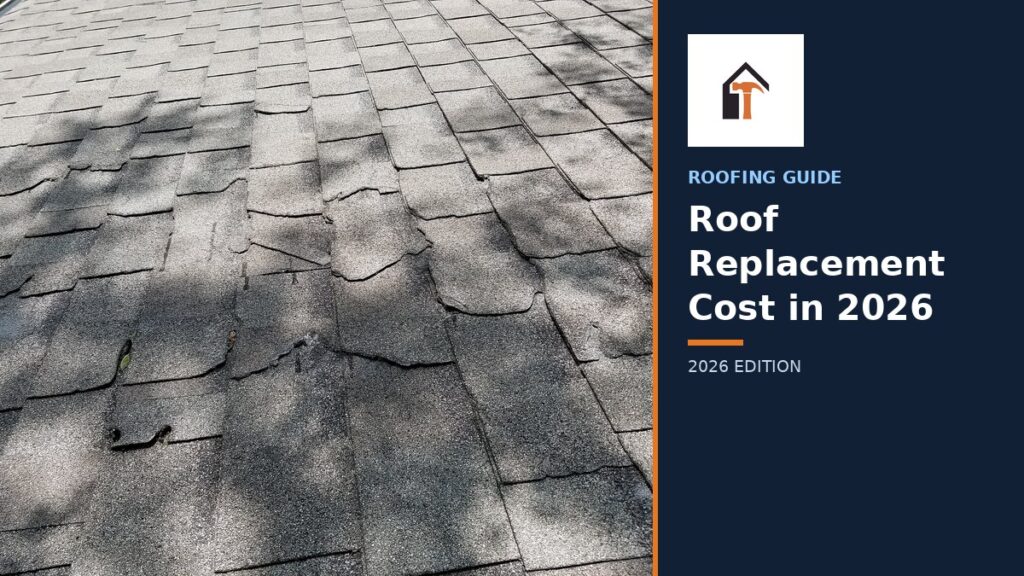
This guide is part of our Roofing and Exterior cluster. For the biggest exterior spend of all, start with our pillar guide: Roof Replacement Cost in 2026. Gutters are the roof’s partner — they carry the water the roof sheds safely away from your foundation. You can also browse the full Roofing and Exterior category for siding, deck, and roof guides.
Gutter Installation Cost Table
Contractors price gutters by the linear foot — the length of roofline, not the square footage of the house. The rule of thumb is that a home needs roughly one linear foot of gutter for every 10 square feet of floor area, so a 2,000 sq ft home needs about 200 linear feet. The figures below use Angi’s 2026 range of $4 to $40 per linear foot and HomeGuide’s 2026 per-material pricing.
| Tier | Material | Per Linear Ft (Installed) | Typical Total (200 Ft Home) | Labor vs. Materials | Timeline |
|---|---|---|---|---|---|
| Budget | Vinyl, sectional | $4–$8 | $800–$1,600 (planning estimate) | Labor ~35% / Materials ~65% (planning estimate) | 1 day |
| Typical | Seamless aluminum | $6–$20 | $1,200–$4,000 (planning estimate) | Labor ~40% / Materials ~60% (planning estimate) | 1–2 days |
| Premium | Copper | $20–$40 | $4,000–$8,000 (planning estimate) | Labor ~45% / Materials ~55% (planning estimate) | 2–3 days |
Why published averages disagree. You will see two very different “average” numbers quoted for this job, and both are real. Angi’s $1,182 average covers all gutter installation projects, including partial jobs on one side of a house and small single-story homes. HomeGuide’s $2,200 to $5,000 range is for a full-home replacement at $12 to $25 per linear foot. When you compare quotes, check whether the number is for a partial repair or a full replacement — that is usually the whole difference.
Cost by Material and Style
Material is the single biggest lever on the price. Here is what each option costs installed, how long it lasts, and where it makes sense, from HomeGuide’s 2026 guide and Angi’s 2026 data:
| Material | Installed Cost per Ft | Lifespan | Best For |
|---|---|---|---|
| Vinyl (sectional) | $4–$8 | 10–20 years | Budget jobs, mild climates without freeze-thaw |
| Aluminum (sectional) | $6–$12 | 20–25 years | DIY-friendly, rust-resistant, most homes |
| Aluminum (seamless) | $6–$20 | 25–30 years | The standard residential choice — no joints to leak |
| Galvanized steel | $9–$18 | 20–30 years | Heavy snow and ice loads, high strength |
| Copper | $20–$40 | 50–100 years | Historic and luxury homes you plan to keep |
| Half-round | $3–$34 | 20–50 years | Historic homes — required by law in some historic neighborhoods |
Seamless vs. sectional. Sectional gutters come in 10-foot pieces that snap together at joints, and those joints are where leaks start. Seamless gutters are custom-formed on site from a single continuous piece of metal, with no joints along each run. The seamless premium runs about $1.50 to $3.50 per foot over sectional — money well spent on any home you plan to keep, since most gutter failures start at a seam.
5-inch vs. 6-inch. The standard residential gutter is 5 inches wide (K-style). A 6-inch gutter handles roughly 40 percent more water and is the right call for steep roofs, large roof areas, or heavy-rain regions. Going 6-inch adds about $1 to $2 per foot to the job.
What $800, $2,210, and $6,000 Actually Buy
$800 — the budget fix. Vinyl sectional gutters on a small single-story home, about 150 linear feet, with the standard downspouts included. No guards, no fascia work, and you accept that joints will need resealing every few years. This is the right budget when the house is small, the climate is mild, and the old gutters are simply worn out.
$2,210 — the typical job. Seamless aluminum on a 2,000 sq ft two-story home — 200 linear feet, 5 downspouts, old gutters removed, and a short run of rotted fascia replaced. This is the worked example below, and it sits squarely inside HomeGuide’s $2,200 to $5,000 full-replacement range. This is what most homeowners actually pay.
$6,000 — the premium system. Copper gutters on a larger home, or seamless aluminum with professionally installed micro-mesh gutter guards, new 6-inch gutters, and significant fascia repair. Guards alone can add $1,200 to $3,000 on a 200-foot home. This is the budget for a forever system on a home you plan to keep for decades.
Worked Example: Seamless Aluminum on a 2,000 Sq Ft Home
A typical 2,000 sq ft two-story home needs about 200 linear feet of gutter — the square-footage-divided-by-10 rule — and about 5 downspouts, one per 40 feet of gutter. The line items below use HomeGuide’s 2026 pricing where noted and planning estimates elsewhere, and they add up to a total inside HomeGuide’s published full-replacement range:
| Item | Cost |
|---|---|
| Seamless aluminum gutters: 200 linear ft at $8 per ft installed (planning estimate, inside HomeGuide’s $6–$20 range) | $1,600 |
| Downspouts: 5 at $50 each (HomeGuide: $30–$75 each installed) | $250 |
| Old gutter removal and disposal (planning estimate, inside the published $50–$300 range) | $200 |
| Fascia repair: 20 linear ft at $8 per ft (HomeGuide: $5–$12 per ft) | $160 |
| Total | $2,210 |
Adding gutter guards to this same job would add $6 to $15 per foot, or $1,200 to $3,000 for the full 200 feet. Premium branded one-piece guard systems run $18 to $45 per foot, which can cost more than the gutters themselves — get a separate line item for guards in every quote so you can judge them on their own.
Regional Differences: Where You Live Moves the Price
Labor is the variable part of a gutter job — Angi puts gutter pros at around $75 per hour — so local wages move the total more than material prices do. The figures below are planning estimates based on Bureau of Labor Statistics regional wage data, as described by roofing cost guides that scale labor by BLS roofer wages:
| Region | Typical Cost vs. National Average | What Drives It There |
|---|---|---|
| Northeast | 10–20% above average (planning estimate) | Higher labor rates; heavy snow and ice make steel and 6-inch gutters common |
| Southeast | At or slightly below average (planning estimate) | Lower labor costs; heavy rain makes 6-inch gutters and extra downspouts worth it |
| Midwest | 5–10% below average (planning estimate) | Lower wages; freeze-thaw cycles punish vinyl and reward seamless aluminum |
| Southwest | At or slightly above average (planning estimate) | Intense sun fades and brittles vinyl faster; aluminum holds up better |
| West Coast | 15–25% above average (planning estimate) | Highest labor rates; coastal salt air shortens the life of uncoated steel |
Regional figures above are planning estimates, not quotes — get three local bids before budgeting. The material rules are universal, though: vinyl is a poor pick anywhere with hard freezes, and copper only pays off on a home you plan to keep for decades.
7 Cost Factors, With the Dollar Impact of Each
1. Material — $4 to $40 per foot swing. This is the single biggest lever. Vinyl at $4 to $8 per foot versus copper at $20 to $40 per foot is a 5x difference on the same house. Aluminum is the middle ground most homeowners land on, and it is the default recommendation for a reason: rust-proof, light, and available in 25-plus colors.
2. Seamless vs. sectional — $1.50 to $3.50 more per foot. Seamless gutters are formed on site to the exact length of each run. The premium buys a system with no joints along the run — and joints are where sectional gutters leak. On a 200-foot home, seamless adds $300 to $700 to the job.
3. Linear footage — $4 to $40 per extra foot. Every foot of roofline costs the per-foot rate. A sprawling ranch with 250 feet of roofline costs far more than a compact two-story with 150 feet, even if both homes have the same floor area. Measure the roofline, not the floor plan.
4. Stories and height — $200 to $600 for a second story. Going from one story to two adds $200 to $600 on a 200-foot job, and a third story adds $400 to $1,000, because the crew needs taller ladders, more setup time, and more safety equipment. Steep roofs add cost the same way.
5. Gutter size — $1 to $2 more per foot for 6-inch. A 6-inch gutter costs about $1 to $2 per foot more than the standard 5-inch, or $200 to $400 on a 200-foot home. Worth it for steep roofs, large roof planes, and heavy-rain regions — undersized gutters overflow in exactly the storms that matter most.
6. Gutter guards — $6 to $15 per foot, or $1,200 to $3,000 on a 200-foot home. Standard micro-mesh guards run $6 to $15 per foot installed. Premium branded systems run $15 to $45 per foot, and full one-piece systems can reach $20 to $70 per foot. Guards cut cleaning to near zero, but they can cost more than the gutters — price them as a separate line item.
7. Fascia condition and old-gutter removal — $50 to $1,000-plus. Removing old gutters costs $50 to $300. Fascia is the hidden cost: gutters screw into the fascia board, and if that wood is rotted from years of overflow, it must be replaced first — new gutters on rotted wood will sag and pull loose. Fascia repair runs $5 to $12 per foot, and a bad run can add $200 to $600 to the job. Ask for a per-foot fascia price in writing before work starts.
DIY vs. Pro: An Honest Comparison
| Factor | DIY | Professional |
|---|---|---|
| Cost | $3–$6 per ft in materials for sectional aluminum (planning estimate) | $6–$20 per ft installed for seamless aluminum (HomeGuide) |
| Time | 8–12 hours for a 150-foot single-story home (planning estimate) | 1–2 days for a typical 200-foot home |
| Skill needed | 3 out of 5 — measuring slope, cutting, sealing joints, ladder work | Not your problem |
| Tools | Extension ladder, drill, tin snips, level, chalk line, sealant gun, hacksaw | All included, including the roll-forming machine for seamless runs |
| Savings | About 40% of the installed price on a sectional job (planning estimate) | — |
| Best for | Single-story homes, sectional vinyl or aluminum, straightforward rooflines | Seamless gutters, two-story homes, steep roofs, fascia repair |
Seamless gutters are pro-only. The roll-forming machine that extrudes a seamless gutter on site costs thousands of dollars and lives on the installer’s truck — a homeowner cannot DIY a seamless run. What you can DIY is sectional vinyl or aluminum, bought in 10-foot pieces at a home center. It works, but every joint is a future leak, and the savings shrink fast once you price a good ladder and a full weekend of your time.
When DIY is a bad idea: any two-story work, steep roofs, homes with rotted fascia, and any job near overhead power lines. Falls from ladders are the most common serious DIY exterior injury. Structural repairs to fascia and soffits belong to a licensed pro.
Step-by-Step: How Gutter Installation Works
Step 1 — Measure the roofline (1–2 hours). Walk the house and measure every eave run where a gutter will hang. Count corners, note where downspouts will go — one per 30 to 40 feet of gutter is standard — and add 10 percent to the total footage for cuts and mistakes. This measurement is the number every quote is built on.
Step 2 — Plan downspout placement (30 minutes). Downspouts should land where water can be carried at least 4 to 6 feet away from the foundation. Water dumped right at the corner of the house is a classic cause of wet basements. Plan splash blocks or extensions — $10 to $50 each — for every downspout.
Step 3 — Remove the old gutters (1–2 hours). Old gutters come off section by section, with spikes or screws pulled from the fascia. Removal and disposal runs $50 to $300 for a typical home, and is often bundled into the install price — confirm it is included before you compare quotes.
Step 4 — Inspect and repair the fascia (1–4 hours). With the old gutters off, the fascia board is fully visible for the first time in years. Probe it with a screwdriver: soft wood means rot, and rotted sections must be cut out and replaced before new gutters go up. This is the step where surprise costs appear — a per-foot fascia price agreed in advance keeps it fair.
Step 5 — Snap lines and set the slope (30 minutes). Gutters need a slight slope toward the downspout — about a quarter inch per 10 feet — so water flows instead of pooling. The crew snaps chalk lines along the fascia to mark the high and low ends of each run.
Step 6 — Hang the gutters (2–4 hours). For seamless jobs, the forming machine extrudes each run to exact length on site. Sections are lifted into place and fastened with hidden hangers screwed into the fascia every 24 to 36 inches. Corners are mitered and sealed.
Step 7 — Install downspouts (1–2 hours). Downspouts are cut to length, attached to the gutter outlets, and fastened to the wall with straps. Each downspout gets a splash block or extension to carry water away from the foundation.
Step 8 — Seal and test (30 minutes–1 hour). Every joint, corner, and end cap gets sealant, and the crew runs a hose into the gutter to check flow and find leaks. A good installer tests before leaving — a leak found on day one is a five-minute fix; a leak found after the first storm is a callback.
Materials & Tools List
Materials: gutters in your chosen material and size (5-inch or 6-inch, K-style or half-round); hidden hangers and screws; end caps; inside and outside corner miters; downspouts with elbows and straps; gutter sealant; splash blocks or downspout extensions; fascia board and primer for any repairs.
Tools (DIY sectional jobs): extension ladder with a stabilizer; cordless drill; tin snips and hacksaw; 4-foot level and chalk line; tape measure; caulk gun; safety glasses and work gloves. Pro-only equipment: the roll-forming machine for seamless gutters, plus scaffolding for second-story runs.
How much to buy: measure the roofline and add 10 percent for cuts and mistakes. One downspout per 30 to 40 feet of gutter is standard — a 200-foot home needs about 5. Buy hangers at one per 24 to 36 inches of gutter run.
8 Mistakes That Ruin a Gutter Job
1. Choosing the wrong size. A 5-inch gutter on a steep roof or in a heavy-rain region overflows in the storms that matter most. If your roof is steep or your area gets intense downpours, pay the $1 to $2 per foot for 6-inch.
2. Skipping the fascia inspection. New gutters screwed into rotted fascia will sag and pull loose within a year or two. The fascia must be sound — inspect it with the old gutters off, and replace what is soft.
3. Wrong slope — or no slope. Gutters installed level hold standing water, which breeds mosquitoes, adds weight, and rusts steel. Gutters sloped too steeply look crooked from the street. A quarter inch per 10 feet toward the downspout is the standard.
4. Too few downspouts. One downspout per 40 feet is the minimum, not a luxury. A long run with a single downspout at one end overflows at the far end in heavy rain — and the overflow runs down the wall and into the foundation.
5. Dumping water at the foundation. A downspout that ends at the corner of the house is worse than no downspout at all — it concentrates roof water exactly where it does the most damage. Every downspout needs a splash block or extension carrying water 4 to 6 feet away.
6. Buying guards before fixing the gutters. Gutter guards on a sagging, mis-sloped, or undersized system just hide the problem. Fix the gutters first; guards are an upgrade to a good system, not a repair for a bad one.
7. Ignoring the overflow test. A gutter that looks fine in dry weather can fail in the first real storm. Always test with a hose before the crew leaves, and check it again after the first heavy rain.
8. Hiring on price alone. The cheapest bid usually means the thinnest gauge aluminum, hangers spaced too far apart, and no fascia allowance in the price. A $500 cheaper bid that sags in two years costs far more than the mid-priced bid that lasts 25.
Permits & Safety
Permits: replacing gutters almost never needs a building permit, since it is a like-for-like exterior repair with no structural change. A permit may be required when the work includes replacing fascia or soffits, changing the roofline, or working in a historic district — and some historic districts require half-round gutters by law. Check with your local building department and your HOA before starting, and confirm any HOA approval in writing.
Lead paint — pre-1978 homes: fascia and soffit work on a home built before 1978 can disturb lead paint. Under the EPA Renovation, Repair and Painting (RRP) rule, a contractor who disturbs painted surfaces must be EPA lead-safe certified and follow lead-safe work practices. Homeowners doing their own work are not covered by the RRP rule, but the lead hazard is real either way — test before scraping or sanding, wear a proper respirator, and keep children and pregnant people away from the work area.
Asbestos — pre-1980 homes: some older siding, especially cement-asbestos shingles, contains asbestos. Never cut, sand, or break suspect siding yourself. If siding must be removed to install gutters, hire a licensed asbestos abatement contractor and have the material tested first.
Ladder and height safety: use a ladder stabilizer, keep three points of contact, never overreach, and never work from a ladder in wind or rain. For second-story work, scaffolding is safer than a tall extension ladder — and a good reason to hire the job out.
Electrical: never install gutters near overhead service lines without the power company involved. Moving or replacing exterior fixtures and service drops is electrician work, not gutter work.
How to Hire a Gutter Installer: 6 Questions, Red Flags, and License Checks
Ask these six questions before signing anything:
1. “What material, gauge, and size are you quoting — and is it seamless or sectional?” The answer should name a specific material, a gauge (0.027-inch is standard aluminum; 0.032-inch is heavier and stiffer), and a size. Get it in writing — gauge and size are where cheap bids hide their savings.
2. “How many linear feet did you measure, and how many downspouts are included?” The quote should be built on a real measurement of your roofline, with the downspout count spelled out. A bid with no footage number is a guess.
3. “Is old-gutter removal, disposal, and fascia repair included — and at what per-foot price?” Fascia is the surprise line item on this job. A per-foot fascia price agreed in writing before work starts is the only protection against a $400 surprise becoming a $1,200 one.
4. “What is the slope, hanger spacing, and warranty?” The slope should be about a quarter inch per 10 feet toward the downspout, hangers every 24 to 36 inches, and a workmanship warranty of at least 2 to 5 years. Get both the labor and material warranties in writing.
5. “Are you EPA lead-safe certified, and will you follow RRP practices?” Required by law for pre-1978 homes where painted fascia or soffits will be disturbed. If the installer does not know what RRP is, walk away.
6. “Can I see three recent gutter jobs in my area, and talk to one homeowner?” Drive by the jobs. Look at whether the runs are straight, the corners are tight, and the downspouts actually carry water away from the house — then check whether the gutters are still holding up after a year or two.
Red flags: no license or insurance; a quote given without measuring the roofline; pressure to sign today for a discount; a demand for full payment upfront (a reasonable deposit is 10 to 30 percent); no written warranty; a bid far below the others with no explanation of what is being left out; and any installer who will not put the fascia price in writing.
License-board lookup: search your state contractor license board online — for example, the California Contractors State License Board, the Texas Department of Licensing and Regulation, or your own state’s equivalent — and confirm the license is active, the name matches, and there are no unresolved complaints. Also confirm the installer carries general liability insurance and workers’ compensation, and ask for a certificate of insurance before work starts.
Financing a Gutter Installation
At $1,182 on average — or $2,210 for a typical full-home seamless aluminum job — gutters are one of the more affordable exterior projects, and most homeowners pay cash. If the job grows because of fascia repair, guards, or a copper upgrade, the usual options are a home equity line of credit (HELOC), a home equity loan, a cash-out refinance, or a personal loan. A HELOC works well for a project this size because you draw only what you need and the interest may be tax-deductible when the money improves the home — check with a tax professional, as rules change. A personal loan is faster to arrange but usually carries a higher rate and a shorter term. For a job under $3,000, many homeowners simply save for a few months or put it on a low-rate card they can pay off quickly. This is general information, not financial advice, and rates and terms vary by lender and by borrower.
Frequently Asked Questions
How much does gutter installation cost per linear foot?
Installed gutters cost $4 to $40 per linear foot in 2026, according to Angi, with the material driving the number. Vinyl runs $4 to $8 per foot, seamless aluminum $6 to $20, galvanized steel $9 to $18, and copper $20 to $40. For a typical 200-foot home, seamless aluminum — the most common choice — lands between $1,200 and $4,000 before downspouts and fascia work.
How much does it cost to replace gutters on a 2,000 sq ft house?
A 2,000 sq ft home needs about 200 linear feet of gutter, and a full replacement in seamless aluminum runs $2,200 to $5,000, per HomeGuide’s 2026 guide. Our worked example — 200 feet of seamless aluminum, 5 downspouts, old-gutter removal, and 20 feet of fascia repair — totals $2,210. Adding gutter guards adds $1,200 to $3,000 more.
Are seamless gutters worth the extra cost?
Yes, for most homes. Seamless gutters cost about $1.50 to $3.50 more per foot than sectional, but they have no joints along each run — and joints are where sectional gutters leak. The premium is $300 to $700 on a typical 200-foot home, and it buys a system that lasts 25 to 30 years with far fewer repairs. Seamless is also pro-only, since it needs a roll-forming machine on site.
How long do gutters last?
Vinyl gutters last 10 to 20 years, aluminum 20 to 30 years, galvanized steel 20 to 30 years, and copper 50 to 100 years. Lifespan depends on climate, maintenance, and installation quality — a well-installed aluminum system with clean downspouts routinely reaches 30 years, while a poorly sloped system fails early no matter the material.
Do I need gutter guards?
Guards are worth it if your home sits under trees and you clean gutters more than twice a year — they cut cleaning to near zero. They are not worth it on a home with few trees, or on a gutter system that is sagging, mis-sloped, or undersized. Standard micro-mesh guards cost $6 to $15 per foot installed; premium branded systems run $15 to $45 per foot and can cost more than the gutters themselves.
Can I install gutters myself?
Yes, for a single-story home with a straightforward roofline — sectional vinyl or aluminum comes in 10-foot pieces at any home center, and a 150-foot job takes 8 to 12 hours with basic tools. Hire a pro for seamless gutters (they need a roll-forming machine), two-story homes, steep roofs, rotted fascia, and any job near overhead power lines.
The Bottom Line
Gutters are a small job with an outsized job: they are the only thing standing between roof water and your foundation. For most homes, seamless aluminum is the right answer — $6 to $20 per linear foot installed, 25 to 30 years of life, and a typical full-home job around $2,210 including downspouts, removal, and a short fascia repair. Get the size right (6-inch for steep roofs and heavy rain), put the fascia price in writing before work starts, and make sure every downspout carries water at least 4 to 6 feet from the house. If your roof itself is the bigger question, start with our roof replacement cost guide and our 9 signs you need a new roof, and compare the two materials head to head in our metal roof vs. shingles comparison.
Ready to get it done right? Get 3 quotes from licensed local gutter installers — compare material, gauge, slope, and warranty side by side before you choose.