Roof Repair Cost 2026: Shingle Replacement, Leak Fixes & When to Replace
Quick Answer
In 2026, the average U.S. roof repair costs between $400 and $2,000, with most homeowners paying around $1,100 for a professional fix. Minor repairs — replacing a few blown-off shingles or resealing a pipe boot — run $150 to $500. Moderate repairs like chimney re-flashing or valley fixes land between $500 and $1,200. Major structural repairs involving rotted decking or sagging can reach $1,500 to $5,000+. A full roof replacement, by comparison, averages about $9,600 nationally.
The right move almost always comes down to three questions: how old is your roof, how widespread is the damage, and what does the repair cost relative to a replacement? We break all of it down below.
Roof Repair Cost by Repair Type (2026)
Not all roof repairs are created equal. A single missing shingle is a quick, cheap fix. A sagging section with rotted decking is a different animal entirely. Here is what each common repair typically costs when done by a professional, labor and materials included:
| Repair Type | Typical Cost (2026) | Notes |
|---|---|---|
| Shingle replacement (a few shingles) | $150 – $500 | Labor minimums often apply even for 2–3 shingles |
| Shingle replacement (larger area, up to ~100 sq ft) | $500 – $1,000 | Matching older shingle color can be tricky |
| Leak repair (located, single area) | $400 – $1,200 | Diagnosis time usually included; hidden damage adds cost |
| Flashing repair (vents, walls, skylights) | $200 – $600 | Re-bending, resealing, or patching existing flashing |
| Chimney re-flashing | $400 – $1,200 | Step + counter-flashing; high-end of the range |
| Valley repair or re-flashing | $400 – $1,500 | Labor-intensive; poor valleys cause chronic leaks |
| Pipe boot / vent seal replacement | $150 – $400 | Common leak source on roofs 10+ years old |
| Ridge cap repair | $250 – $750 | Often a sign of broader shingle wear |
| Underlayment repair | $300 – $1,200 | Requires removing shingles above the affected area |
| Sagging or damaged decking (per section) | $500 – $2,500 | Rot, structural damage; can exceed $5,000 if widespread |
| Fascia / soffit repair | $300 – $1,500 | Often bundled with gutter-line work |
| Emergency tarping | $200 – $700 | Temporary; buys time after storm damage |
Three things move you within these ranges: roof pitch (steep roofs need harnesses and extra time), material (asphalt is cheapest to fix; tile, slate, and metal cost two to four times more per repair), and accessibility (a three-story roofline costs more to service than a single-story ranch). Expect minimum service charges of $150–$350 even for tiny fixes — roofers have to price in ladder setup, safety gear, and travel for any visit.
Cost by Repair Size
Another way to think about pricing is by the footprint of the damage:
| Repair Size | Square Feet | Cost Range |
|---|---|---|
| Small repair | Under 10 sq ft | $150 – $500 |
| Medium repair | 10–25 sq ft | $500 – $1,200 |
| Large repair | 25–100 sq ft | $1,200 – $3,000 |
| Section replacement | 100+ sq ft | $3,000 – $8,000+ |
Size matters because larger jobs mean more materials, longer labor, and often equipment like scaffolding. At the top end, a “section replacement” starts to approach replacement territory — which is exactly when you should run the repair-vs-replace math below.
Shingle Replacement: What to Expect
Shingle work is the most common roof repair. After windstorms, it is normal to find a few tabs in the yard. Replacing up to ten shingles typically costs $150–$500; the price covers the shingles themselves (a bundle runs $30–$60 for standard architectural shingles) plus the roofer’s minimum charge.
Things to know before you call:
- Color matching: On roofs older than 8–10 years, new shingles will look noticeably different from weathered ones. Ask your roofer to pull replacement shingles from a less-visible slope (the back of the house) and use the new shingles there.
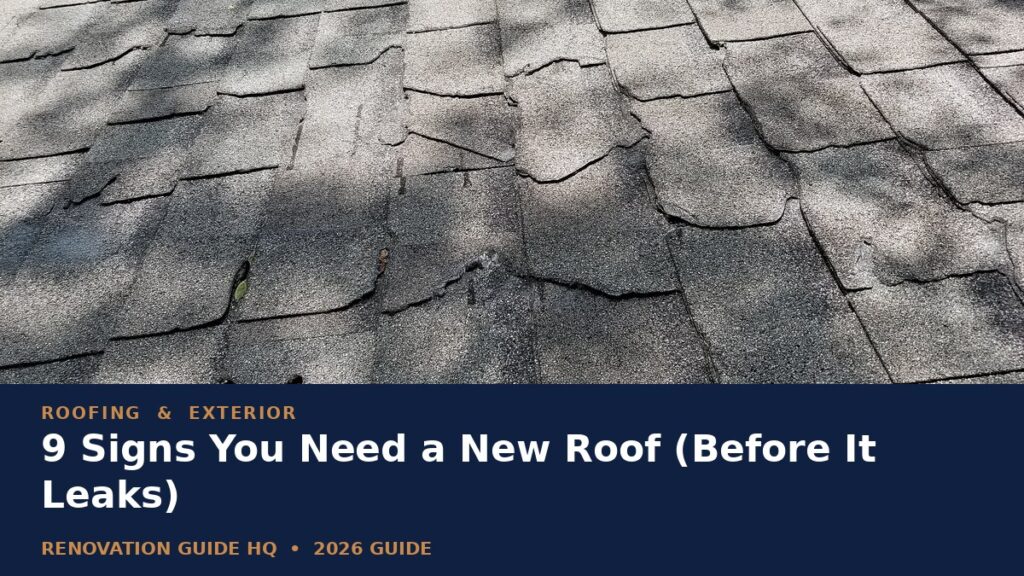
- Curling vs. missing: If shingles are curling across more than 20–25% of the roof, replacement shingles won’t fix the underlying wear. That is a replacement signal, not a repair job.
- Ridge caps: Ridge shingles wear faster than field shingles because they take sun from both sides. Ridge-only repair ($250–$750) can buy a few more years on an otherwise sound roof.
- Non-asphalt roofs: Repairing tile ($400–$1,600), metal ($400–$1,700), or slate ($400–$1,800) costs more because materials are pricier, heavier, and more fragile to work around.
Leak Fixes: Finding It Costs as Much as Fixing It
Leak repairs average $400–$1,200 for a located, single-area fix. The uncomfortable truth: the expensive leaks are not the leak itself — they are the water damage the leak caused before anyone found it. An attic leak quietly soaking insulation and decking for months can push the total past $2,000 once interior repairs are added.
Typical leak sources and their costs:
- Pipe boot or vent pipe: $150–$500 — rubber boots crack after 8–15 years; the fix is fast and cheap.
- Cracked or missing shingles: $200–$500 — straightforward once located.
- Flashing (chimney, wall, skylight): $200–$600 — flashing is the #1 leak culprit on otherwise healthy roofs.
- Skylight leak (flashing or seal): $300–$800 — sometimes the skylight itself needs replacement, not just the flashing.
- Roof valley: $500–$1,500 — valleys funnel the most water, so failures here are urgent.
- Structural or deck damage: $1,000–$3,000+ — when the leak has been working for a while.
Catching leaks early is worth real money. Water stains on ceilings, musty attic smells, and granules collecting in gutters are all early warnings. A free or low-cost roof inspection ($0–$200) every couple of years can catch these before they become four-figure problems.
Flashing Repairs: Small Metal, Big Consequences
Flashing — the thin metal strips that seal roof edges, chimneys, skylights, valleys, and walls — is responsible for a disproportionate share of leaks. Simple flashing repair (re-bending, resealing, patching) runs $200–$600. Full chimney re-flashing, with new step and counter-flashing, costs $400–$1,200 and is on the higher end of flashing work.
Flashing fails for predictable reasons: caulk dries out, metal corrodes, and step flashing gets disturbed when siding or chimneys are worked on. If your roof is otherwise young and healthy but you have a leak near a chimney, skylight, or wall intersection, flashing is the first suspect — and fixing it is one of the best-value repairs in roofing.
Sagging Roofs: When Repair Gets Serious
A sagging roofline is a serious red flag. Sagging can come from water-rotted decking, undersized rafters, excessive accumulated weight (multiple shingle layers), or age — and targeted shingle work cannot fix it. Structural repair costs $500–$2,500 per section and can exceed $5,000 if the problem is widespread.
From inside the attic, look for:
- Daylight visible through roof boards
- Rafters or decking that feel soft or show dark water staining
- Visible dips in the roofline from outside (stand across the street and sight along the ridge)
Sagging almost always pushes the decision toward replacement rather than repair, because the structure beneath the shingles is compromised. Do not ignore it — a sagging roof is a safety issue, not just a cosmetic one.
DIY vs Pro: A Safety-First Warning
Roof work is genuinely dangerous. Falls are the leading cause of injury in roofing, and a steep or two-story roof is no place to learn. That said, there is a clear line between what a handy homeowner can do and what belongs to a licensed roofer:
Reasonable DIY (single-story, low slope only)
- Replacing a handful of shingles on a walkable, low-pitch roof — materials $30–$80
- Applying roofing sealant around a vent pipe — $10–$20 for a tube of sealant
- Clearing debris from valleys and gutters — free, and prevents many leaks
Hire a Pro (always)
- Anything on a steep pitch or above one story
- Flashing replacement (requires proper layering technique; done wrong, it leaks worse)
- Structural or decking work
- Any repair where you are unsure of the leak source — misdiagnosis wastes money twice
Professional installation also matters for warranties. Manufacturer material warranties (GAF, CertainTeed, Owens Corning) typically require proper installation, and workmanship warranties (1–10 years) only exist when a pro does the work. A botched DIY repair that voids coverage can cost far more than the labor you saved.
When to Repair vs Replace: The Decision Rules
This is the question that separates a few hundred dollars from twenty thousand. Use these four rules together:
1. The 30–50% Rule
If the proposed repair costs more than 30–50% of a full replacement, replacement is usually the smarter buy. At 30%, you should strongly consider replacing — especially if the roof is past the halfway point of its expected life. At 50%, replacement wins outright. You are spending a large chunk of replacement money on a system that will likely need another expensive fix in a year or two.
2. The 25% Rule
If damage covers more than 25% of the roof surface, replacement is generally the right call. Florida has even codified this into building code: shingle damage beyond 25% of the roof requires a full replacement rather than a partial repair. Even where it is not law, the logic holds — patching a substantially compromised roof extends the problem rather than resolving it.
3. The Age Rule
Roof age changes the equation. Repairs make sense when damage is isolated and the rest of the system has substantial life left. Once an asphalt shingle roof is around 20 years old, repeated repairs become a poor investment — you are paying roofing labor’s fixed costs over and over on a roof that is telling you goodbye. At 20+ years, put the repair money toward replacement instead.
4. The Recurrence Test
Ask yourself three questions: Have I repaired this roof multiple times already? Are leaks appearing in multiple areas? Do I plan to stay 5+ more years? If the answer is yes to the first two, stop funding quick fixes. If yes to the third, a new roof with a 25–50 year warranty is the better long-term return.
One more factor: curb appeal and resale. Patching a 15-year-old roof leaves a visible “patchwork” look that buyers and home inspectors flag. A new roof is a major selling point; a patched old roof is a negotiation liability.
Insurance Claims Guide
Homeowners insurance covers sudden, accidental damage — hail, windstorms, falling trees. It does not cover wear and tear, aging, or neglect. An old roof that simply wears out will not qualify for a covered replacement, no matter how expensive the quote.
Before you file
- Know your deductible. If the repair is $800 and your deductible is $1,000, filing gains you nothing and puts a claim on your record.
- Check your coverage type. Some older roofs carry actual cash value (ACV) coverage instead of replacement cost. With ACV, depreciation is subtracted — a $15,000 replacement might settle at $8,000, minus a $2,000 deductible, leaving you with roughly $6,000. Read your declarations page before counting on insurance money.
- Document everything. Photograph damage from the ground and (safely) from a ladder, note the storm date, and keep any fallen shingles or debris.
The claims process
- Mitigate further damage — emergency tarping ($200–$700) is usually reimbursable and expected by insurers.
- File the claim promptly; most policies have deadlines.
- Get 2–3 written contractor estimates that separate necessary work from recommended upgrades.
- Meet the adjuster on-site with your contractor present if possible.
- Do not sign over the entire claim check to a contractor upfront. Standard practice: a deposit of 10–30%, progress payments, and final payment on completion.
Storm-chaser warning
After major storms, door-knocking “roofers” flood neighborhoods promising free roofs through insurance. Verify licensing, check reviews, and never sign a contingency contract that assigns your claim rights to the contractor. A legitimate local roofer will be there after the storm season ends.
What Drives Repair Costs Up or Down
- Roof pitch: Steep roofs need safety equipment and move slower — expect 15–30% more than a walkable pitch.
- Material: Asphalt is the cheapest to repair; metal, tile, and slate run 2–4x per repair.
- Stories and access: Three stories, tight lot lines, or landscaping that blocks ladder placement all add labor time.
- Emergency service: After-hours or same-day emergency calls add 20–40% to the base price — worth it when water is actively coming in.
- Region: Labor rates vary widely. Expect roughly 15% below national average in states like Alabama or Mississippi, and 25–50% above in California, New York, or Massachusetts.
- Hidden damage: The most common budget-buster. A $400 leak fix becomes a $2,500 job when the decking underneath is rotted.
FAQ
How much does it cost to repair a roof leak in 2026?
Most homeowners pay $400–$1,200 for a professional leak repair covering one area, with a national average around $1,100 across all repair types. The price depends on the leak source — a cracked pipe boot ($150–$500) is far cheaper than a valley leak with deck damage ($1,000–$3,000+). Catching leaks early keeps you at the low end; leaks that soak insulation and drywall for months land at the high end.
Is it better to repair or replace a 20-year-old roof?
At 20 years, an asphalt shingle roof is at or past its expected lifespan. Unless the damage is minor and truly isolated, replacement is the better investment — repeated repairs on a 20-year-old roof have poor returns, and each repair carries fixed labor costs. Apply the 30–50% rule: if the repair quote exceeds 30% of replacement cost, replace.
Can I claim roof repair on homeowners insurance?
Only if the damage came from a covered peril like hail, wind, or a fallen tree. Insurance does not pay for wear, age, or neglected maintenance. Check whether your policy pays replacement cost or actual cash value (depreciated) — the difference can be thousands. And if the repair costs less than your deductible, do not file.
How long does a typical roof repair take?
Most repairs take half a day to one full day. Shingle replacement and pipe boots: 1–2 hours. Flashing and valley work: 2–5 hours. Decking or structural sections: 1–2 days. Emergency tarping is usually done within hours of the call.
Why do roofers charge a minimum fee even for tiny repairs?
A $150–$350 minimum covers ladder setup, safety gear, travel, and diagnosis time — the fixed costs of any roof visit. It is standard across the industry. You can sometimes avoid it by bundling: if you need a few shingles replaced and the gutters cleaned, ask for both in one visit.
How We Estimated These Costs
Cost ranges in this guide are planning estimates compiled from Angi’s 2026 roofing cost data (average replacement ~$9,609 nationally), HomeAdvisor’s repair averages (~$1,174), Angi’s composite-shingle repair tables, and manufacturer guidance from GAF on repair-vs-replacement decisions. Regional multipliers reflect published state-level labor data.
These are planning ranges, not quotes. Your actual cost depends on roof size, pitch, material, local labor rates, and what the roofer finds under the shingles. Get 2–3 written estimates, ask how many years each option realistically buys you, and confirm whether the work carries a transferable workmanship warranty. Never pay the full amount upfront — 10–30% down with the balance on completion is standard.
Renovation Guide HQ publishes independent cost research for U.S. homeowners. We are not a roofing contractor; for structural concerns or active leaks, contact a licensed local roofer promptly.