Disclosure: Renovation Guide HQ publishes free, independent home improvement guides. We do not earn commissions from the products or services mentioned in this guide, and we have no affiliate relationships.
By Renovation Guide HQ · Updated November 1, 2026
Updated: November 2026
Quick Answer
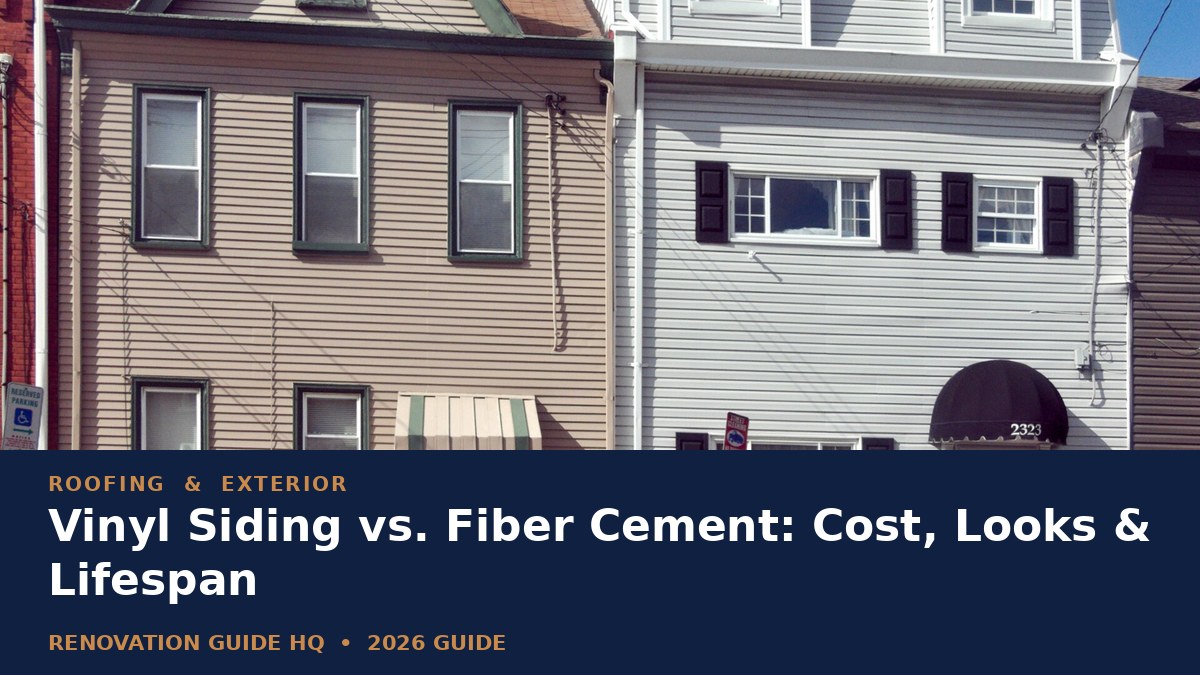
Vinyl siding costs $4 to $12 per square foot installed, while fiber cement costs $6 to $15 per square foot installed. Typical totals: $10,000 to $16,000 vinyl, $14,000 to $30,000 fiber cement, in 3 to 8 days on site. Vinyl wins on price; fiber cement wins on lifespan and fire resistance.
This guide is part of our Roofing and Exterior cluster. For the full exterior picture, start with our pillar guide: Roof Replacement Cost in 2026. It covers the biggest exterior spend of all, and this comparison covers the walls underneath it.
Cost Table: Vinyl vs. Fiber Cement
| Option | Per Sq Ft Installed | Typical Total | Timeline | Lifespan | Labor vs. Materials |
|---|---|---|---|---|---|
| Vinyl, standard | $4 to $8 | $8,000 to $16,000 | 3 to 5 days (planning estimate) | 20 to 40 years (planning estimate) | About 45 percent labor, 55 percent materials (planning estimate) |
| Vinyl, premium or insulated | $7 to $12 | $13,000 to $22,000 (planning estimate) | 4 to 6 days (planning estimate) | 30 to 40 years (planning estimate) | About 45 percent labor, 55 percent materials (planning estimate) |
| Fiber cement, primed | $7 to $14 | $14,000 to $28,000 (planning estimate) | 5 to 8 days (planning estimate) | 30 to 50 years (planning estimate) | About 55 percent labor, 45 percent materials (planning estimate) |
| Fiber cement, factory-finished | $9 to $15 | $18,000 to $30,000 (planning estimate) | 5 to 8 days (planning estimate) | 50 years or more (planning estimate) | About 55 percent labor, 45 percent materials (planning estimate) |
Siding is priced per square foot of wall, not per square foot of house. A 2,000-square-foot home typically has 2,000 to 2,600 square feet of wall area once windows and doors are subtracted and gables are added. Angi puts the average siding project at $11,589, with most jobs between $5,554 and $17,720. Labor runs higher for fiber cement because the boards are heavy, about 2.5 pounds per square foot, and need two-person handling, special cutting tools, and careful nailing.
Worked Budget Example: A 1,500 Sq Ft Home With 1,600 Sq Ft of Wall
Take a single-story, 1,500-square-foot home with 1,600 square feet of siding wall after subtracting windows and doors. Here is what each option looks like, line by line. All figures are planning estimates except where a source is linked.
Vinyl at $8 per square foot: $12,800 total (planning estimate)
| Line Item | Cost |
|---|---|
| Vinyl panels, trim, and housewrap | $4,200 (planning estimate) |
| Installation labor | $5,800 (planning estimate) |
| Tear-off and disposal of old siding | $1,600 (planning estimate) |
| Soffit, fascia, and trim allowance | $900 (planning estimate) |
| Permit, dumpster, and miscellaneous | $300 (planning estimate) |
| Total | $12,800 (planning estimate) |
The math checks out: $4,200 plus $5,800 is $10,000; plus $1,600 is $11,600; plus $900 is $12,500; plus $300 is $12,800.
Fiber cement at $11 per square foot: $17,600 total (planning estimate)
| Line Item | Cost |
|---|---|
| Fiber cement boards, trim, and housewrap | $6,400 (planning estimate) |
| Installation labor | $7,900 (planning estimate) |
| Tear-off and disposal of old siding | $1,600 (planning estimate) |
| Trim, caulk, and paint touch-up | $1,200 (planning estimate) |
| Permit, dumpster, and miscellaneous | $500 (planning estimate) |
| Total | $17,600 (planning estimate) |
The math checks out: $6,400 plus $7,900 is $14,300; plus $1,600 is $15,900; plus $1,200 is $17,100; plus $500 is $17,600. The gap between the two jobs is $4,800 (planning estimate) on day one. Whether that gap pays off depends on how long you stay, which the 30-year math below answers.
What $10,000, $16,000, and $25,000 Actually Buy
$10,000 buys standard vinyl on a small, simple home: one-layer tear-off, basic trim, and a straightforward install. It is a clean, low-maintenance exterior with the shortest life of the three tiers, best for a home you plan to sell within 10 years or a tight budget that still demands a full job.
$16,000 buys premium or insulated vinyl, or primed fiber cement on a mid-size home. This is the sweet spot for most homeowners: thicker panels, better trim detail, and either vinyl’s zero-paint upkeep or fiber cement’s wood-like look at a mid-range price.
$25,000 buys factory-finished fiber cement on a typical home, with full trim, caulked joints, and a finish warranted for years. You pay roughly double the cheapest vinyl job, but you get the longest life, the best fire rating, and the strongest resale story.
Regional Differences
The figures below are illustrative planning estimates, not quotes. Siding materials cost roughly the same nationwide, but labor does not, and labor is about half the bill. Expect the highest totals in the Northeast and on the West Coast, where a mid-range job can run 20 to 40 percent above the national average. The Midwest tracks close to the average. The South and rural markets often run 10 to 20 percent below it. Climate moves the choice, not just the price: hail country favors fiber cement’s impact resistance, hot southern climates punish dark vinyl that can warp, and wildfire-prone areas favor fiber cement because it is non-combustible. Get three local quotes with identical scope, because a quote that skips tear-off or trim is not comparable to one that includes them.
7 Cost Factors With Dollar Impact
1. Wall area. Every 100 square feet of wall adds $400 to $1,200 for vinyl and $600 to $1,500 for fiber cement (planning estimates). Two-story homes cost more per square foot because of scaffolding and slower work.
2. Tear-off and disposal. Removing old siding adds $0.70 to $2.00 per square foot (planning estimate). A second buried layer roughly doubles that, and damaged sheathing underneath adds $75 to $150 per sheet replaced (planning estimate).
3. Trim and detail. Corner boards, window surrounds, frieze boards, and soffits add $1,000 to $4,000 (planning estimate). Fiber cement trim costs more because it is cut and painted like the field boards.
4. Finish choice. Factory-finished fiber cement adds $0.75 to $1.50 per square foot over primed boards (planning estimate), but pushes the first repaint out to 15 years or more.
5. House height and complexity. Gables, dormers, bay windows, and tall walls add $1,000 to $3,000 (planning estimate) in labor and staging. A simple ranch is always the cheapest shape to side.
6. Old siding condition. Rot, insect damage, or failed housewrap found during tear-off adds $500 to $3,000 (planning estimate). Insist on a per-sheet sheathing price in the contract before work starts.
7. Season and crew availability. Late fall and winter are typically the slowest window, with possible labor savings of 5 to 10 percent (planning estimate). Spring and summer are peak season, with longer waits and firmer prices. Storm-chasing crews after hail events charge the most.
The 30-Year Math: Vinyl Twice vs. Fiber Cement Once
Comparing only the first invoice misleads. A vinyl job at $12,800 that lasts 25 years, then needs a second job at a similar price, costs about $25,600 over 30 years before inflation (planning estimate). A fiber cement job at $17,600 that lasts 50 years costs $17,600 in that same window, plus one repaint at roughly $3,500 to $5,000 (planning estimate) if you chose primed boards. Even with the repaint, fiber cement comes out ahead over 30 years for homeowners who stay put. Vinyl still wins on cash today and for short stays: if you sell within 10 years, you never pay the second vinyl job, and the lower upfront cost matters more than the longer lifespan. Resale reinforces the picture: the 2025 Cost vs. Value Report puts siding replacement at 97 to 114 percent recouped at resale, with fiber cement at the top of that range. For the standard 1,250-square-foot Cost vs. Value project, vinyl cost $17,950 and fiber cement cost $21,485, trim included.
Looks, Maintenance, and Durability Side by Side
| Factor | Vinyl | Fiber Cement |
|---|---|---|
| Appearance | Clean and uniform, but flat shadow lines give it away up close | Deep shadow lines and wood-grain texture that mimic real wood |
| Color choice | Factory color only; painting vinyl voids most warranties | Any exterior paint color; factory finishes in dozens of colors |
| Maintenance | Wash once a year; no painting ever | Wash twice a year; repaint field-painted boards every 12 to 15 years (planning estimate) |
| Fire rating | Melts and can ignite under high heat | Non-combustible, the best rating of any common siding |
| Hail and impact | Cracks in cold weather and under large hail | Resists hail and debris far better, though corners can chip |
| Insects and rot | Not a food source for insects; will not rot | Not a food source for insects; will not rot |
| Warping | Can buckle or melt near grills and reflected heat | Dimensionally stable; does not expand and contract like vinyl |
| Warranty | Lifetime limited, usually prorated (planning estimate) | 30-year limited warranty on boards, 15-year finish warranty on factory color (planning estimate) |
DIY vs. Pro
| Factor | Vinyl DIY | Fiber Cement DIY | Professional |
|---|---|---|---|
| Skill level, 1 to 5 | 3, confident DIYer | 5, expert only | Licensed siding crew |
| Tools needed | Snips, level, chalk line, nail gun or hammer, ladder | Diamond-blade saw with dust collection, respirator, scaffolding | Included in the quote |
| Time for 1,600 sq ft of wall | 2 to 3 weekends with a helper (planning estimate) | 3 to 4 weekends with a helper (planning estimate) | 3 to 5 days vinyl, 5 to 8 days fiber cement |
| Savings | Up to 45 percent of the total (planning estimate), mostly labor | Up to 50 percent of the total (planning estimate), mostly labor | None, but includes warranty and code compliance |
| Legal and permit limits | Most jurisdictions allow homeowner siding with a permit | Same, but silica dust rules and weight make pro install strongly advised | Contractor pulls the permit and carries liability and workers’ compensation |
Vinyl is one of the most DIY-friendly sidings: panels are light, snap together, and forgive small mistakes. Fiber cement is a different story. Cutting it creates respirable silica dust, which requires dust-collecting saws or outdoor cutting with a respirator under OSHA rules. Boards weigh about 2.5 pounds per square foot, so a full plank needs two people, and nailing must be exact or boards crack. Electrical work for new exterior lights or outlets, gas venting, and any structural sheathing repair belong to licensed pros. If you DIY vinyl, work with a partner, never side alone on a ladder, and keep grills and heat sources away from finished walls.
Step-by-Step: How a Siding Job Runs
Step 1: Inspection and measurement, 1 to 2 hours. The crew measures wall area, checks sheathing, photographs problem areas, and confirms trim and color choices.
Step 2: Tear-off, 4 to 8 hours. Old siding comes off down to the sheathing, usually in one day. Debris goes straight into a dumpster to protect landscaping.
Step 3: Sheathing repair and housewrap, 2 to 4 hours. Soft or damaged sheets are replaced at the contract’s per-sheet price, then housewrap and flashing go on.
Step 4: Starter strip and corner posts, 2 to 3 hours. The starter course sets every row above it, so a level start matters more than speed here.
Step 5: Field installation, 2 to 5 days. Panels go on from bottom to top, with proper nailing clearance so vinyl can expand and contract. Fiber cement takes longer because every cut is slower and boards are heavier.
Step 6: Trim, soffit, and fascia, 1 to 2 days. Window surrounds, corner boards, soffits, and fascia finish the job and seal the edges.
Step 7: Caulk and paint touch-up, 2 to 4 hours. Fiber cement joints are caulked and touched up; primed boards get their first full coat within 180 days if not factory-finished.
Step 8: Cleanup and final walk-through, 2 to 3 hours. Magnetic nail sweep of the yard and driveway, gutter check, and a walk-through with the crew lead. The building inspector signs off where a permit was pulled.
Materials and Tools List
A complete vinyl system includes: vinyl panels, starter strip, J-channel, corner posts, housewrap, flashing tape, soffit and fascia panels, and siding nails. A fiber cement system swaps panels for fiber cement boards and trim, adds caulk and touch-up paint, and requires a diamond-blade saw with dust collection. For a small DIY vinyl repair you need: snips, a zip tool, a level, replacement panels, and a ladder with a stabilizer. Rent, do not buy, the scaffolding for a one-off job.
9 Mistakes Contractors See Too Often
1. Nailing vinyl tight. Vinyl must hang loose on its nails so it can expand and contract. Tight nails cause buckling in summer heat.
2. Skipping housewrap. New siding over failed wrap traps water. The wrap and flashing are the weather barrier, not the siding itself.
3. Reusing old trim. Old trim telegraphs every flaw in the new job. New siding deserves new trim, especially around windows.
4. No sheathing allowance in the contract. Without a per-sheet price, every soft sheet becomes a negotiation mid-job, when you have no leverage.
5. Choosing on price alone. The lowest bid usually omits something: tear-off, disposal, trim, or the permit. Compare line items, not totals.
6. Painting vinyl a dark color. Dark paint absorbs heat, warps panels, and voids most vinyl warranties. If you want a dark color, choose fiber cement.
7. Cutting fiber cement dry indoors. Silica dust is a serious health hazard. Cut outdoors with dust collection and a proper respirator, never with a dry saw in a garage.
8. Caulking vinyl joints shut. Vinyl joints are designed to move. Caulk traps water and causes buckling; only fiber cement joints get caulked.
9. Paying most of the money up front. A reasonable schedule is a deposit of 10 to 30 percent, progress payments tied to milestones, and final payment after inspection (planning estimate of standard practice). Full payment before work starts is a red flag.
Permits and Safety
Most US jurisdictions require a permit for a full siding replacement under the International Residential Code (IRC); small repairs often do not. Your contractor should pull the permit and schedule the inspection. Work on homes built before 1978 must follow EPA Renovation, Repair and Painting (RRP) lead-safe practices when painted surfaces are disturbed, and siding materials installed before 1980 should be tested for asbestos before disturbance. Never burn or grind suspect materials. Cutting fiber cement creates silica dust, so crews must use dust-collecting tools and respirators. On the safety side, ladder and scaffolding rules apply to all siding work: stable footing, a spotter for tall work, and eye protection when cutting. If a crew shows up cutting fiber cement dry with no respirator, stop the job and call the company owner.
Hiring a Contractor: 6 Questions, Red Flags, License Checks
Ask every bidder these six questions: (1) Are you licensed and insured, and will you show certificates for both general liability and workers’ compensation? (2) Will you pull the permit and handle inspections? (3) What is your per-sheet sheathing price, and what does the tear-off include? (4) Is all trim new, and what caulk and paint schedule applies to fiber cement? (5) What manufacturer and workmanship warranties do you offer, in writing? (6) Can you give three local references from jobs done more than a year ago? Red flags: cash-only pricing, pressure to sign today, no local address, a bid far below the others, and any request for full payment up front. Verify licensing through your state’s contractor license board website before signing: search for your state’s board by name, confirm the license is active, and check for complaints or disciplinary actions.
Financing a Siding Job
Most homeowners do not pay for siding out of pocket, and several general options exist. A home equity line of credit (HELOC) offers flexible draws and interest-only payments during the draw period. A home equity loan gives a lump sum with fixed payments. A cash-out refinance replaces your mortgage with a larger one and takes the difference in cash, which only makes sense if current rates beat your existing rate. A personal loan requires no home equity but carries higher rates and shorter terms. This is general information, not financial advice, and no specific rates are quoted here because they change constantly. Compare at least two lenders and read the total cost, not just the monthly payment. Insurance may cover replacement when damage comes from a covered event like hail or wind, but not when siding simply wore out. Document damage with photos before repairs, and get the adjuster’s scope in writing before the crew starts.
Frequently Asked Questions
Is fiber cement worth the extra cost over vinyl?
For homeowners staying 15 years or more, usually yes. The upfront gap of roughly $4,800 on a typical home (planning estimate) is offset by a lifespan roughly twice as long and stronger resale. For a short stay or a tight budget, vinyl is the smarter spend.
How long does vinyl siding last?
Vinyl typically lasts 20 to 40 years with basic care (planning estimate). Premium and insulated panels sit at the top of that range, while thin builder-grade panels in harsh climates sit at the bottom.
How long does fiber cement siding last?
Fiber cement typically lasts 30 to 50 years or more when installed correctly and maintained on schedule (planning estimate). The boards themselves outlast the paint, so repainting is maintenance, not replacement.
Does fiber cement need painting?
Factory-finished boards carry a 15-year finish warranty against fading, peeling, and cracking (planning estimate), then need repainting. Primed boards must be painted within 180 days of installation and repainted roughly every 12 to 15 years (planning estimate).
Can you paint vinyl siding?
Technically yes, but it is rarely wise. Most manufacturers void the warranty if vinyl is painted, and dark colors can warp panels. If you want a new color, budget for new siding in the color you want, or choose fiber cement next time.
Which siding is best for fire-prone areas?
Fiber cement, by a wide margin. It is non-combustible, while vinyl melts under high heat. In wildfire-prone areas, fiber cement plus ember-resistant vents and cleared defensible space is the standard recommendation.
Bottom Line
Choose vinyl if budget and zero painting matter most, and you plan to sell within 10 to 15 years. Choose fiber cement if you are staying long-term, want the wood look without wood’s upkeep, or live in hail, fire, or high-wind country. Either way, judge every quote on its line items: tear-off, sheathing allowance, trim, and finish, not its total. For the full exterior picture, read Roof Replacement Cost in 2026, then compare roof materials in Metal Roof Cost vs. Shingles and Asphalt Shingles vs. Metal Roof. Ready for quotes? Get 3 quotes through our contact page and bring your wall measurement to the first conversation.