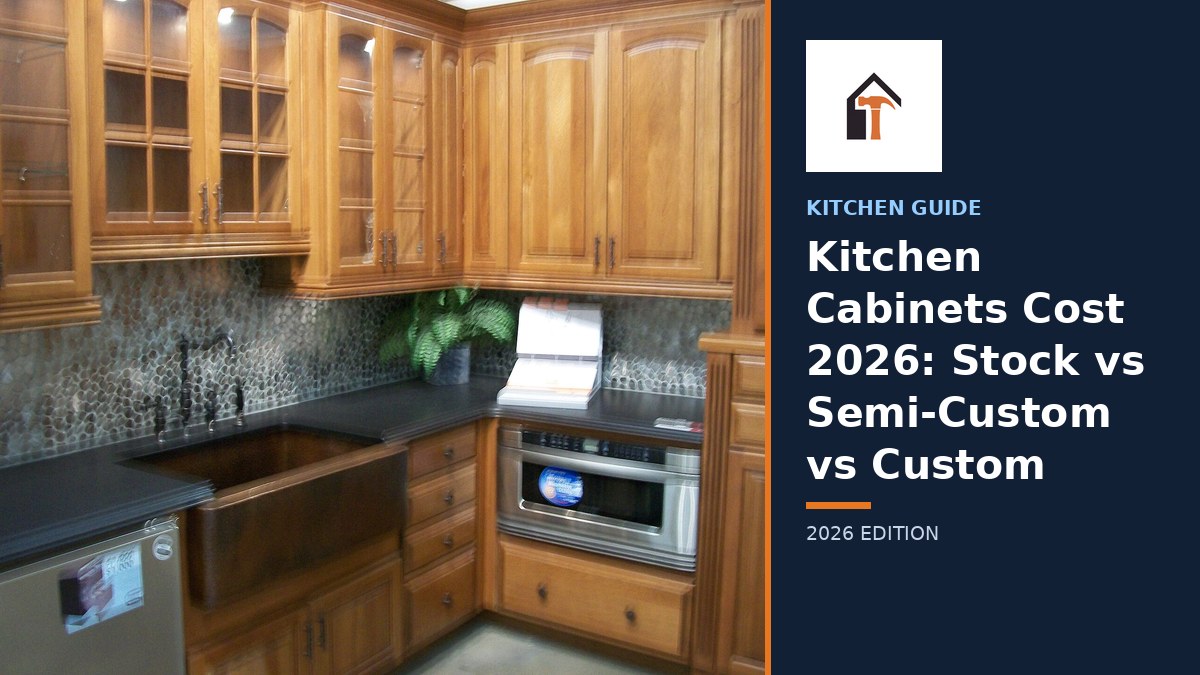
Quick Answer: How Much Do Kitchen Cabinets Cost in 2026?
Kitchen cabinets cost $2,000 to $24,000+ installed for a standard 10×10 kitchen in 2026, depending on the type you choose. Stock cabinets run $2,000–$6,000, semi-custom cabinets run $5,000–$13,000, and custom cabinets run $10,000–$24,000 or more for the same 10×10 layout (HomeGuide). Cabinets typically eat up 25% to 40% of a total kitchen remodel budget, making them the single biggest line item in most renovations. The per-linear-foot price — the industry’s standard unit, measuring the total width of your cabinet runs — ranges from roughly $100/linear foot for stock up to $1,200+/linear foot for custom.
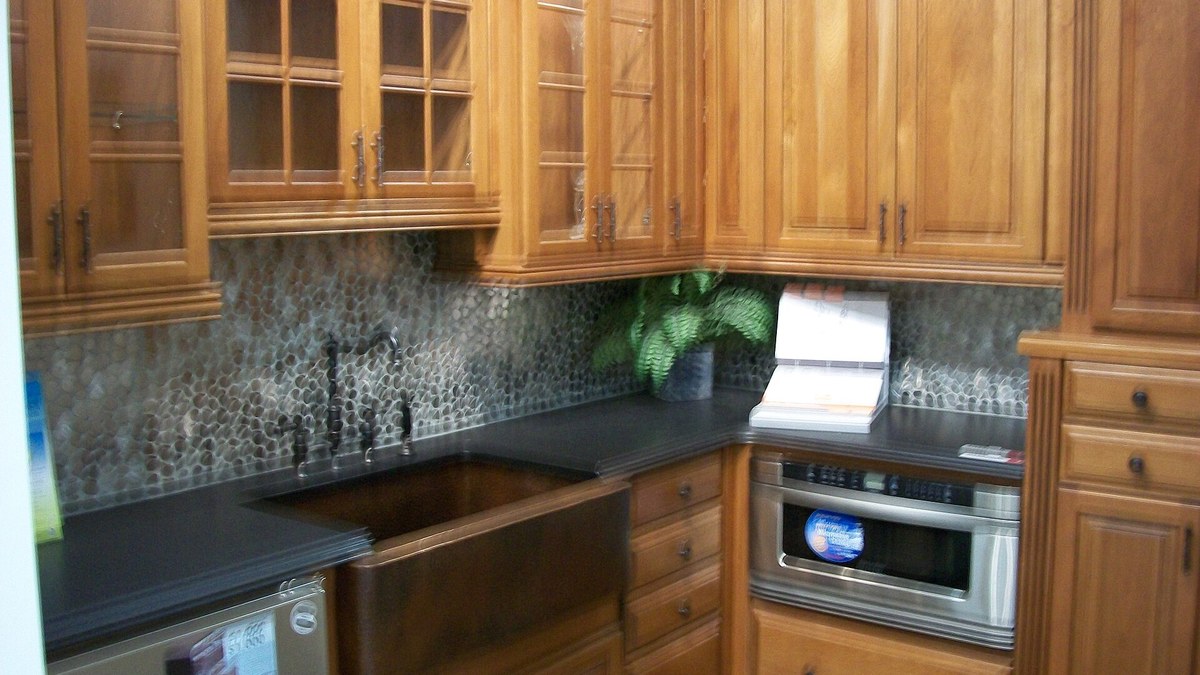
Kitchen Cabinet Cost Comparison Table (2026)
A standard 10×10 kitchen contains about 20 linear feet of cabinetry (roughly 12 feet of base cabinets and 8 feet of wall cabinets). Here is how the three main cabinet types compare at that scale:
| Cabinet Type | Cost Per Linear Foot (Installed) | 10×10 Kitchen Total | Lead Time | Best For |
|---|---|---|---|---|
| Stock | $100–$300 | $2,000–$6,000 | 1–7 days | Budget renovations, rentals, fast timelines |
| Semi-Custom | $250–$650 | $5,000–$13,000 | 4–8 weeks | Most homeowners — the sweet spot of price and choice |
| Custom | $500–$1,200+ | $10,000–$24,000+ | 8–12 weeks | High-end kitchens, unusual layouts, specific needs |
| IKEA (SEKTION) | $150–$300 | $3,000–$6,500 | 1–14 days | DIYers, modern designs |
| Ready-to-Assemble (RTA) | $100–$300 | $2,000–$5,500 | 1–3 weeks | Budget DIY projects |
Sources: HomeGuide, Angi 2026 data, Lily Ann Cabinets October 2026 pricing. Regional variance runs +10–20% on the West Coast and +15% in the Northeast.
What “Per Linear Foot” Actually Means
Linear-foot pricing measures the total width of your cabinet runs, not floor area. A 10×10 kitchen test layout — the industry’s standard comparison format — uses about 20 linear feet. To estimate your own kitchen, measure the width of each wall where cabinets will hang, add them together, and multiply by the per-linear-foot rate for your cabinet type. Islands, pantry towers, and specialty units (lazy Susans, pull-out pantries) are often priced separately or push you toward the high end of the range.
What’s Included in Cabinet Pricing?
Quotes can be confusing because “cabinets” means different things to different sellers. Here is what is typically included — and what is not.
Usually Included
- Cabinet boxes — the carcass (particleboard, MDF, or plywood depending on type)
- Doors and drawer fronts — in the line’s standard styles and finishes
- Basic shelving — usually one adjustable shelf per wall cabinet
- Standard hinges and drawer slides — soft-close is often an upgrade on stock lines
- Toe kicks — the recessed base at the bottom of base cabinets
- Installation labor — when the quote says “installed” (always confirm this)
Usually NOT Included (Budget 15–30% Extra)
- Hardware — knobs and pulls run $3–$25 each; a 10×10 kitchen needs 30–50 pieces
- Interior organizers — pull-out trays, trash pull-outs, spice racks: $50–$300 per cabinet
- Glass door upgrades — $50–$150 per door
- Crown molding and decorative trim — $200–$600+ for the kitchen
- Under-cabinet lighting — $200–$800 installed
- Demolition of old cabinets — $300–$800
- Countertops, sink, and backsplash — always separate line items
That 15–30% in extras is the most common budget surprise in cabinet projects. When comparing quotes, ask each bidder for an itemized list so you are comparing the same scope.
Box Materials: What You’re Really Paying For
The single biggest cost driver is the material inside the cabinet box:
- Particleboard/MDF — the base of most stock and entry semi-custom lines. Takes paint well but swells with moisture — a risk under sinks and near dishwashers. Lowest cost.
- Plywood — the mid-to-premium standard. Holds screws better, resists moisture, weighs less. Most reputable custom shops use 3/4-inch plywood as their baseline.
- Solid wood — typically reserved for doors and face frames (full solid-wood boxes are rare and expensive). Drives the top end of custom pricing: white oak $700–$900/linear foot, walnut $800–$1,000/linear foot installed.
Stock vs Semi-Custom vs Custom: Which Should You Choose?
Stock Cabinets ($2,000–$6,000 for 10×10)
Stock cabinets are pre-manufactured in fixed sizes (usually 3-inch width increments) and sold off the shelf at Home Depot, Lowe’s, and similar retailers. You pick a style and finish from the available menu — no modifications. Quality ranges from basic to surprisingly good; look for KCMA certification (tested to 25,000 door cycles and 600-lb wall loads) as a quality floor. Best when: budget is under $10,000, the timeline is tight, or it is a rental property. Biggest limitation: filler strips eat space in non-standard layouts, and finish choices are limited.
Semi-Custom Cabinets ($5,000–$13,000 for 10×10)
Semi-custom lines (KraftMaid, Aristokraft, and similar) start from stock platforms but let you modify dimensions, finishes, and features — deeper drawers, pull-out shelving, specialty storage, dozens of door styles. This is the sweet spot for most homeowners: meaningful personalization without custom-shop pricing or lead times. Expect 4–8 weeks from order to delivery. Watch out for option creep — every upgrade (soft-close, dovetail drawers, upgraded finish) nudges the total upward.
Custom Cabinets ($10,000–$24,000+ for 10×10)
Custom cabinets are built to order by a local shop or craftsman to your exact specifications — any size, any wood species, any finish, any interior configuration. The right choice for unusual layouts (angled walls, very tall ceilings), accessibility needs, or high-end homes where the kitchen must match existing millwork. Lead times run 8–12 weeks, and you will pay for the craftsman’s design time. Always review a full-size shop drawing before approving, and confirm the finish warranty in writing.
Cabinet Door Styles and Their Cost Impact
The door style you choose affects both price and lead time, because complex profiles require more machining and finishing labor:
- Shaker (flat-panel, five-piece) — the price baseline. Simple, timeless, and produced at massive scale, which keeps costs down across all three cabinet tiers.
- Flat-slab — similar to Shaker in cost; popular in modern kitchens. Thermofoil and acrylic slabs add $100–$200 per linear foot over painted MDF.
- Raised-panel — adds roughly 10–20% over Shaker for the extra milling and detail sanding. Classic traditional look.
- Inset doors — adds 15–30%. Inset construction demands tighter tolerances and skilled fitting, so it is rare in stock lines and common in custom shops.
- Glass-front and open shelving — glass inserts add $50–$150 per door, plus the cost of finishing the cabinet interior. Beautiful for display — but everything inside must stay tidy.
If budget matters, Shaker in a stock or semi-custom line is the undisputed value champion: maximum style longevity per dollar, and every manufacturer offers it.
Regional Cost Differences
Cabinet pricing is not the same everywhere in the US. Based on Angi and HomeAdvisor regional data:
- Northeast (Boston, NYC, DC) — expect +15% over national averages. Dense urban labor markets and higher shop overhead drive the premium.
- West Coast (LA, San Francisco, Seattle) — expect +10–20%. Permitting complexity and high cost of living push both materials and labor up.
- Midwest (Chicago, Minneapolis, Kansas City) — closest to national averages; strong Amish and regional cabinet-shop competition keeps custom pricing honest.
- Southeast (Atlanta, Charlotte, Orlando) — roughly 5–10% below national averages for labor, but specify plywood or solid-wood boxes — high humidity punishes particleboard.
- Rural areas — labor can run 10–20% below metro rates, but delivery surcharges for stock lines and fewer competing shops can erase the savings.
When budgeting, apply your regional multiplier after selecting a cabinet type — a $8,000 semi-custom quote nationally becomes roughly $9,200 in Boston.
Refacing vs Replacing: When Each Makes Sense
If your cabinet boxes are structurally sound, you may not need new cabinets at all:
| Option | Typical Cost (10×10) | What It Involves |
|---|---|---|
| Painting | $2,000–$6,500 | Professional spray finish on existing doors/boxes |
| Refinishing | $1,500–$4,500 | Strip and re-stain or re-paint |
| Refacing | $5,000–$13,000 | New doors, drawer fronts, hardware + veneer over old boxes |
| Replacing (stock) | $2,000–$6,000 | Full tear-out and new cabinets |
Source: HomeGuide 2026.
Reface when: boxes are solid plywood or hardwood, the layout works, and you like the current footprint. Note that refacing is mostly labor — at $150–$450 per linear foot it often costs about the same as new stock cabinets.
Replace when: boxes are water-damaged, sagging, or made of swollen particleboard; the layout must change; or you want to reconfigure storage entirely. Replacement also resets the clock on hinges, slides, and box integrity.
Money-Saving Tips (Without Regretting It)
- Keep the layout. Moving plumbing, electrical, and gas lines can add $1,000–$3,000+. Same footprint = same cabinet sizes = lower cost.
- Mix and match. Use stock cabinets for the perimeter and splurge on one custom piece (a pantry wall or island) where it shows.
- Choose Shaker. The simple five-piece Shaker door is the most widely produced style — more competition means lower prices and timeless resale appeal.
- Consider RTA. Ready-to-assemble cabinets from reputable online sellers run $100–$300/linear foot; assembling them yourself skips $500–$1,500 in labor. Lily Ann’s lines run about $3,000–$5,100 for a 10×10 kitchen, materials only (October 2026).
- Time it right. Cabinet retailers run their deepest promotions around major holidays (Labor Day, Black Friday). Custom shops are often hungriest in late winter.
- Limit the upgrades. Soft-close everything, full-extension everything, and boutique organizers are wonderful — but each adds up. Prioritize the 2–3 upgrades you will touch daily (trash pull-out, deep drawers) and skip the rest.
- Get 3 written quotes. Angi, HomeAdvisor, and local referrals. Itemized quotes let you compare boxes, doors, finish, hardware, and labor separately instead of guessing.
Frequently Asked Questions
How much do cabinets cost for a 10×10 kitchen in 2026?
A 10×10 kitchen (about 20 linear feet) costs $2,000–$6,000 for stock, $5,000–$13,000 for semi-custom, and $10,000–$24,000+ for custom cabinets, installed. IKEA’s SEKTION system lands around $3,000–$6,500 installed for the same size (HomeGuide).
What does the average homeowner spend on kitchen cabinets?
Most homeowners replacing cabinets with stock or semi-custom units spend $4,500 to $15,000 installed for an average kitchen, according to HomeGuide. Custom work pushes that to $15,000–$30,000. Cabinets typically represent 25–40% of a full kitchen remodel budget.
Is it cheaper to reface or replace kitchen cabinets?
Often about the same. Refacing runs $5,000–$13,000 for an average kitchen because it is labor-intensive, while new stock cabinets run $2,000–$6,000 plus installation. Reface only when the boxes are solid and the layout works; replace when boxes are damaged or the layout must change.
How long do kitchen cabinets last?
Well-built plywood or hardwood cabinets last 25–50 years. Particleboard stock cabinets typically last 15–25 years in a dry kitchen, less near moisture. KCMA-certified cabinets are tested to 25,000 door open/close cycles — roughly decades of normal family use.
Do new kitchen cabinets increase home value?
Yes, but modestly relative to cost. Kitchen remodels recoup roughly 40–70% of cost at resale depending on scope and market (Zonda Cost vs. Value). Cabinets alone rarely “pay for themselves,” but dated or damaged cabinets actively hurt showings — replacement is often about marketability as much as ROI.
How We Estimated These Costs
Every figure in this guide is a planning range, not a quote. We built these estimates from:
- Angi — 2026 national cost data for cabinet installation and replacement projects
- HomeGuide — per-linear-foot and per-kitchen-size pricing tables (stock, semi-custom, custom, IKEA, refacing)
- Home Depot / Lowe’s — current retail pricing for stock cabinet lines and hardware
- HomeAdvisor — regional labor rates and project cost distributions
- Lily Ann Cabinets — October 2026 RTA materials pricing for 10×10 kitchens
We cross-checked ranges across at least two sources before publishing, rounded to realistic bands, and flagged regional variance (+10–20% West Coast, +15% Northeast). No figures were invented. For your exact price, get three itemized written estimates from local contractors — and make sure each one lists boxes, doors, finish, hardware, and labor separately.
By Renovation Guide HQ — October 2026.