Quick Answer
Kitchen countertops in 2026 cost $15 to $140 per square foot installed, depending on the material. Laminate runs $15–$40 per sq ft installed, butcher block $40–$100, granite $40–$120, and quartz $50–$140. For a typical 40 sq ft kitchen, that translates to roughly $600 for laminate, $2,400 for butcher block, $3,200 for granite, and $4,000 for quartz — before extras like sink cutouts and upgraded edge profiles. The material you choose moves the final bill more than any other single decision, which is why this guide compares all four side by side with real numbers, worked examples, and the fabrication line items nobody quotes you upfront.
Countertop Material Comparison: Cost, Durability, and Upkeep
Every countertop material is a trade-off between price, durability, maintenance, and looks. Here is how the four most popular options stack up in 2026.
| Material | Installed Cost per Sq Ft | 40 Sq Ft Kitchen | Durability | Maintenance | Best For |
|---|---|---|---|---|---|
| Laminate | $15–$40 | $600–$1,600 | Fair | Low | Tight budgets, rentals, quick refreshes |
| Butcher block | $40–$100 | $1,600–$4,000 | Good (with care) | Medium–High | Warm look, islands, prep zones |
| Granite | $40–$120 | $1,600–$4,800 | Excellent | Medium (seal yearly) | Natural stone lovers, resale value |
| Quartz | $50–$140 | $2,000–$5,600 | Excellent | Low (never seal) | Busy families, low upkeep |
Laminate: $15–$40 per sq ft installed
Laminate is the undisputed budget champion. Modern high-definition laminates mimic stone and wood convincingly from a few feet away, and installation is fast — many kitchens are done in a day. The downsides are real: it scorches under hot pans, scratches with knife work, and seams are visible. A laminate top typically lasts 10–20 years. It is the right choice for rental properties, laundry rooms, or a kitchen you plan to fully renovate later.
Butcher Block: $40–$100 per sq ft installed
Wood counters bring warmth no stone can match, and they are the only surface you can sand back to new when they get tired. Maple and oak sit at the low end ($40–$60); walnut and teak push toward $80–$100. The catch is maintenance: monthly oiling with food-safe mineral oil, prompt wipe-ups around the sink, and refinishing every few years. Water is the enemy — skip wood immediately next to an undermount sink unless you are disciplined about it.
Granite: $40–$120 per sq ft installed
Granite remains the natural-stone standard. Entry-level colors (Santa Cecilia, Black Pearl, New Venetian Gold) run $40–$70; mid-grade stones with more movement run $70–$95; exotic slabs with dramatic veining can exceed $120 and reach $200. Granite shrugs off heat and daily abuse, but it is porous — plan on sealing once a year, a 20-minute job. No two slabs are alike, which is the whole point for buyers who want a one-of-a-kind kitchen.
Quartz: $50–$140 per sq ft installed
Engineered quartz has become America’s most-installed premium countertop, and the price reflects it. Value lines from MSI or Allen + Roth start around $50–$65; most homeowners land in the $70–$130 band; designer marble-look collections from premium brands reach $140 and beyond. Quartz never needs sealing, resists stains and bacteria, and offers the most consistent patterns. Its weaknesses: it can discolor with sustained high heat (always use trivets), and it is not rated for outdoor use since UV can fade the resins.
40 Sq Ft Kitchen: Worked Cost Example for Each Material
A 40 sq ft countertop run is a classic medium kitchen — think an L-shaped layout with a modest island or a long galley with a peninsula. Here is what each material costs for that exact footprint, installed, with a standard eased edge and one sink cutout.
| Material | Per Sq Ft (installed) | 40 Sq Ft Subtotal | Sink Cutout | Estimated Total |
|---|---|---|---|---|
| Laminate | $15–$40 | $600–$1,600 | $75–$150 | $675–$1,750 |
| Butcher block | $40–$100 | $1,600–$4,000 | $75–$150 | $1,675–$4,150 |
| Granite (mid-grade) | $60–$95 | $2,400–$3,800 | $100–$300 | $2,500–$4,100 |
| Quartz (mid-range) | $70–$110 | $2,800–$4,400 | $100–$300 | $2,900–$4,700 |
A few things this example assumes: 3cm slab thickness for stone (the standard), a simple eased edge (free), cabinets that are level and don’t need repair, and no tear-out of old counters. Change any of those and the number moves — which brings us to the line items fabricators often quote separately.
Fabrication and Installation Line Items (What the Quote May Not Include)
That per-square-foot number covers the slab, templating, cutting, and setting the top. It frequently does not cover the items below. Ask for an itemized quote so you are comparing the same scope across fabricators.
Edge profiles: $0 to $30 per linear foot
The standard eased edge (a 90-degree edge with slightly softened corners) is included free by most fabricators. Upgrades cost real money: a bevel runs $10–$20 per linear foot, a half bullnose $10–$20, an ogee (the classic S-curve) $20–$30, and a Dupont up to $45. A typical kitchen has 20–30 linear feet of exposed edge, so an ogee upgrade can add $400–$900. For modern kitchens with straight lines, the free eased edge looks intentional and saves the money.
Sink and cooktop cutouts: $75–$300 each
A standard drop-in sink cutout runs $75–$150. An undermount sink cutout — where the stone edge is exposed and must be polished — costs $100–$300 because it requires precision router work and waterproof polishing. Cooktop cutouts run $100–$250; each faucet hole is another $25–$75. A kitchen with an undermount sink, a cooktop, and a soap dispenser hole can easily carry $300–$600 in cutout charges alone.
Tear-out and disposal: $200–$600
Removing old countertops and hauling the debris typically costs $7–$14 per square foot, or $200–$500 flat for an average kitchen. Heavy stone or tile tear-outs land at the high end. Confirm whether your quote includes this — many “installed” prices assume the old top is already gone.
Plumbing reconnect: $150–$400
Disconnecting and reconnecting the sink, faucet, garbage disposal, and dishwasher usually requires a plumber at $40–$200 per hour. Budget $150–$400 total. Some countertop installers coordinate this; others leave it to you.
Slab thickness upgrades and seams
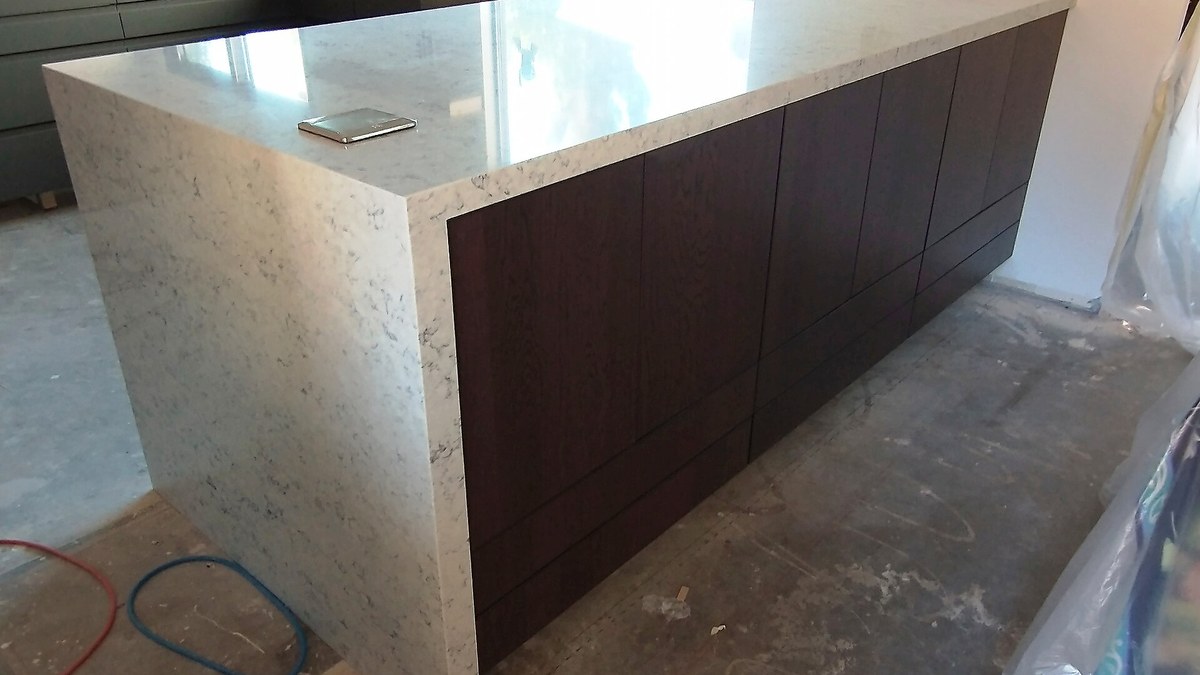
Most stone quotes assume 3cm (about 1¼ inch) slabs. Thinner 2cm slabs cost less but need plywood sub-tops and look less substantial. Waterfall panels (stone running down the side of an island) and bookmatched seams (mirror-image veining across a joint) are premium upgrades — beautiful, but each can add hundreds to the fabrication bill. Ask how many slabs your layout requires: every additional slab means another seam to cut, match, and polish.
The Slab Remnants Hack: Save 20–40% on Stone
Here is the single best money-saving move in countertops that almost nobody tells first-time buyers about: ask fabricators about their remnant inventory.
Every stone shop ends up with leftover slab pieces — “remnants” — from larger jobs. These are full-quality granite and quartz pieces, typically 10–30 square feet, sitting in the yard waiting for a small project. Because the shop has already paid for the slab, remnants routinely sell for 20–40% below full-slab pricing, fabrication included.
Remnants are perfect for bathroom vanities, laundry rooms, wet bars, desk areas, and small kitchen islands. Some shops will even cut a small galley kitchen from two remnants. The trade-off is selection: you choose from what is in stock rather than ordering your dream slab. But if you are flexible on color, call three local fabricators and ask, “What remnants do you have in granite and quartz right now?” You might find a $90/sq ft stone for $55 — the same stone, the same fabricator, the same installation warranty.
Two more remnant tips: visit the yard in person (photos don’t show veining well), and ask whether the remnant price includes the sink cutout and edge — some shops quote remnants all-in, which makes the deal even better.
Which Material Should You Choose? A 60-Second Decision Guide
If the tables above left you torn, run through these four questions — the answers point to a clear winner for most households.
1. What is your all-in budget? Under $2,000 for a 40 sq ft kitchen: laminate is your only realistic installed option, and there’s no shame in it — modern HD laminates look far better than the 1990s sheets you remember. $2,000–$4,000: butcher block or entry-to-mid granite open up. $4,000+: quartz and premium granite are in play.
2. How do you actually cook? Daily heavy cooking with hot pots and sharp knives favors granite (heat-proof, scratch-tough) or quartz (stain-proof, forgiving). If the kitchen is more for show and light meals, butcher block’s warmth or even quality laminate will serve you well for years.
3. How much maintenance will you honestly do? Be brutal with yourself. If annual sealing sounds like a chore you’ll skip, quartz’s zero-maintenance promise is worth real money. If you enjoy oiling wood and don’t mind the ritual, butcher block rewards the effort with a surface that ages beautifully.
4. Are you selling within 5 years? Appraisers and buyers in most US markets expect stone (granite or quartz) in mid-range homes and up. In that window, the resale premium of stone usually outweighs its higher upfront cost. If this is your forever kitchen, choose what you’ll love looking at every morning — you’ll live with it far longer than any buyer will.
FAQ: Kitchen Countertop Costs
What is the cheapest countertop material in 2026?
Laminate, at $15–$40 per square foot installed. A 40 sq ft kitchen in laminate runs roughly $675–$1,750 all-in. It is the right pick for rentals, flips, and kitchens you plan to gut later — but budget for replacement in 10–20 years, since it can’t be refinished like wood or stone.
Is quartz cheaper than granite?
Usually not — quartz runs about 5–15% more than comparable granite grades. Entry-level granite ($40–$70) undercuts entry-level quartz ($50–$85), and mid-range quartz ($70–$130) typically costs more than mid-range granite ($70–$95). Quartz earns its premium with zero sealing and near-zero staining, which many busy households find worth the difference over the countertop’s lifetime.
How much do quartz countertops cost for a 10×10 kitchen?
A 10×10 kitchen typically needs 40–55 sq ft of countertop. At $70–$110 per sq ft installed (the most common quartz band), budget $2,800–$6,000 for the top itself, plus $300–$600 for cutouts, tear-out, and plumbing if those aren’t included. Get three itemized quotes — the spread between fabricators is often 20% or more.
Do I need to seal granite countertops?
Yes — once a year, and it takes about 20 minutes. Apply an impregnating stone sealer, let it penetrate, buff off the excess. The water-drop test tells you when it’s due: if water darkens the stone instead of beading, it’s time to reseal. Quartz, by contrast, never needs sealing because its resin binders make it non-porous from the factory.
Can I install countertops myself to save money?
Laminate and butcher block are genuinely DIY-friendly with basic carpentry skills — many homeowners save $500–$1,500 on labor. Stone (granite, quartz, marble) is not a DIY project: slabs weigh 200–400+ pounds, require diamond tooling and water-jet precision for cutouts, and one cracked slab wipes out any savings. Leave stone to insured fabricators.
What countertop adds the most resale value?
Quartz and granite both test well with buyers; industry cost-vs-value data consistently shows stone counters as one of the safer kitchen investments. That said, the kitchen as a whole drives resale — a $6,000 quartz top in a kitchen with 30-year-old cabinets won’t return like a balanced $15,000–$25,000 minor kitchen refresh. Match the countertop tier to the home’s price point: laminate is fine in a starter home, while quartz or granite is expected in mid-range and up.
How We Estimated These Costs
Every figure in this guide is a planning range, not a quote. We built them by cross-referencing 2026 installed-price data from Angi’s countertop installation cost guide, HomeAdvisor cost data, Home Depot’s installation pricing, and independent 2026 slab pricing reports from stone fabricators and surfaces manufacturers (including MSI Surfaces’ 2026 quartz pricing tiers). Where sources disagreed, we published the wider range rather than the narrower one.
Three things move your actual price more than national averages: (1) your market — coastal metros and high-cost cities run 15–30% above national figures; (2) slab grade — the same “granite” label spans $40 and $200 per sq ft depending on rarity and veining; and (3) fabrication complexity — edges, cutouts, seams, and tear-out routinely add $500–$1,500 beyond the per-square-foot math. Always get three itemized quotes for identical scope before signing.
By Renovation Guide HQ — October 2026.