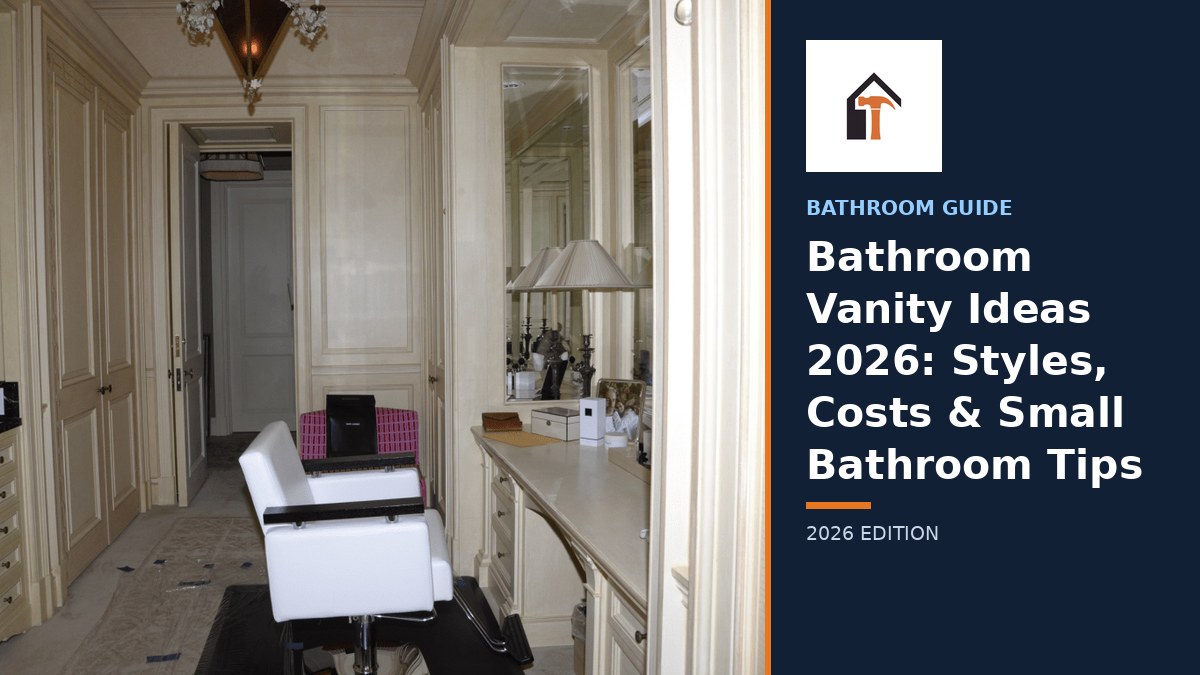
The bathroom vanity does more work than any other piece of furniture in your home. It holds the sink, hides the plumbing, stores the clutter, and sets the visual tone for the entire room. In 2026, vanity design favors clean lines, warm natural materials, and smarter storage, with floating vanities, fluted wood fronts, and integrated sink tops leading the trend. This guide pairs design ideas with real 2026 US pricing: every major vanity type, what each costs installed, which width fits your bathroom, practical small-space tips, and an honest DIY versus pro breakdown.
Quick Answer: Vanity Types and 2026 Costs
A freestanding vanity sits on the floor like a small cabinet and is the most common and affordable option at $350 to $1,200 installed. A floating vanity mounts to the wall with open space beneath, making small bathrooms feel larger, at $500 to $1,800 installed. A double vanity with two sinks suits master bathrooms at $900 to $3,000 installed. A console vanity with an open leg frame works beautifully in powder rooms at $400 to $1,500 installed. Standard widths run from 24 inches for tiny powder rooms to 60 inches for double-sink master baths. Cabinet material, countertop choice, and whether plumbing must move are the three factors that push a project toward the high or low end of these ranges.
Vanity Type Comparison Table
| Vanity Type | Description | Common Widths | 2026 Installed Cost |
|---|---|---|---|
| Freestanding | Cabinet base on the floor; classic furniture look | 24″, 30″, 36″, 48″, 60″ | $350 – $1,200 |
| Floating | Wall-mounted; modern, airy, easy to clean under | 24″, 30″, 36″, 48″ | $500 – $1,800 |
| Double | Two sinks in one wide cabinet; master bath standard | 48″, 60″, 72″ | $900 – $3,000 |
| Console | Open leg frame; slim, vintage-inspired, minimal storage | 24″, 30″, 36″ | $400 – $1,500 |
Cost by Type: Cabinet, Top, and Installation
Freestanding Vanity: $350 to $1,200 Installed
Stock cabinets in 24 to 36 inch widths cost $150 to $400, while semi-custom and furniture-style solid wood pieces run $400 to $700. A cultured marble top with integrated sink adds $100 to $300, granite $200 to $500, and quartz $250 to $600. Professional installation runs $150 to $450, covering removal of the old vanity, leveling, drain and supply connections, and caulking. As the simplest type to install, this is where DIY saves the most money.
Floating Vanity: $500 to $1,800 Installed
Wall-hung cabinets in 24 to 48 inch widths run $250 to $1,000, with oak veneer, walnut, and matte lacquer at the top. Tops follow freestanding pricing at $150 to $800. Labor is the real driver: the cabinet must anchor into studs or solid blocking, and adding blocking to a finished wall means opening drywall, patching, and painting, pushing installation to $200 to $600. In new construction or a full remodel with open walls, the premium nearly disappears.
Double Vanity: $900 to $3,000 Installed
Cabinets in 48 to 72 inch widths cost $400 to $1,800, with solid wood construction and soft-close drawers at the top. A 60 inch double-bowl cultured marble top runs $300 to $600; quartz or granite with two undermount sinks runs $600 to $1,200. Installation is $250 to $700 for two drain assemblies and faucet sets. Converting from single to double plumbing adds $300 to $800, the most common budget surprise in this category.
Console Vanity: $400 to $1,500 Installed
Metal or wood leg-frame bases cost $250 to $900, with brass, matte black, and chrome the popular 2026 finishes. The fully visible top becomes the visual star, so many homeowners splurge on marble at $200 to $700. Installation is the simplest of all types at $100 to $300. The tradeoff is storage: with no cabinet, console vanities suit powder rooms and guest baths far better than busy family bathrooms.
Vanity Size Guide: 24″, 30″, 36″, 48″, 60″
Measure your available wall space, then subtract at least 4 inches of clearance on each side for comfortable movement and door swings.
24 Inch: Powder Rooms and Tiny Baths
The smallest practical size, fitting a single small sink with minimal storage. A 24 inch console or floating model works best, since a bulky cabinet looks cramped at this width. Expect $350 to $800 installed. If your bathroom is under 40 square feet, this is likely your size.
30 Inch: Apartments and Small Full Baths
The sweet spot for small full bathrooms and kids baths: a standard single sink, usable counter space, and a workable mix of cabinet and drawers. Also the most common replacement size in older homes. Installed cost runs $400 to $1,000. A 30 inch floating vanity is one of the best small-bathroom upgrades available.
36 Inch: The Most Popular Size
A full-size single sink with generous counter space on both sides, or an offset sink leaving one long counter stretch. Storage is genuinely useful: two doors plus drawers is standard. Suits hall baths, guest baths, and primary baths in modest homes at $450 to $1,300 installed. When torn between 30 and 36 inches, choose 36 if the wall allows.
48 Inch: Roomy Single or Compact Double
As a single sink, it delivers luxurious counter space and deep storage. As a double, each user gets 24 inches, which works but feels snug, better for kids baths than a busy master. Single-sink models cost $600 to $1,600 installed; doubles run $900 to $2,200. Tape the outline on your floor and test the elbow room before choosing the double layout.
60 Inch: The Double-Sink Standard
The classic master bathroom width, giving each sink 30 inches of personal space with shared counter in the middle. Nearly all 60 inch vanities are doubles. Expect $1,000 to $3,000 installed. At this width, drawers beat doors: deep drawers on each side keep two users supplies separated, with a center stack for shared items.
Small Bathroom Vanity Tips
1. Float It to Free the Floor
A wall-mounted floating vanity is the single most effective trick for a small bathroom. Revealing the floor tile underneath removes visual bulk and makes the room read noticeably larger, while also simplifying mopping. Budget $500 to $1,200 for a 24 or 30 inch floating model installed.
2. Go Light, Bright, and Reflective
White, soft gray, pale oak, and light beige vanities reflect light and recede visually, while dark finishes advance toward the viewer and shrink the room. Pair a light vanity with a mirror spanning nearly the full vanity width to double the perceived space. Gloss or satin finishes reflect slightly more light than flat matte.
3. Steal Counter Space with the Right Sink and Faucet
A wall-mounted faucet frees the deck area behind the sink, and a compact vessel or semi-recessed sink leaves usable counter on both sides. If you prefer an integrated top, choose one with the bowl set toward the back to preserve a usable ledge in front. In a tiny bath, these small moves decide whether there is room for daily items or just clutter.
4. Consider Narrow-Depth and Corner Models
Standard vanities are 21 inches deep, but 16 to 18 inch narrow-depth models can rescue a bathroom with tight door swings or toilet clearance. Corner vanities, usually 24 to 30 inches across the front, tuck into dead corner space and cost $400 to $900 installed.
5. Use Vertical Storage to Compensate
A small vanity means small storage, so move upward. A mirrored medicine cabinet adds hidden storage without stealing floor space. Open shelves above the toilet or a tall narrow linen tower absorb the overflow of towels and toiletries. Keep the vanity zone visually light and push bulk storage to the walls.
6. Keep Plumbing Where It Is
Moving drain or supply lines typically costs $300 to $800 and can snowball into wall and floor repairs. A new vanity aligned with your existing rough-in keeps the project a one-day swap. This matters most with floating vanities, where the drain must land precisely behind the cabinet, so measure twice against the spec sheet before ordering.
DIY vs Pro Installation
Replacing a like-for-like freestanding vanity is one of the most approachable bathroom DIY projects. With the plumbing staying put, a handy homeowner finishes in 3 to 5 hours using an adjustable wrench, a level, a caulk gun, and silicone. DIY saves $150 to $450 in labor, which is meaningful on a tight budget. The critical skills are shutting off supply valves, disconnecting the P-trap without cracking old pipes, and setting the vanity perfectly level so the sink drains correctly.
Hire a pro when the project involves moving drain or supply lines, installing a floating vanity that needs wall blocking, converting single to double sinks, or dealing with corroded valves and galvanized pipes. A licensed plumber or experienced handyman charges $150 to $700 depending on complexity, usually including haul-away of the old vanity. If your shutoff valves have not been turned in years, have a pro on standby, because a valve that snaps off turns a Saturday project into an emergency call. The smart split: DIY the straightforward freestanding swap, hire a pro for anything involving the wall, the floor, or a second sink.
Frequently Asked Questions
How much does it cost to replace a bathroom vanity in 2026?
A standard freestanding single-sink replacement costs $350 to $1,200 including cabinet, top, and pro installation. Floating models run $500 to $1,800 and doubles $900 to $3,000. Moving plumbing adds $300 to $800. A budget DIY swap with a stock 30 inch vanity can come in under $400 all in.
What size vanity is best for a small bathroom?
For bathrooms under 50 square feet, a 24 or 30 inch vanity is the right call. The 24 inch suits powder rooms with minimal storage needs; the 30 inch gives a small full bath a real sink, counter space, and drawers. For extremely tight floors, choose a floating or narrow-depth 18 inch model. Measure your wall width and subtract 8 inches total for side clearance before ordering.
Are floating vanities worth the extra cost?
In small bathrooms, yes. The visible floor space makes the room feel larger, cleaning is easier, and the modern look matches 2026 trends, which helps resale appeal. The premium is $100 to $400 over a comparable freestanding model, mostly in installation. The case is weakest in large bathrooms and homes with plaster walls where adding blocking gets expensive. With walls already open during a remodel, the extra cost nearly vanishes.
Can I install a bathroom vanity myself?
Yes, for a like-for-like freestanding replacement with no plumbing changes. Most DIYers finish in half a day and save $150 to $450. Hire a professional for floating vanities needing wall reinforcement, double-sink conversions, and any project with old or corroded valves, supply lines, or drain pipes. A simple pro install is often cheaper than fixing a DIY mistake involving water.
What is the most durable countertop for a bathroom vanity?
Quartz is the best all-around 2026 pick: nonporous, stain-resistant, and maintenance-free under daily moisture. Granite is equally tough but needs periodic resealing. Cultured marble and solid-surface tops are the budget choice at $100 to $300 and perform well, though they scratch more easily. Natural marble looks stunning but etches on contact with acidic products, so reserve it for low-traffic powder rooms.
How We Estimated These Costs
These 2026 US national planning estimates rest on two anchor sources. Cabinet and countertop pricing reflects current retail listings from Home Depot across stock, semi-custom, and furniture-style vanities in 24 to 60 inch widths, plus cultured marble, granite, and quartz tops. Installation labor ranges are benchmarked against Angi 2026 national average cost data for vanity installation, adjusted for floating mounts and double-sink plumbing. Coastal metros typically run 15 to 30 percent above these figures; rural markets run below. Figures assume no structural repair and no plumbing relocation unless noted. Get two to three local quotes before committing, and treat every number here as a planning range, not a bid.
Choosing the right vanity comes down to three decisions in order: the width your space allows, the type that matches how you use the bathroom, and the materials that fit your budget and maintenance tolerance. Get those three right and the style almost takes care of itself. Start by measuring your wall space and checking plumbing locations, then set a realistic budget from the tables above before falling in love with a showroom piece.