By Muhammad Haroon · Updated October 8, 2026
Transparency: Renovation Guide HQ carries no affiliate links. Every cost figure below is either linked to its published source or clearly labeled as a planning estimate. If you need contractor quotes, contact us and we will point you in the right direction.
Quick Answer: What Does a Walk-In Shower Cost in 2026?
Cost Insights
A walk-in shower typically costs $4,000–$12,000 in 2026 (planning estimate, anchored on published data below). Angi’s 2026 data puts the average shower installation at $8,204, with most homeowners spending $4,448–$12,373, and lists walk-in showers specifically at $1,150–$8,000. A separate This Old House 2026 survey found a wider $4,000–$20,000 spread averaging about $12,000, while a bathroom-industry guide citing Angi 2026 figures lands at $6,000–$12,000 with a $9,000 average. A basic prefab kit installed runs 2–3 days; a custom tiled walk-in takes 3–5 days of active work, and a complex curbless build can run 1–3 weeks.
Why the Sources Disagree
The three most-cited guides do not agree on one number, because they were published at different times and count different things. Lily Ann Cabinets compared all three on October 5, 2026.
| Source | Last updated | Walk-in shower range | What the figure covers |
|---|---|---|---|
| This Old House | Mar 12, 2026 | $4,000–$20,000 | About $12,000 on average; tiers include glass, waterproofing and labor |
| The Spruce | Jul 19, 2024 | $1,150–$8,000 | $6,700 on average; the low end is a small prefab kit with plumbing already in place |
| Bob Vila | Apr 18, 2024 | $4,200–$8,500 | $8,000 is the average for any shower remodel, not only walk-ins |
Source: Lily Ann Cabinets, “Walk-In Shower Cost in 2026: Install and Tub Conversion,” Oct 9, 2026, comparing This Old House, The Spruce and Bob Vila.
What’s included in each figure — check before you compare two quotes:
- Glass and enclosure: included in This Old House’s tiers; not in a prefab kit price.
- Waterproofing and labor: included in This Old House’s tiers.
- Permits, disposal and drain work: check whether the quote includes them — in this guide’s worked example they are separate line items.
- Prefab kit or custom tiled build: the Spruce’s low end is a small prefab kit; This Old House’s high end is a custom tiled build.
Walk-In Shower Cost by Type
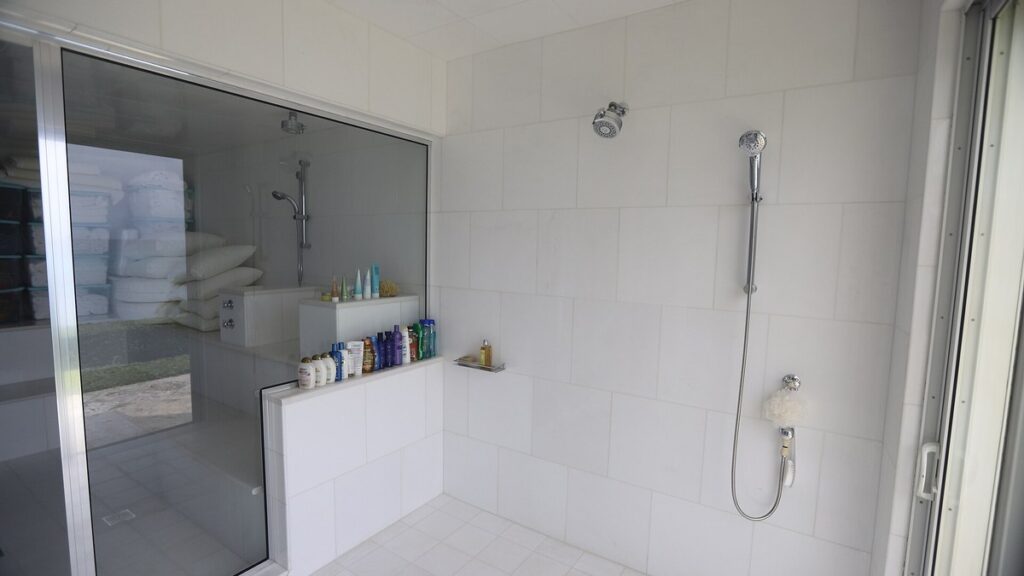
The single biggest cost driver is what kind of shower you build. A prefab insert dropped into an existing alcove and a curbless, frameless-glass, stone-tiled showpiece are barely the same project.
| Shower type | Installed cost | Source |
|---|---|---|
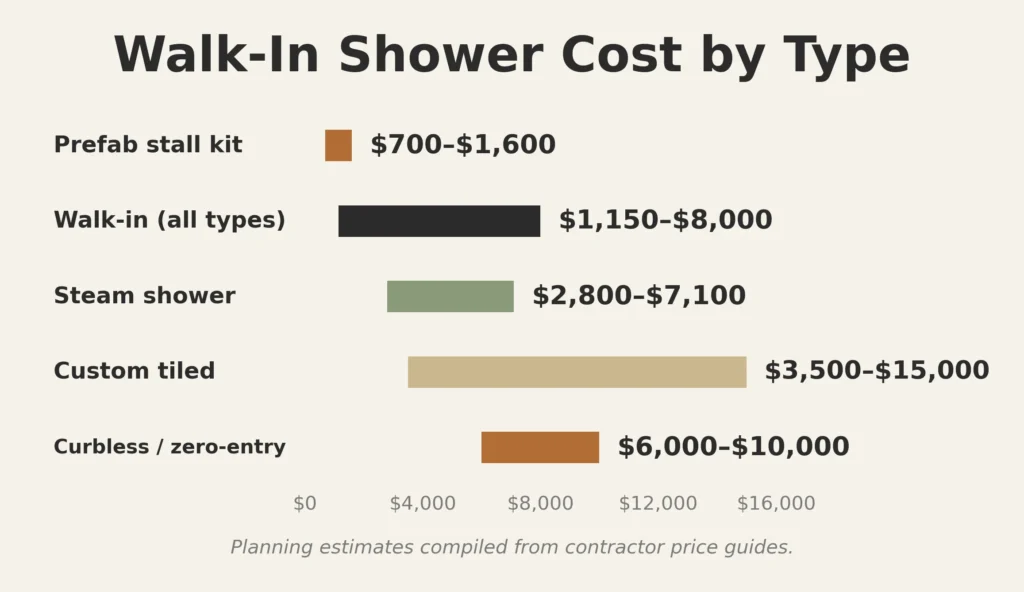
| Prefab shower stall kit (installed) | $700–$1,600 | HomeBuddy 2026 |
| Walk-in shower, all types | $1,150–$8,000 | Angi 2026 |
| Walk-in shower (avg, labor + materials) | $4,200–$8,500 | Angi 2026 |
| Custom tiled walk-in | $3,500–$15,000 | HomeBuddy 2026 |
| Curbless / zero-entry walk-in | $6,000–$10,000 | HomeBuddy 2026; costtorenovate.com via SeekingVault |
| Accessible / ADA-style shower | $1,750–$8,600 | Angi 2026 |
| Barrier-free (roll-in style) | $3,000–$6,000+ | Angi 2026 via SeekingVault |
| Wet room | $2,000–$30,000 | Angi 2026 |
| Steam shower | $2,800–$7,100 | Angi 2026 |
Modernize’s 2026 shower cost calculator independently puts walk-in showers at $3,000–$10,200, which sits comfortably inside the bands above.
Walk-In Shower Material Costs
Angi’s 2026 material prices show how much the wall surface alone moves the budget. These are material prices — labor, waterproofing and glass are extra.
| Material | Cost | Source |
|---|---|---|
| Acrylic | $500–$2,000 | Angi 2026 |
| Fiberglass | $400–$2,000 | Angi 2026 |
| Tile | $2–$17 per sq ft | Angi 2026 |
| Marble | $10–$35 per sq ft | Angi 2026 |
| Cultured granite / Corian | $40–$65 per sq ft | Angi 2026 |
Source: Angi, “How Much Does a Walk-In Shower Cost? (2026 Data),” updated Oct 30, 2026. This Old House’s 2026 component prices are in the same range: ceramic or porcelain tile $12–$30 per sq ft installed, and natural stone $20–$50 per sq ft installed.
Extra Features & Add-Ons
Angi’s 2026 figures for the extras homeowners ask about most. Add these to the base shower price — a steam system alone can cost more than a basic prefab kit.
| Feature | Typical cost | Source |
|---|---|---|
| Built-in shelves | $75–$700 | Angi 2026 |
| Grab bar | $100–$500 | Angi 2026 |
| Rainfall showerhead | $100–$1,000 | Angi 2026 |
| Dual showerheads | $100–$1,000 | Angi 2026 |
| Steam shower system | $1,500–$11,700 | Angi 2026 |
Source: Angi, “How Much Does a Walk-In Shower Cost? (2026 Data),” updated Oct 30, 2026. Angi notes luxury upgrades can add up to $10,000 to a project.
Budget Tiers: What $3K, $10K, and $20K Buy
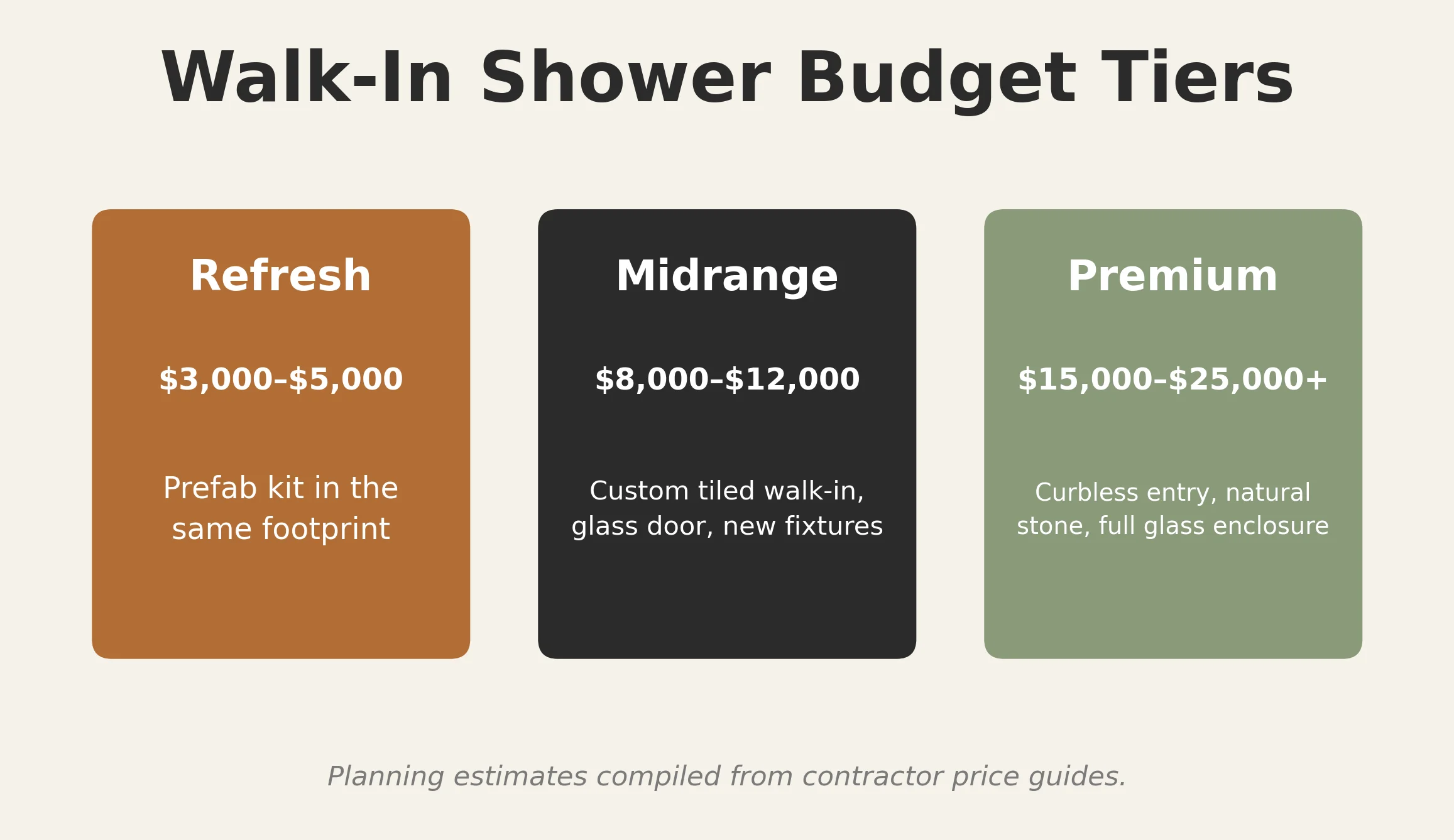
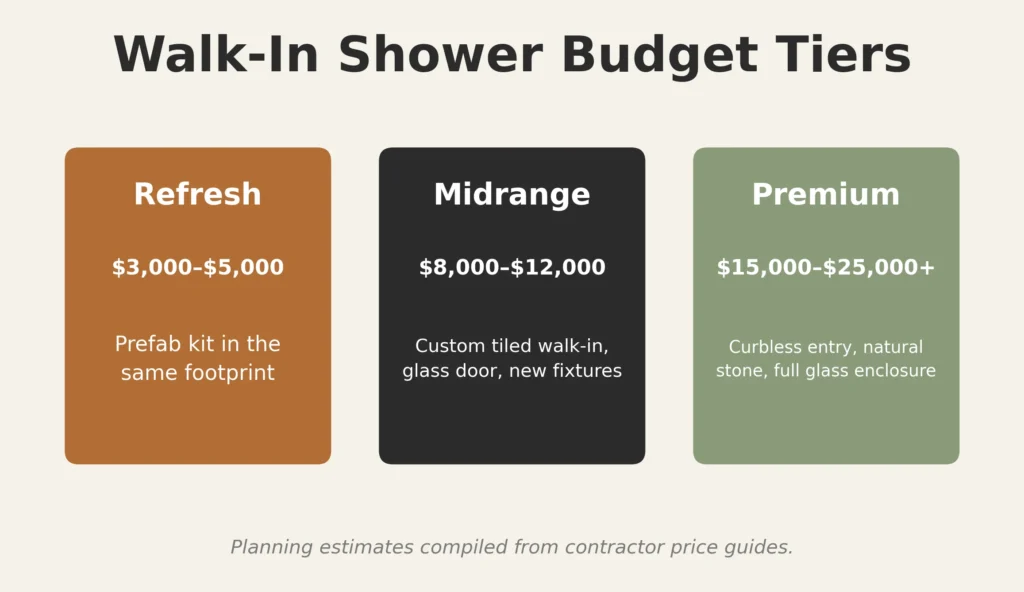
Refresh tier: $3,000–$5,000 (planning estimate)
A prefabricated acrylic or fiberglass walk-in unit set into the existing footprint — same drain location, same walls. You get a low-threshold entry, a basic glass door or curtain, and new fixtures. This is the fastest route: typically 2–3 days installed.
Midrange tier: $8,000–$12,000 (planning estimate)
A custom tiled walk-in with a proper waterproofing system, a frameless or semi-frameless glass door, and upgraded fixtures. This is where most homeowners land — about $9,000 on average per 2026 industry data. Expect roughly a week of calendar time once tile curing and glass fabrication are included.
Premium tier: $15,000–$25,000+ (planning estimate)
Curbless entry with a linear drain, floor-to-ceiling natural stone or large-format tile, full frameless glass enclosure, and extras like a built-in bench, niche shelving, and a rain head. Complex builds with plumbing relocation run 1–3 weeks.
A Worked Example: 36″ × 60″ Tiled Walk-In
Here is what a mid-range custom walk-in shower can look like as a line-item budget. Every line below is a planning estimate anchored to the published component ranges cited in this guide; the total is the point — it sums correctly so you can sanity-check contractor quotes against it.
| Line item | Cost |
|---|---|
| Demo + disposal of old tub/shower | $500 |
| Plumbing rough-in + drain upsizing (1.5 in to 2 in) | $1,500 |
| Shower pan / tile-ready base | $800 |
| Waterproofing membrane system | $500 |
| Wall + floor tile, installed | $2,700 |
| Frameless glass door | $1,400 |
| Valve, showerhead, trim | $500 |
| Built-in bench + niche | $400 |
| Permit + inspection | $300 |
| Subtotal | $8,600 |
| Contingency (15%) | $1,290 |
| Total | $9,890 |
The 15% contingency is not padding — contractor-published 2026 guidance recommends 15–20% for shower conversions, because water damage and mold behind old walls are discovered after demo, not before. Fixr’s 2026 data puts mold remediation alone at $500–$1,500.
Hidden Costs
You can’t see behind a tub until it is gone. In This Old House’s 2026 survey, most tub-to-shower conversions hit at least one surprise — Lily Ann Cabinets puts it at nearly 70% of conversions.
| Surprise | How often | Typical cost |
|---|---|---|
| Structural repairs | 38% of conversions | Varies with the extent — hold back 10–20% of the budget (This Old House) |
| Water damage behind walls | 32% of conversions | $500–$4,500 (Fixr 2026, as cited in this guide) |
| Unplanned plumbing upgrades | 29% of conversions | Moving a drain $900–$1,100 (This Old House); plumbing additions $600–$1,600 (Angi 2026) |
Source: Lily Ann Cabinets, “Walk-In Shower Cost in 2026: Install and Tub Conversion,” Oct 9, 2026, reporting This Old House’s 2026 survey of 1,000 homeowners. Mold is the other classic find: Fixr’s 2026 data puts mold remediation at $500–$1,500, and Bob Vila puts mold cleanup at $1,100–$3,400 — both cited by Lily Ann Cabinets. This Old House recommends holding back 10–20% of the budget for surprises.
7 Cost Factors That Move Your Quote
1. Shower size
Costs scale roughly with square footage — more tile, more waterproofing, more labor. A standard 36″ × 60″ alcove conversion is the budget baseline; expanding beyond the old tub’s footprint means new subfloor work and often a drain relocation, which is where quotes jump.
How size moves the price, using this guide’s own bands and published 2026 size data:
| Size | Typical installed cost | Source |
|---|---|---|
| Compact — 32″×32″ to 34″×36″ | $1,000–$5,000 (prefab $1,000–$3,000; custom $3,000–$5,000) | Modernize 2026 |
| Standard — 36″×48″ to 36″×60″ | About $7,000 for 36″×48″; $9,890 for this guide’s 36″×60″ tiled example | Modernize 2026; this guide |
| Large / expanded — 48″×60″ or larger | $9,000–$12,000+; high-end custom $14,000–$20,000+ | Modernize 2026; This Old House 2026 |
Size is only part of the price — a large prefab kit can cost less than a small custom-tiled shower. Sources: Modernize, “How Much Does a Walk-In Shower Cost in 2026? By Size and Type,” updated Nov 3, 2026; This Old House, “How Much Does a Walk-In Shower Cost? (2026 Pricing),” updated Oct 7, 2026.
2. Tile vs. prefab walls
Wall material is the second-biggest lever after size. Component data puts wall materials anywhere from $500 for a prefab acrylic surround to $5,000 for natural stone. Ceramic and porcelain tile sit in the middle and are the most common choice for custom walk-ins.
3. Glass: framed vs. frameless
The door or enclosure is a line item many homeowners underestimate. Angi’s 2026 figures put a frameless door at $1,400 on average, with most spending $1,000–$2,500; glass runs $35–$70 per square foot and installation labor $50–$100 per hour. HomeGuide’s 2026 data (389 reported projects) shows frameless installed at $600–$1,900 versus roughly $400–$1,000 for a framed door. A doorless walk-in design skips this cost entirely but needs careful sloping so water stays in the shower.
4. Plumbing: same spot vs. relocated
Keeping the drain and valve where they are is the cheapest move — contractor guidance notes that staying in the existing footprint and handling demo yourself can save $500–$1,500. Moving the drain (required for most curbless designs and linear drains) means opening the floor, re-sloping, and upsizing the drain line from the tub’s 1.5-inch pipe to a 2-inch shower drain — roughly $500–$1,000 (planning estimate) before anything cosmetic happens.
5. Waterproofing system
This is the invisible work that determines whether the shower lasts 25 years or 5. A sheet-membrane system (Schluter KERDI, Wedi, or equivalent) over cement board or foam panels is the professional standard. Materials run $200–$600 (planning estimate); the labor is folded into the tile install. Skimp here and you are buying the shower twice.
6. Labor share
Labor is the biggest slice of any walk-in shower project. 2026 contractor data puts labor at 50–60% of the total budget, with plumbers and installers charging $100–$200 per hour. Component breakdowns show labor at $1,000–$4,000 depending on scope. Custom tile and curbless builds are labor-heavy; prefab kits are material-heavy.
Angi’s 2026 pro rates for the three trades a walk-in shower usually needs:
| Pro | Typical cost | Source |
|---|---|---|
| Bathroom contractor | $400–$2,000 (excluding materials) | Angi 2026 |
| Plumber | $45–$200 per hour (shower plumbing additions $600–$1,600) | Angi 2026 |
| Tile installer | $30–$120 per hour (tile installation $3–$15 per sq ft, plus materials) | Angi 2026 |
Source: Angi, “How Much Does a Walk-In Shower Cost? (2026 Data),” updated Oct 30, 2026. Hiring pros costs more than DIY, but a plumber can install the drain and shower in a few days, while doing it yourself can take much longer.
7. Hidden conditions
Rot, mold, and outdated plumbing hide behind old shower walls. Fixr’s 2026 figures list mold remediation at $500–$1,500 and water-damage repair at $500–$4,500 for an average bathroom. Pre-1978 homes may also trigger lead-safe work rules under the EPA’s Renovation, Repair, and Painting program, and pre-1980 homes can harbor asbestos in old tile or insulation — both are pro-only situations.
Regional Cost Differences
Labor rates and permit fees drive most regional variation. Published 2026 regional bands for walk-in showers: West Coast $5,000–$15,000, Northeast $4,500–$12,000, South $3,500–$10,000, Midwest $3,000–$8,000. As a concrete local example, a Denver-metro 2026 guide reports $1,936–$10,403 for walk-in showers of all types locally, versus $6,000–$12,000 nationally. Treat your own market as a band, not a number — get three local quotes.
DIY vs. Hiring a Pro
A walk-in shower sits at skill level 4 out of 5 for DIY. HomeGuide notes that an experienced DIYer can handle a basic prefab install, but plumbing and electrical work require professional expertise, and many manufacturers require pro installation to keep the warranty valid.
Realistic DIY math: materials alone for a DIY walk-in run $500–$2,000 depending on complexity (component data), versus $1,500+ (planning estimate) for even a basic pro-done conversion. The saving is real, but so is the risk: waterproofing mistakes do not show up until the subfloor rots, years later.
Where DIY is flatly a bad idea: drain relocation and new supply lines (permit + inspection required in most municipalities), any electrical work for lighting or heated floors, and anything involving suspected mold, lead paint (pre-1978), or asbestos (pre-1980). A safe middle path many homeowners take: do the demo yourself and hire licensed pros for plumbing, waterproofing, and tile.
What Homeowners Told Us
In This Old House’s 2026 survey of 1,000 homeowners who had completed a bathroom renovation:
- 51% hired licensed professionals for the work.
- 37% said the project took 3–4 weeks.
- 64% felt the renovation increased their home’s overall value.
Source: This Old House, 2026 survey (updated Oct 7, 2026). These are This Old House’s survey results — not a Renovation Guide HQ survey.
Accessibility & Seniors
An accessible walk-in shower is built around four things — and it costs more than a basic one because of the floor work and the safety parts (Lily Ann Cabinets, Oct 9, 2026):
- Grab bars: about $100–$500 each (Angi 2026); this guide lists $100–$350+ each (HomeGuide).
- Bench or fold-down seat: a built-in bench runs $250–$1,000 (this guide); a fold-down seat is about $300–$800 (Modernize 2026).
- Handheld shower: about $100–$300 (Modernize 2026).
- Curbless / roll-in entry: a curbless conversion runs $8,000–$15,000+ (Modernize 2026); a roll-in shower needs at least 30″×60″ with no curb, and a transfer shower at least 36″×36″ with a seat (Modernize 2026).
Coverage: Original Medicare doesn’t usually pay for bathroom remodels (Modernize, Nov 3, 2026), and a walk-in shower is generally treated as a home improvement, not durable medical equipment (Lily Ann Cabinets, Oct 9, 2026). Some Medicare Advantage plans, Medicaid waiver programs and VA home-modification grants may help eligible people with accessibility work — check eligibility with the program before budgeting, as rules vary.
Step-by-Step: How a Walk-In Shower Gets Built
- Demo (1 day): Remove the old tub or shower, surround, and any damaged drywall. Haul-away and disposal typically run $150–$1,000 (planning estimate).
- Rough plumbing (1–2 days): Relocate or upsize the drain, set the valve height, add body-spray or rain-head lines if planned. Inspection happens here in most jurisdictions.
- Subfloor and framing prep (1 day): Sister or level joists, build the sloped shower floor bed or set the prefab pan, install blocking for grab bars and glass.
- Waterproofing (1–2 days + cure time): Install the membrane system over walls and floor. Liquid membranes need 12–24 hours to dry before tile goes on.
- Tile (2–5 days): Set floor tile with proper slope to the drain, then walls. Grout needs 24–48 hours to cure before the shower sees water.
- Glass and fixtures (1–2 days): Set the valve trim, showerhead, and accessories. Frameless glass is measured after tile is done and typically fabricated off-site, which can add a week to the calendar.
- Final inspection and caulk: Seal all corners and penetrations with silicone, run the shower, and check for leaks before sign-off.
The same seven steps as a table, with the days from the step list above:
| Phase | Duration | What happens |
|---|---|---|
| Demo | 1 day | Remove the old tub or shower, surround, and any damaged drywall; haul away |
| Rough plumbing | 1–2 days | Relocate or upsize the drain, set the valve height, add body-spray or rain-head lines if planned |
| Subfloor and framing prep | 1 day | Level joists, build the sloped floor bed or set the pan, add blocking for grab bars and glass |
| Waterproofing | 1–2 days + cure time | Membrane over walls and floor; liquid membranes need 12–24 hours to dry before tile |
| Tile | 2–5 days | Set floor tile sloped to the drain, then walls; grout needs 24–48 hours to cure |
| Glass and fixtures | 1–2 days | Valve trim, showerhead, accessories; frameless glass is measured after tile and fabricated off-site |
| Final inspection and caulk | — | Seal all corners and penetrations with silicone, run the shower, and check for leaks before sign-off |
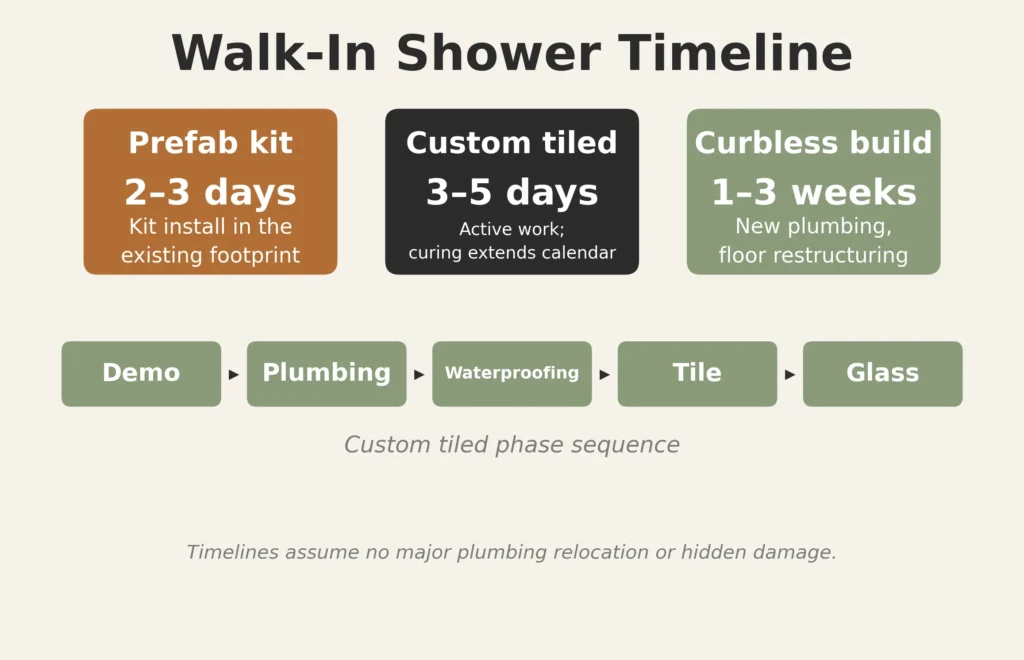
All-in timelines: 2–3 days for a prefab kit, 3–5 days of active work for a standard custom tiled shower, and 1–3 weeks for a complex curbless build with new plumbing. HomeGuide similarly notes complete installs take 1–3+ days, stretching to 1–2 weeks with custom tile work.
Materials & Tools: What Goes Into the Project
- Shower pan or tile-ready base: $300–$1,500 (component data); $500–$3,500 installed per HomeGuide.
- Wall system: prefab acrylic surround ($500-ish low end, planning estimate) through ceramic/porcelain tile to natural stone ($5,000 high end).
- Waterproofing membrane: $200–$600 in materials (planning estimate) — sheet membrane plus sealant, corners, and pipe seals.
- Glass door or panels: $400–$1,900 installed (HomeGuide); frameless averages $1,400 (Angi).
- Valve, showerhead, trim: basic sets $200–$900; high-end fixtures $650–$1,500+ (HomeGuide).
- Bench, niche, grab bars: built-in bench or shelving $250–$1,000; grab bars $100–$350+ each (HomeGuide).
- Drain: standard center drain is cheapest; a linear drain adds material cost plus the labor of a single-slope floor bed.
- Thin-set, grout, silicone: small line items, but buy the polymer-modified thin-set the membrane manufacturer specifies — mixing systems voids warranties.
5 Common Mistakes (and How to Avoid Them)
- Skipping the flood test. Before tile goes on, the waterproofed pan should hold water for 24 hours. If the contractor resists, that tells you everything.
- Wrong floor slope. A walk-in floor needs a consistent 1/4-inch-per-foot slope to the drain — flat spots pond, steep spots feel wrong underfoot. Large-format tile on a center drain needs an envelope cut; a linear drain allows a single clean slope.
- Glass measured too early. Frameless glass is cut to the finished opening. Measure after tile, not before — walls are rarely perfectly plumb, and a 1/4-inch miss is a reorder.
- No blocking in the walls. Grab bars, benches, and heavy glass panels need solid wood blocking behind the tile. Retrofitting it later means opening the wall.
- Forgetting the curb-height code question. Some jurisdictions require a minimum curb or a specific drain setup for curbless designs. Confirm with your local building department before the design is final — a failed inspection mid-project is the most expensive kind.
Permits & Codes
In most US municipalities, a walk-in shower project that touches plumbing — drain relocation, new supply lines, a new valve — requires a permit and inspection. 2026 guidance puts permit costs at $250–$500 in most markets, and Angi-sourced data agrees on the same $250–$500 band. A like-for-like prefab swap in the same footprint sometimes does not need one, but never assume — confirm with your local building department before work starts. Unpermitted plumbing can stall a future home sale and void insurance coverage for water damage.
How to Hire a Walk-In Shower Contractor: 14 Questions to Ask
- Is demolition, disposal, waterproofing, plumbing, tile, glass, and fixtures each itemized in this quote — or bundled?
- What waterproofing system do you install, and will you flood-test the pan for 24 hours before tiling?
- Is the glass door included in this price, or quoted separately after tile is finished?
- Who pulls the permit, and are permit + inspection fees in the quote?
- What happens if you find mold or water damage behind the walls — how is that priced?
- What warranty do you provide on the waterproofing and the tile work, in writing?
- What tile allowance is in the quote, and does the pattern (large-format, mosaic, herringbone) change the labor price?
- What drain type and location are planned — center drain or linear drain — and is the floor slope included?
- How thick is the glass, and what hardware and finish are included?
- Which fixture brands and models are quoted — and can I see them in writing before you order?
- Is drywall, paint and trim repair after the shower work included, or billed separately?
- How will you protect the rest of the house, and is daily cleanup included?
- How are change orders handled if you find hidden damage — who approves the extra cost, and when?
- What written warranties cover the workmanship and the products, and for how long?
Red flags: a quote with no waterproofing line item, pressure to skip the permit, a price far below the $4,000–$12,000 typical band with no explanation, or no written warranty. Get at least three written quotes — 2026 contractor guidance stresses comparing itemized breakdowns, not just totals. Verify the license through your state’s contractor license lookup page.
Getting quotes? Tell us about your project and we will point you toward the right questions to ask local pros — contact Renovation Guide HQ.
ROI and Resale: Is a Walk-In Shower Worth It?
For bathroom projects broadly, Zonda’s 2025 Cost vs Value Report shows a midrange bathroom remodel recouping 80.0% of its $26,138 cost at resale. Walk-in showers specifically score well with buyers: analysis citing Zillow data finds walk-in showers return about $1.71 for every dollar spent, with homes selling for roughly $1,583 more on average than comparable homes without one, and mid-range conversions returning 60–74%.
The one big caveat: do not remove your home’s only bathtub. A National Association of Home Builders survey found 74% of buyers prefer a tub and shower in the primary bathroom (via a 2026 walk-in shower guide), and the same Zillow-cited analysis warns that removing the only tub can shrink your buyer pool by up to 40%. If you are converting a tub to a walk-in shower, our tub-to-shower conversion cost guide covers that project in detail — and our full bathroom remodel cost guide puts the shower in the context of the whole room.
The Bottom Line
Budget $4,000–$12,000 for a walk-in shower in 2026 (planning estimate), with about $9,000 as the realistic midpoint for a custom tiled build with a glass door. Spend the money where it is invisible — waterproofing, drain slope, and wall blocking — and economize where it is visible: a semi-frameless door instead of frameless saves hundreds with nearly the same look, and porcelain tile delivers the stone aesthetic at a fraction of the cost. Get three itemized quotes, confirm the permit situation before anyone swings a hammer, and keep at least one bathtub in the house. For the bigger picture, see our 2026 bathroom remodel cost guide.
How We Estimated These Costs
Cost figures in this guide come from published 2026 industry sources: Angi’s shower installation and frameless door cost data, HomeGuide’s project-cost database, This Old House’s 2026 homeowner survey, Modernize’s 2026 cost calculator, Fixr’s 2026 remodeling data, Zonda’s 2025 Cost vs Value Report, and contractor-published pricing guides. Ranges explicitly marked “(planning estimate)” are our synthesis of multiple published ranges, not quotes from any single source. Figures are national; your market will differ. Last updated October 2026.
Related guide: A walk-in shower is often the priciest upgrade in the room; our bathroom remodel cost guide compares it with the other big-ticket items.
Related guide: Still torn between the two layouts? Our walk-in shower vs tub comparison walks through cost, space and who each suits best.
About the Author
Muhammad Haroon, Founder & Editor, Renovation Guide HQ — Muhammad Haroon writes Renovation Guide HQ’s US renovation cost guides, comparing published contractor and industry pricing so homeowners can plan with real numbers. Every cost figure in this guide is either linked to its published source or clearly labeled as a planning estimate.
Frequently Asked Questions
How much does a walk-in shower cost in 2026?
A walk-in shower typically costs $4,000–$12,000 (planning estimate). Angi’s 2026 data averages shower installation at $8,204, with walk-in types at $1,150–$8,000, while a This Old House survey found $4,000–$20,000 averaging about $12,000. Prefab kits sit at the low end; curbless custom tile at the high end.
Is a curbless walk-in shower more expensive?
Yes. Curbless showers run $6,000–$10,000 installed (HomeBuddy 2026; costtorenovate.com), versus $3,500–$15,000 for a standard tiled walk-in. The premium comes from floor restructuring — the finished shower floor must sit flush with the bathroom floor, which usually means lowering the subfloor or raising the surrounding floor, plus precise sloping and expanded waterproofing.
How long does walk-in shower installation take?
A prefab kit installs in 2–3 days. A standard custom tiled walk-in takes 3–5 days of active work, though curing times for the waterproofing membrane, thin-set, and grout stretch the calendar to roughly 7–10 days (2026 installation guidance). Complex curbless builds with new plumbing run 1–3 weeks, and custom frameless glass fabrication can add another week.
Can I install a walk-in shower myself?
An experienced DIYer can install a prefab kit — materials alone run $500–$2,000 (component data). But drain relocation, new supply lines, and electrical work need licensed pros and permits, and waterproofing mistakes fail silently for years. Most homeowners do the demo themselves and hire pros for plumbing, waterproofing, and tile.
Do I need a permit for a walk-in shower?
In most municipalities, yes — any project that moves or adds plumbing typically requires a permit and inspection, costing $250–$500 in most markets (2026 guidance). A like-for-like prefab swap in the same footprint may not need one. Always confirm with your local building department; unpermitted work can complicate a future sale.
Will a walk-in shower hurt my home’s resale value?
Usually it helps — Zillow-cited analysis shows about $1.71 returned per dollar spent and $1,583 higher sale prices on average. The exception is removing your home’s only bathtub, which can shrink the buyer pool by up to 40% and trigger a value penalty with family buyers. Keep at least one tub somewhere in the house.
Does Medicare pay for a walk-in shower?
Usually not. Medicare’s durable-medical-equipment coverage lists items such as walkers and wheelchairs; a walk-in shower is generally treated as a home improvement, not covered equipment (Lily Ann Cabinets, Oct 9, 2026). Original Medicare doesn’t usually pay for bathroom remodels (Modernize, Nov 3, 2026). Some Medicare Advantage plans, Medicaid waiver programs and VA home-modification grants may help eligible people — check with the program before counting on it.
What are the disadvantages of a walk-in shower?
The main one is losing the bathtub. A walk-in shower helps home value only if the home keeps a tub elsewhere (Lily Ann Cabinets, Oct 9, 2026, citing The Spruce). A National Association of Home Builders survey found 74% of buyers prefer a tub and shower in the primary bath, and removing the home’s only tub can shrink the buyer pool by up to 40% (as cited in this guide). A custom tiled walk-in also costs more and takes longer than a prefab unit — 3–5 days of active work versus 2–3 days for a kit.
Is it cheaper to replace a tub or convert it to a shower?
Replacing a tub with another tub is usually cheaper than building a tiled walk-in shower (Lily Ann Cabinets, Oct 9, 2026). A tub-to-shower conversion runs $2,000–$12,000 (This Old House, Mar 2026), with a prefab conversion at the lower end of that range and a custom tiled walk-in at the top.
How much does a walk-in shower cost for seniors?
An accessible walk-in shower costs more than a basic one because of the floor work and the safety parts (Lily Ann Cabinets, Oct 9, 2026). A curbless/accessible conversion runs $8,000–$15,000+ (Modernize 2026; see the Accessibility & Seniors section above). Grab bars add about $100–$500 each (Angi 2026), a fold-down seat about $300–$800 and a handheld shower about $100–$300 (Modernize 2026).