Transparency note: This guide contains no affiliate links. Renovation Guide HQ currently earns no commissions from any product or service mentioned — every figure is cited so you can verify it yourself.
By Renovation Guide HQ · Updated October 8, 2026
Quick Answer
A bathroom remodel in 2026 costs $6,600–$17,600 for a typical project, with a national average of $12,100, according to Angi’s 2026 bathroom remodel cost data. Small refreshes start near $3,000, mid-range full remodels run $12,000–$25,000, and high-end renovations with layout changes reach $25,000–$50,000+. Most builds take 1–5 weeks depending on scope.
The bathroom is the second most expensive room to renovate — and the one where a single decision (moving the toilet or shower drain) can add thousands overnight. This guide walks through real 2026 numbers: tier tables, a worked 5×8 budget, aging-in-place costs almost nobody covers honestly, and how to hire right. Want a fast ballpark first? Try our free renovation cost estimator on the homepage, then come back for the details.
Want your own number first? Try our free Renovation Cost Calculator — pick your bathroom size and finish level and get an instant ballpark estimate, then compare it against the detailed breakdowns below.
2026 Bathroom Remodel Cost Breakdown
The table below combines Angi’s 2026 cost data with per-square-foot figures from iBuyer’s 2026 bathroom guide (citing HomeAdvisor and NerdWallet), with typical timelines added.
| Remodel tier | Typical cost | Cost per sq ft | What’s included | Typical timeline |
|---|---|---|---|---|
| Budget refresh | $3,000–$8,000 | $80–$120 | Paint, new fixtures and hardware, reglazed tub, new mirror and lighting, same layout | 1–2 weeks |
| Mid-range remodel | $12,000–$25,000 | $120–$280 | New vanity, tile shower surround, new toilet, tile or LVP flooring, exhaust fan — same footprint | 3–5 weeks |
| High-end renovation | $25,000–$50,000+ | $300–$800+ | Walk-in or curbless shower, custom vanity, premium tile, heated floors, layout changes | 6–8+ weeks |
Cost per square foot climbs fast in small bathrooms: a 5×8 hall bath has the same plumbing and electrical fixed costs as a larger bath spread over fewer square feet, so don’t be surprised when the $/sq ft looks high (planning estimate).
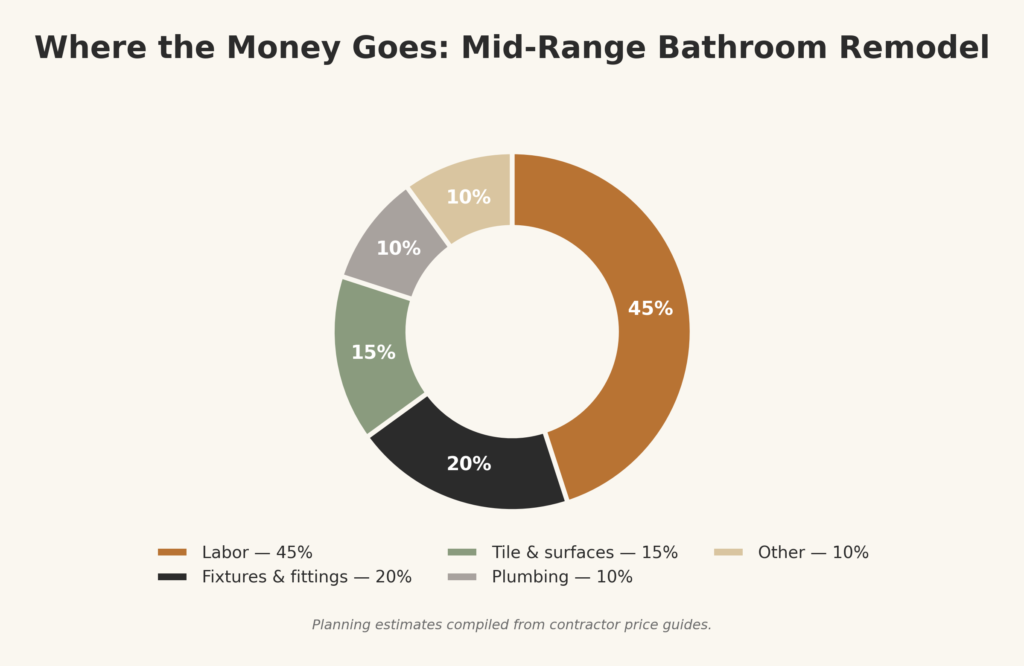
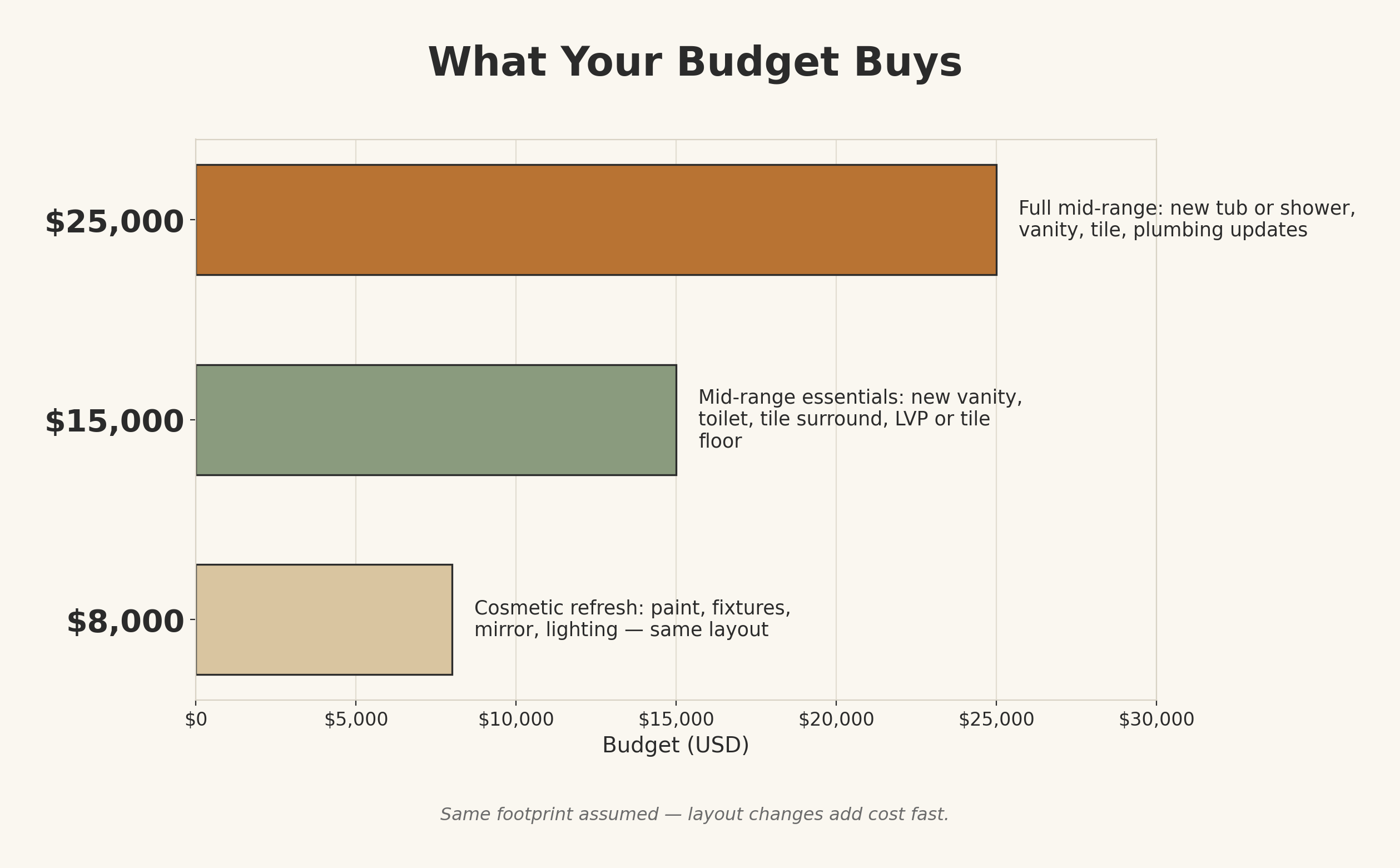
What $8,000, $15,000, or $25,000 Actually Buys
National averages are abstract. Here’s what three common budgets realistically cover — and what they don’t (planning estimates).
$8,000: the cosmetic refresh
Covers: professional tub reglazing, fresh paint, a new vanity faucet and hardware, a new mirror and light fixtures, a new toilet seat or basic toilet swap, and recaulking everything. Keep all plumbing exactly where it is.
Doesn’t cover: new tile, a new vanity cabinet, any plumbing moves, or a tub-to-shower conversion.
$15,000: the mid-range essentials
Covers: a new vanity with countertop, a tile tub surround or basic shower refresh, a new comfort-height toilet, LVP or basic tile flooring, a new exhaust fan, updated lighting, and paint — same footprint, no drain moves.
Doesn’t cover: a walk-in or curbless shower, premium stone tile, heated floors, or relocating the toilet, shower, or sink drains.
$25,000: the full mid-range remodel
Covers: a walk-in tiled shower with glass door, a quality vanity with quartz top, porcelain tile flooring, a new toilet, a quiet high-CFM exhaust fan, layered lighting, and fresh paint and trim — professionally installed, same footprint.
Doesn’t cover: moving the toilet or shower drain to a new location, custom glass or stone slab walls, or expanding the bathroom’s footprint.
Rule of thumb: in bathrooms, the drain decides the budget. Moving a toilet or shower drain means opening the floor and rerouting plumbing — that single change can jump you an entire budget tier. Keep the wet wall where it is and your money goes twice as far.
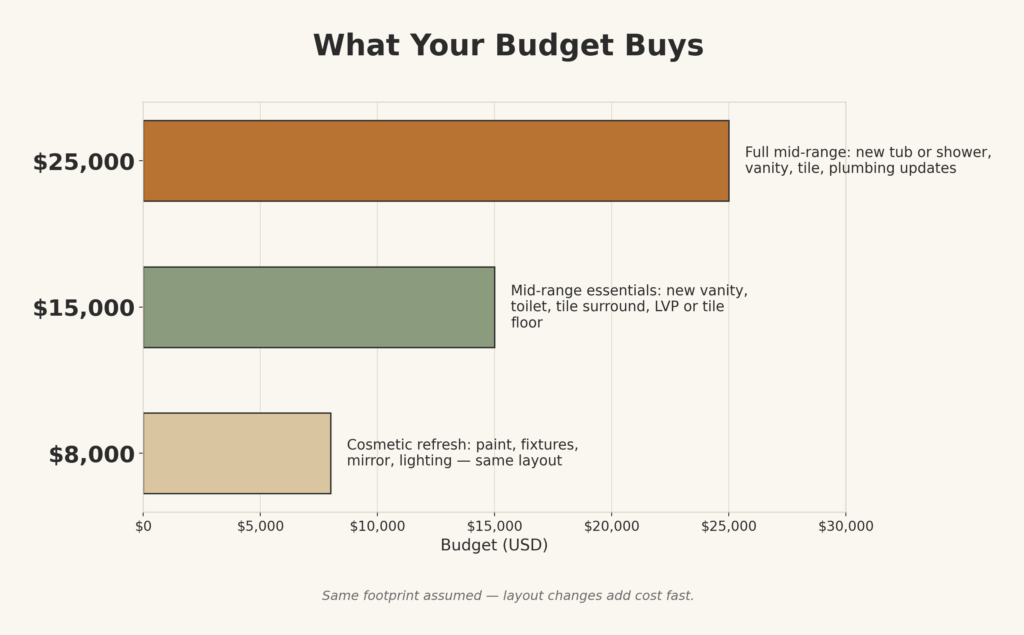
Where the Money Goes: Component Costs
Component ranges below mix verified 2026 figures with planning estimates compiled from contractor price guides. Use them to sanity-check bids, not as quotes.
| Component | Typical range (installed) | Notes |
|---|---|---|
| Walk-in shower (tiled, glass door) | $4,449–$12,373 | Angi’s 2026 shower data averages $8,205; basic acrylic units start near $1,150 |
| Tub-to-shower conversion | $1,200–$8,000 | Angi 2026; average around $3,000 for a straightforward swap |
| Vanity + countertop + faucet | $400–$2,200 | Angi’s 2026 vanity data averages $1,500 installed |
| Shower wall tile | $1,800–$5,000 | Tile itself runs $7–$25 per sq ft installed (planning estimate) |
| Floor tile | $10–$30 per sq ft | A 40 sq ft bath runs roughly $400–$1,200 in tile labor and materials (planning estimate) |
| Toilet (comfort-height, installed) | $200–$600 | Basic models at the low end; one-piece and smart toilets higher (planning estimate) |
| Heated floors | $1,000–$3,000 | Electric radiant mats under tile (Angi 2026) |
| Labor (all trades) | 40–60% of total | Demo, plumbing, electrical, tile, and project management — the biggest slice |
| Exhaust fan + electrical | $300–$900 | Quiet high-CFM fan, GFCI outlets, vanity lighting (planning estimate) |
| Permits | $150–$1,000 | Angi’s 2026 small-bathroom data; varies by city and scope |
The 5×8 Hall Bath Example: A Worked Mid-Range Budget
The standard 5×8 hall bath (40 sq ft) is the industry’s bathroom benchmark — the same way the 10×12 kitchen anchors our kitchen remodel cost guide. Here’s what a professionally installed mid-range remodel of that size looks like, line by line (all figures are planning estimates):
| Line item | Planning estimate |
|---|---|
| Demolition + debris removal | $900 |
| Walk-in shower: tile surround, pan, glass door, installed | $6,200 |
| Vanity cabinet + countertop + faucet, installed | $2,200 |
| Comfort-height toilet + install | $650 |
| Floor tile, installed (40 sq ft) | $1,200 |
| Plumbing labor (valves, fixtures, connections) | $1,600 |
| Electrical: exhaust fan, GFCI outlets, lighting | $1,300 |
| Drywall repair + paint + trim | $900 |
| Mirror, towel bars, accessories | $350 |
| Permits | $400 |
| Subtotal | $15,700 |
| Contingency (15%) | $2,355 |
| Total | $18,055 |
If a contractor quotes far outside the $15,000–$22,000 band for this scope with the same footprint, ask for an itemized breakdown — something is either missing or padded.
Regional Cost Differences
Labor rates and permit fees shift bathroom prices significantly by region. High-cost coastal metros typically run 20–50% above the national baseline, while smaller cities and rural areas usually land near or just under national numbers (directional planning estimate — always calibrate with 3 local quotes).
- Northeast and West Coast metros (New York, Boston, San Francisco, Seattle): expect to pay at or above the top of every national range — tight labor markets and strict codes.
- Mid-size metros (Denver, Austin, Charlotte): often 10–20% above national averages.
- Smaller cities and rural areas: usually near or just under national numbers, with faster permitting.
7 Factors That Move Your Price Most
1. Moving plumbing (the biggest lever)
Relocating a toilet or shower drain means opening the floor slab or subfloor and rerouting waste lines — the single most expensive change in a bathroom (planning estimate: several thousand dollars added). Keeping the toilet, shower, and sink on the existing wet wall is the biggest money saver there is.
2. Shower choice
A basic acrylic tub-shower unit is the budget pick; a tiled walk-in shower with a glass door averages $8,205 installed per Angi’s 2026 data (range $4,449–$12,373). Curbless showers cost more because the floor must be recessed or ramped for drainage — see the aging-in-place section below.
3. Tile selection and coverage
Tile is where budgets quietly double. Ceramic at $7–$10 per sq ft installed versus natural stone at $20–$25+ adds up fast across a full shower surround and floor (planning estimate). Tiling to the ceiling instead of a standard 6-foot height adds roughly a third more tile labor.
4. Vanity and fixtures
A stock 36-inch vanity runs a few hundred dollars; a furniture-style double vanity with quartz top runs into the thousands. Angi’s 2026 data puts installed vanities at $400–$2,200, averaging $1,500. Faucet and hardware finishes (chrome vs. brushed brass vs. matte black) swing the fixtures line by hundreds.
5. Labor rates
Labor is 40–60% of a bathroom budget — the largest single slice. Tile setters and plumbers command the highest hourly rates in the room, and skilled tile work can’t be rushed: a waterproofed, properly sloped shower pan takes days, not hours (planning estimate).
6. Hidden water damage
Bathrooms hide the most expensive surprises in the house: rotted subfloors around toilets and tubs, mold behind shower surrounds, and corroded supply lines. Budget a 10–20% contingency on every quote (planning estimate) — bath-specific, because water finds every weakness.
7. Ventilation and electrical upgrades
An undersized or missing exhaust fan is a code and mold problem, not a luxury. If your panel needs a new dedicated GFCI circuit or the fan must be ducted through the roof instead of the soffit, budget accordingly (planning estimate).
Aging in Place: Accessibility Remodel Costs
Almost no cost guide covers this honestly — yet it’s one of the fastest-growing reasons Americans remodel bathrooms. If you’re planning to stay in your home, these are the upgrades that matter, with real 2026 numbers:
- Curbless (zero-threshold) shower: $6,000–$10,000 installed. The floor is recessed or ramped so there’s no lip to step over — the gold standard for wheelchair and walker access. Costs more than a standard shower because of the drainage and waterproofing work.
- Walk-in shower with bench and grab bars: $4,000–$20,000, averaging around $12,000, per a 2026 industry survey of accessible shower projects. A bench, handheld showerhead on a slide bar, and blocking for grab bars are the core features.
- Walk-in tub: $2,500–$8,000 installed (planning estimate). Sounds appealing, but note the honest tradeoff: you wait for it to fill and drain while seated, and it uses 40–60 gallons per bath.
- Grab bars: $150–$400 professionally installed per bar (planning estimate) — but only if there’s wood blocking behind the tile. Adding blocking during a remodel costs almost nothing; retrofitting it later means opening finished walls.
- Comfort-height toilet and lever faucets: a few hundred dollars more than standard during a remodel (planning estimate) — trivial as an add-on, annoying as a retrofit.
The smart move: even if you don’t need accessibility features today, have your contractor add grab-bar blocking behind shower and toilet walls and choose a curbless-ready pan during any mid-range remodel. It adds almost nothing now and saves thousands later. Zonda’s 2025 Cost vs. Value data backs the investment case too: a universal-design bathroom remodel averaged $42,183 and recouped 61.2% at resale — better than most upscale projects (see Zonda’s 2025 Cost vs. Value report).
DIY vs. Hiring a Pro: An Honest Breakdown
| Task | DIY skill (1–5) | Who should do it |
|---|---|---|
| Demolition (non-structural) | 2 | DIY-friendly; shut off water and power first |
| Painting walls and trim | 2 | DIY-friendly with moisture-resistant paint |
| Installing accessories (mirror, towel bars) | 1 | Easy DIY win |
| Vanity and toilet swap (same location) | 3 | Confident DIY or pro — wax rings and supply lines leak if rushed |
| Floor tile | 3 | DIY possible on small floors; shower tile hire out |
| Shower waterproofing and tile | 5 | Pro, always — a failed pan rots the subfloor silently |
| Plumbing (moving drains, new lines) | 5 | Licensed plumber, always |
| Electrical (new circuits, fan venting) | 5 | Licensed electrician, always — GFCI protection is code |
The bathroom punishes DIY mistakes more than any room except the kitchen: a slow shower-pan leak can destroy a subfloor and the ceiling below before you ever see it. A common middle path: DIY the demo, paint, and accessories; hire licensed pros for plumbing, electrical, and all shower waterproofing and tile.
Get 3 local quotes — minimum. Bathroom bids for the same scope routinely vary 20–30% between contractors (planning estimate). Contact us and we’ll point you toward the right questions to ask each one.
Step-by-Step: How a Bathroom Remodel Actually Proceeds
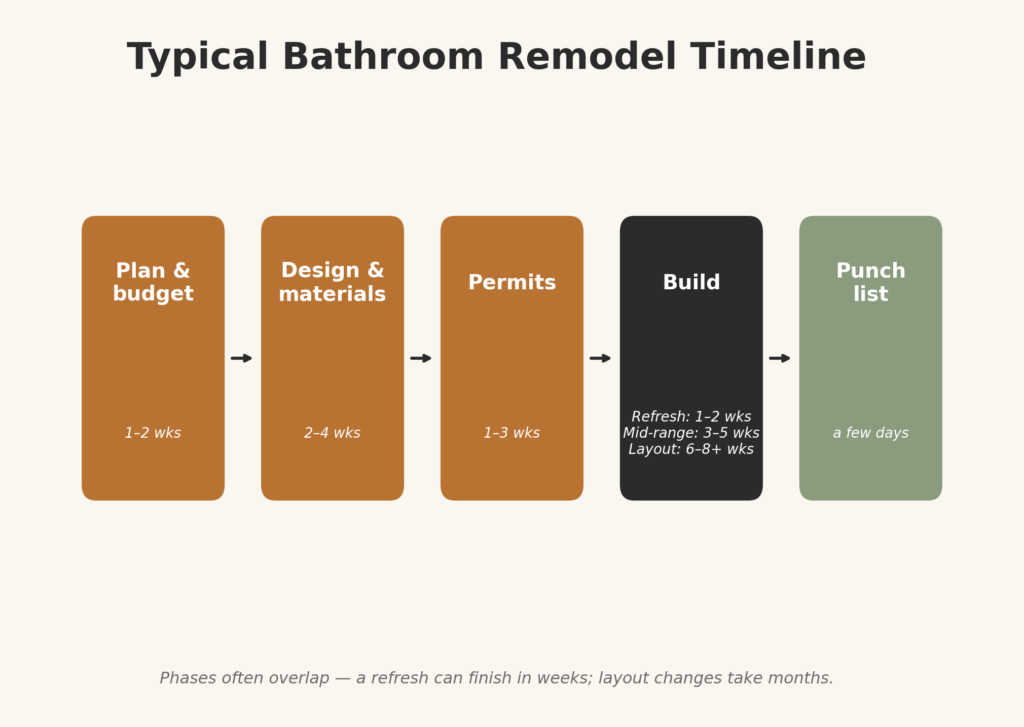
Timelines below are planning estimates — material lead times and inspection scheduling are the usual wildcards.
- Plan and budget (1–2 weeks). Define must-haves vs. nice-to-haves, set a budget with a 10–20% contingency, and get 3 itemized quotes.
- Demolition (2–4 days). Fixtures, tile, and flooring come out. This is when hidden water damage gets discovered — your contingency earns its keep here.
- Rough-in: plumbing and electrical (3–7 days). New valves, drains, circuits, exhaust fan ducting, and grab-bar blocking go in. Inspections happen before walls close.
- Waterproofing and tile (1–2 weeks). Shower pan, waterproof membrane, wall and floor tile. The most skill-intensive phase — don’t rush it.
- Fixtures and vanity (3–5 days). Toilet, vanity, faucets, shower trim, and glass door installation.
- Paint, trim, and accessories (2–4 days). Moisture-resistant paint, baseboards, mirror, towel bars, and final caulking.
- Final inspection and punch list (1–3 days). Plumbing and electrical sign-off, then a walkthrough — hold final payment until every item is done.
Realistic total timeline: cosmetic refresh, 1–2 weeks; mid-range remodel, 3–5 weeks; high-end with layout or drain changes, 6–8+ weeks from demo to done.
7 Mistakes That Blow Up Bathroom Budgets
- Skipping proper waterproofing. A $200 membrane skipped today becomes a $5,000 subfloor replacement in three years. This is the one place never to value-engineer.
- Undersizing the exhaust fan. You need roughly 1 CFM per square foot of bathroom, ducted outdoors — not into the attic. Chronic moisture grows mold that eats your remodel from the inside.
- Tiling before the plumbing inspection. If the inspector flags a drain slope issue after tile is up, you’re tearing out finished work. Rough-in first, inspect, then tile.
- No contingency for water damage. Behind nearly every old tub surround is a story. Budget 10–20% extra or you’ll make panicked decisions mid-project.
- Buying fixtures before measuring. Rough-in dimensions (like the toilet’s 12-inch standard) are unforgiving. Confirm every measurement before ordering.
- Forgetting you’re without a bathroom. A hall-bath remodel means weeks with one fewer bathroom. Plan the household logistics — or the schedule — around it.
- Over-improving for the neighborhood. A $40,000 spa bath in a starter-home neighborhood rarely returns its cost. Check comparable home prices before going high-end.
Permits, Codes & Safety
When you need a permit: moving or adding plumbing, new electrical circuits, exhaust fan ducting through the roof, or any structural change requires a permit in nearly every US jurisdiction. Permit fees for a bathroom remodel typically run $150–$1,000 depending on scope and city, per Angi’s 2026 data. Always confirm with your local building department before starting — unpermitted plumbing and electrical can void insurance claims and complicate a future sale.
When you usually don’t: purely cosmetic work — repainting, swapping a faucet for the same type, replacing a toilet in the same location, updating a light fixture on an existing circuit — typically doesn’t require one.
Lead paint: if your home was built before 1978, federal law requires contractors to be lead-safe certified when their work disturbs painted surfaces — that’s the EPA’s Renovation, Repair, and Painting (RRP) rule. Ask your contractor for their RRP certification.
Asbestos: homes built before 1980 may contain asbestos in old vinyl flooring, insulation, or joint compound. Get certified testing before you demo — never cut into suspect materials yourself.
Electrical basics: bathrooms require GFCI protection on all outlets under the National Electrical Code, and the exhaust fan should be ducted to the outdoors (never into the attic). If your bathroom has no dedicated 20-amp circuit, budget for an electrician to add one.
How to Hire a Bathroom Contractor
6 questions to ask every bidder
- Are you licensed and insured in my state? (Then verify it yourself — search for your state’s contractor license lookup page on the official state licensing board website.)
- How do you waterproof a shower — and can you walk me through your pan and membrane process?
- Who will actually be on site every day: your crew or subcontractors?
- What is the payment schedule, and what triggers each payment?
- How do you handle change orders — in writing, with pricing, before the work happens?
- What warranty do you offer on tile and plumbing labor, and for how long?
Red flags — walk away if you see these
- No proof of license or insurance, or excuses about why they “don’t need it”
- Cash-only pricing or demands for a large deposit before work starts
- No written contract — just a handshake and a start date
- Pressure to sign today for a “one-time discount”
- Can’t explain their shower waterproofing method in plain language
Get 3 quotes — minimum. Ask every bidder the same 6 questions above and compare itemized bids line by line. Contact us if you want a second set of eyes on a quote before you sign.
Bathroom Remodel ROI: What You Get Back at Resale
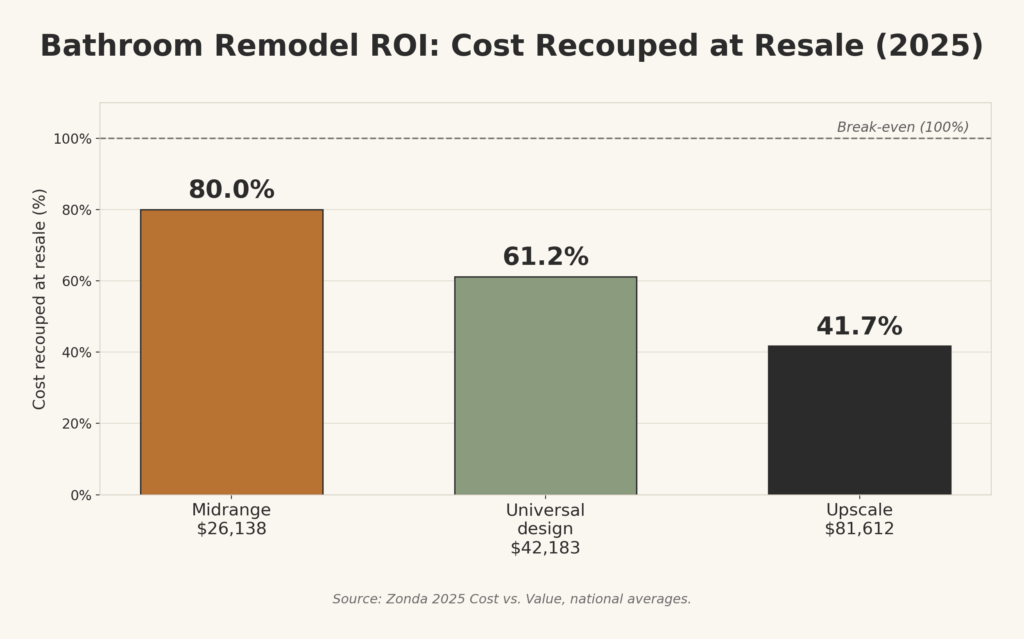
The numbers below come from Zonda’s 2025 Cost vs. Value report — national averages across 119 US markets:
| Project | Average job cost | Resale value added | Cost recouped |
|---|---|---|---|
| Bathroom remodel (midrange) | $26,138 | $20,915 | 80.0% |
| Universal design bathroom | $42,183 | $25,812 | 61.2% |
| Bathroom remodel (upscale) | $81,612 | $34,000 | 41.7% |
The pattern matches what we found in our kitchen remodel cost guide: restrained mid-range projects return a far higher percentage than upscale overhauls. A mid-range bath recoups 80 cents on the dollar nationally — one of the strongest returns in the home. These are national averages, not a promise for your market.
Financing a Bathroom Remodel
Most homeowners don’t pay cash for a full remodel. Here are the common options, in general terms — talk to a financial professional about actual terms, because rates and qualification rules change:
- Cash or savings: the cheapest option for refreshes under about $8,000. No interest, no paperwork.
- HELOC (home equity line of credit): a revolving credit line secured by your home equity. Useful because you draw only what you need, when the tile invoice arrives.
- Home equity loan: a lump sum with fixed payments — a good fit when your total project cost is already nailed down.
- Personal loan: unsecured and faster to get, which suits smaller budget gaps.
- Contractor financing: convenient, sometimes promotional — but always compare the total cost against the options above before signing.
Guardrail: keep the project in proportion to your home’s value and neighborhood. A $30,000 bathroom in a $200,000 home rarely comes back at resale — match the scope to what surrounding homes support.
Full vs Partial Remodel: Head-to-Head
| Partial Remodel | Full Remodel | |
|---|---|---|
| Cost range | $7,000–$15,000 | $15,000–$30,000+ |
| Timeline | 2–3 weeks | 4–10 weeks |
| Demolition | Limited (fixtures, surfaces) | Gut to studs, sometimes to joists |
| Plumbing | Stays in place; fixtures swapped | Can be relocated; all-new rough-in possible |
| Electrical | Minor (lights, fan swap) | New circuits, GFCI layout, heated floors |
| Permits | Often none needed | Almost always required ($100–$1,000) |
| Best for | Working layout, dated finishes | Bad layout, water damage, aging plumbing |
Partial Remodel Options That Save Thousands
If your layout works and the plumbing is sound, a partial remodel captures most of the visual payoff at roughly half the price. These are the highest-value partial projects:
Tub-to-shower conversion ($4,000–$10,000)
Removing a tub and installing a walk-in shower is the most requested partial project of 2026. Cost depends on whether you use a prefabricated shower kit ($2,000–$5,000 installed) or a custom tiled shower ($6,000–$10,000). Keep the drain in the same spot to stay at the low end.
Vanity and fixture swap ($1,500–$4,000)
New vanity, faucets, toilet, and lighting transform a bathroom without touching walls or plumbing. This is the classic $5,000 weekend-warrior-plus-pro project: pro installation of the vanity and toilet, DIY paint and hardware.
Re-tile shower or floor ($2,000–$6,000)
Re-tiling a 32 sq ft shower surround runs $1,500–$4,000; a bathroom floor $800–$2,000. Regrouting ($500–$1,200) is the budget alternative when tile is sound but grout is stained or failing.
Cosmetic refresh ($2,500–$7,000)
Paint, new mirror, lighting, hardware, toilet seat, caulk, and accessories. Won’t fix layout problems or failing plumbing, but buys 5–10 years of fresh looks for the price of a nice vacation.
Bathroom Remodel Timelines
- Cosmetic refresh: 3–7 days
- Partial remodel: 2–4 weeks
- Full gut (hall bath): 4–6 weeks
- Primary suite with layout changes: 8–10+ weeks
Material lead times are the #1 schedule killer in 2026 — custom vanities, stone slabs, and glass enclosures can take 4–8 weeks to arrive. Order everything before demolition starts.
Remodel Costs by Bathroom Type
Not all bathrooms cost the same to remodel. Size, fixture count, and finish expectations vary sharply by type:
Half bath / powder room ($5,000–$12,000)
At 15–25 sq ft with just a toilet and sink, a half bath is the cheapest remodel in the house. No shower means no waterproofing, no glass, and minimal tile — often just a floor and a backsplash. A cosmetic refresh can land under $3,000; a full gut with a new vanity, toilet, flooring, and lighting typically runs $5,000–$12,000. Because there’s no tub or shower, labor minimums — not square footage — set the floor price.
Guest / hall full bath ($10,000–$25,000)
The classic 5×8, 40 sq ft full bath with tub-shower combo is the baseline most national averages describe. A straightforward partial update (new tub surround, vanity, toilet, flooring, paint) runs $10,000–$18,000; a full gut with a tiled walk-in shower and new plumbing layout runs $18,000–$25,000. Keep the tub and the plumbing stack where they are, and you’ll stay near the low end.
Primary / master suite ($20,000–$50,000+)
At 100–150+ sq ft, primary suites carry the heaviest price tags: double vanities, a separate tub and curbless shower, more tile square footage, upgraded lighting, and often heated floors. Mid-range primary remodels average $20,000–$35,000; luxury projects with stone, custom glass, and layout changes routinely pass $50,000. Per-square-foot costs actually drop slightly vs. a hall bath — the fixtures and labor spread across more space — but total spend is far higher.
Budget rule by type
As a planning shortcut: budget roughly $200–$350 per sq ft for half baths (high fixed costs, tiny footprint), $150–$280 for hall baths, and $150–$250 for primary suites (economies of scale on the larger footprint). Then adjust ±20–40% for your metro area.
Cost of a Shower Remodel
If your remodel centers on the shower rather than the whole bathroom, budget it as its own project. In 2026, the national average cost of a shower remodel is $7,000, with most homeowners spending $2,000–$9,000. Simple fixture upgrades can start around $300, while a full overhaul with custom tile, relocated plumbing, and premium glass can reach $15,000. The spread comes down to three things: the shower type you choose, its size, and its materials.
Shower remodel cost by feature
Most shower remodels are a bundle of smaller jobs. Priced separately, the pieces look like this:
| Shower feature | Typical cost |
|---|---|
| Showerhead and faucet | $50–$900 |
| Shower door | $600–$1,350 |
| Full-body shower unit | $600–$12,000 |
| Regrouting shower tile | $10–$25 per sq ft |
| New tiles | $0.50–$50 per sq ft |
| New plumbing | $600–$3,500 |
| Stall installation | $700–$1,600 |
A fixture-only refresh (new showerhead, faucet, and door on a sound surround) can land under $2,000. Once you move the drain, replace the pan, or re-tile the whole enclosure, you are in the $5,000-plus range.
Shower remodel cost by shower type
| Shower type | Typical cost | Best for |
|---|---|---|
| Prefabricated shower kit | $200–$8,000 for the kit, plus $400–$1,000 labor | Fastest, most budget-friendly full replacement |
| Walk-in shower | $350–$8,000 | Accessibility and a modern, open look |
| Tub-and-shower combo | About $3,000 for materials and labor | Family bathrooms that still need a tub |
| Tub-to-shower conversion | $1,500–$8,000 | Replacing a rarely used tub with a shower |
| Steam shower | $2,600–$6,050 | Luxury upgrade on an existing shower footprint |
One note on the conversion range: elsewhere on this page, our partial-projects section prices a tub-to-shower conversion at $4,000–$10,000. Both figures are right — they describe different scopes. A kit-based conversion that keeps the existing drain and plumbing lands toward the $1,500–$5,000 end, while a fully custom tiled walk-in with a new pan, glass enclosure, and relocated drain reaches $10,000. When comparing quotes, check whether the price covers a kit or a custom build, and whether the drain stays put.
Shower remodel cost by size
Size matters most when you are buying a unit rather than tiling custom. For a tub-and-shower combo:
| Combo size | Typical cost |
|---|---|
| 30-by-60 inches | $994–$3,400 |
| 32-by-60 inches | $780–$4,000 |
| 42-by-60 inches | $2,000–$2,400 |
For a walk-in shower:
| Walk-in size | Typical cost |
|---|---|
| 30-by-60 inches | $750–$3,900 |
| 32-by-60 inches | $760–$4,400 |
| 36-by-36 inches | $700–$5,300 |
Custom tiled showers break this pattern: the unit price matters less than the tile, waterproofing, and labor, so a small custom shower can cost more than a large prefab one.
Shower material costs
Your first material decision is prefab versus custom tile. Prefab units by material:
| Prefab material | Typical cost |
|---|---|
| Acrylic | $500–$2,500 |
| Cultured marble | $700–$2,450 |
| Fiberglass | $400–$5,000 |
Custom tile, priced per square foot:
| Custom material | Typical cost per sq ft |
|---|---|
| Ceramic tile | $0.50–$100 |
| Porcelain tile | $0.50–$30 |
| Stone tile | $5–$50 |
| Porcelain slab | $10–$30 |
| Glass tile | $10.50–$25 |
| Stone slab | $40–$65 |
| Solid surface | $40–$70 |
The wide tile ranges reflect real product tiers: basic ceramic and porcelain cover the low end, while handmade, large-format, or natural-stone tiles push toward the top. Custom tile installation itself typically runs $1,800–$6,800 for a shower, before materials.
Shower remodel extras to budget for
These are the line items that most often surprise homeowners mid-project:
- Permits: $50 for minor electrical or plumbing work up to $2,000 for larger projects, averaging around $1,600. Our general permit range elsewhere on this page is lower because whole-bathroom permits and shower-only permits are priced differently by many municipalities — confirm with yours before work starts.
- Water-damage repair: $1,000–$3,000 when demolition reveals rot or weakened framing, plus $500 or more for mold remediation if mold is present.
- Specialist labor: electricians $50–$130 per hour, plumbers $45–$200 per hour, tile installers $30–$120 per hour. Drywall work for a 100 sq ft bathroom runs $400–$650.
- Glass upgrades: framed glass doors $540–$1,320; frameless doors $1,000–$3,300.
- Comfort features: multiple showerheads $75–$250, a shower bench $100–$800, bi-fold glass doors $750–$2,700.
- Bath fan: $100–$300 for a replacement fan — worth doing while the shower is open.
Does a shower remodel pay back at resale?
A bathroom remodel returns about 73% of its cost at resale on average. Accessibility remodels (curbless entry, grab bars, seating) sit near 70%, while upscale shower remodels with luxury finishes return closer to 55% — they are lifestyle spending more than investment. A tub-to-shower conversion averages about 60% ROI, with one caveat buyers care about: keep at least one bathtub somewhere in the home, since families with small children actively look for one.
Bathtub Renovation Cost
A bathtub project has three very different price points depending on whether you refresh, cover, or replace the tub. In 2026, the national average cost to replace a bathtub is $5,929, with most homeowners paying $2,104–$9,756; a basic swap can start near $220 for the tub itself, while a high-end clawfoot or custom tub can push the total past $15,000.
Refinish, liner, or replace?
| Option | Typical cost | Downtime | What to know |
|---|---|---|---|
| Refinishing (reglazing) | $336–$629 | 1 day plus 24–72 hours curing | Cheapest refresh; a new coating over the existing tub. Best when the tub is structurally sound but stained or chipped. Expect 5–10 years before it needs redoing, and use only non-abrasive cleaners. |
| Bathtub liner | $2,656–$10,110 | 1–2 days once the custom shell arrives (fabrication takes weeks) | A molded acrylic shell glued over the old tub. More durable than a coating (typically 10–15 years) but slightly reduces interior space, and a failed seal can trap moisture behind it. |
| Full replacement | $1,961–$9,239 | Several days to a week | Highest cost and mess, but the only option for a damaged tub, a new size or location, or a full style change. Usually needs a permit when plumbing moves. |
Rule of thumb: refinish when the tub is solid and you want the cheapest cosmetic fix; line it when you want a durable new surface without demolition; replace it when the tub is damaged, the wrong size, or you are already gutting the bathroom.
Bathtub replacement cost by tub type
These are tub prices before installation, which varies by type — for example, an alcove tub typically adds $600–$1,500 in installation, while a freestanding tub adds $1,200–$3,000 because of the freestanding drain and floor work:
| Tub type | Tub cost | Notes |
|---|---|---|
| Standard (alcove) | $200–$800 | The three-wall workhorse; cheapest to buy and install. |
| Soaking tub | $600–$13,000 | Deeper than standard; check that your water heater keeps up with the extra volume. |
| Jet / whirlpool | $1,000–$4,000 | Needs electrical work for the pump and sometimes floor reinforcement. |
| Freestanding | $2,000–$3,000 | Sculptural centerpiece; heavier models may need subfloor reinforcement ($300–$800). |
| Walk-in | $4,000–$22,100 | Door and built-in seat for accessibility; professional installation and sometimes electrical upgrades required. |
| Clawfoot | $10,000+ | Heavy cast iron; refinishing is often the smarter play for a sound antique tub. |
Old-tub removal is its own line item: $150–$4,500 depending on the tub, with cast iron at the high end, plus disposal fees. Get removal and disposal in writing on the quote — it is one of the most commonly “forgotten” charges.
Ways to Save on a Bathroom Remodel
Our mistakes section covers what not to do. This is the positive version: the moves that genuinely lower the bill without creating leaks or rework.
- Keep the layout. Moving a toilet, tub, or drain is the single biggest cost lever in a bathroom. A same-footprint remodel avoids new rough-in plumbing and the permits that come with it.
- Choose cheaper fixtures first. Faucets, showerheads, and lighting are easy to upgrade later and hard to overspend on early. Put the money into waterproofing and tile you cannot cheaply redo.
- Pick acrylic or fiberglass over cast iron or solid surface. The material saving is real, and so is the installation saving — lighter units need less structural work.
- Consider a prefab shower kit. A kit plus $400–$1,000 labor beats a custom tiled enclosure by thousands and finishes in days, not weeks.
- Refinish instead of replacing. Reglazing a sound tub ($336–$629) versus replacing it ($1,961–$9,239) is the largest single saving available in most bathrooms.
- Do the demo yourself — carefully. Removing an old tub or shower yourself saves labor, but stop before plumbing, electrical, and waterproofing. Damage you cause during DIY demo comes back on your bill.
- Try a fixture-only facelift first. New fixtures, a deep clean, fresh caulk, and a new shower curtain or door can make a tired shower feel new without any demolition at all.
- Get three itemized quotes. The spread between bidders is often wider than any single saving above, and an itemized quote is what lets you compare them honestly.
Bathroom Remodel Cost FAQ
How much does a bathroom remodel cost in 2026?
Most bathroom remodels cost $6,600–$17,600, with a national average of $12,100, according to Angi’s 2026 data. Budget refreshes start near $3,000, mid-range full remodels run $12,000–$25,000, and high-end renovations with layout changes reach $25,000–$50,000 or more.
How much does a small bathroom remodel cost?
A small bathroom averages $6,500 to remodel, with a typical range of $1,500–$15,000, per Angi’s October 2026 data. Small baths cost more per square foot because plumbing and electrical fixed costs don’t shrink with the room — but the total stays manageable.
Is a bathroom remodel worth it before selling?
Usually yes — if you keep it restrained. A mid-range remodel recoups 80.0% of its cost nationally per Zonda’s 2025 Cost vs. Value report. Fresh fixtures, regrouted tile, and a new vanity return the highest percentage. A full upscale gut right before listing rarely pays for itself.
How long does a bathroom remodel take?
A cosmetic refresh takes 1–2 weeks; a mid-range remodel takes 3–5 weeks; a high-end renovation with drain or layout changes takes 6–8+ weeks (planning estimates). Permit processing and tile lead times can add weeks before work begins.
What is the most expensive part of a bathroom remodel?
Labor — 40–60% of the total budget — followed by the tiled shower, which averages $8,205 installed. Moving the toilet or shower drain is the costliest single change because it means opening the floor and rerouting waste lines (planning estimate).
Do I need a permit to remodel my bathroom?
Yes, if the work involves plumbing changes, new electrical circuits, or structural modifications. Cosmetic work like painting or swapping a faucet typically doesn’t. Permit fees generally run $150–$1,000 per Angi’s 2026 data — always confirm with your local building department first.
Is it cheaper to remodel a bathroom in stages?
Sometimes, but rarely. Doing the shower now and the floor later means paying two mobilization fees and living through two rounds of disruption. The exception: a cosmetic refresh now (paint, fixtures, $2,500–$5,000) while you save for a full gut in 2–3 years is a perfectly reasonable strategy.
Will bathroom remodel prices go up in 2027?
No one can guarantee 2027 prices, but nothing in the cost structure points down. Labor is 40–60% of a bathroom budget — the largest slice — and tile setters and plumbers command the highest hourly rates of any trade in the room. Material lead times remain a schedule risk as well. If you are planning a remodel within the year, locking in quotes now protects you against increases better than waiting for a drop.
What adds the most value in a bathroom remodel?
Scope restraint, first of all: a mid-range remodel recoups 80.0% of its cost at resale nationally, while an upscale one returns just 41.7%. Within that scope, the highest-value upgrades are a tiled walk-in shower, a quality vanity, and fresh fixtures with regrouted tile. Accessibility-ready choices — grab-bar blocking behind the shower and toilet walls, and a curbless-ready shower — also widen your future buyer pool while adding almost nothing during the remodel.
How much does a small bathroom remodel cost vs. a full remodel?
A small or partial remodel — keeping the layout and swapping fixtures, surfaces, or just the shower or tub — typically runs $7,000–$15,000 and takes 2–3 weeks. A full remodel, gutted to the studs with possible plumbing relocation, runs $15,000–$30,000+ and takes 4–10 weeks. By room: a powder room is $5,000–$12,000, a guest or hall full bath $10,000–$25,000, and a primary suite $20,000–$50,000+. If your layout works and there is no water damage, the partial route buys most of the visual result for roughly half the money.
How much can DIY save on a bathroom remodel?
Labor accounts for 40–60% of a typical bathroom remodel, so DIY is where the saving lives — but only on the right tasks. Homeowners can realistically handle demolition, painting, hardware, and fixture swaps. Plumbing rough-in, electrical work, and shower waterproofing are where DIY mistakes turn into $20,000 rot repairs, so those belong to pros. The smart middle ground: hire a plumber for the rough-in and do the finishing yourself.
What is the labor vs. materials split in a bathroom remodel?
Labor typically makes up 40–60% of the total, with materials taking the rest. Tile-heavy or plumbing-heavy projects push toward the high end of the labor share, because setting tile, waterproofing a shower, and moving drains are slow, skilled work. When a quote looks high, ask for the labor/materials breakdown — it is the fastest way to see whether you are paying for product or for hours.
Does a shower-only remodel or a full bathroom remodel pay back better at resale?
A full bathroom remodel returns about 73% of its cost at resale on average, while an upscale shower-only remodel returns closer to 55% — luxury shower finishes are lifestyle spending, not investment. A tub-to-shower conversion sits in between at about 60% ROI. If resale is the goal, a clean full-bathroom refresh beats a high-end shower alone; if you plan to stay, spend on the shower you will use every day.
The Bottom Line
A bathroom remodel in 2026 costs anywhere from $3,000 for a cosmetic refresh to $50,000+ for a high-end renovation — with the national average near $12,100 per Angi’s 2026 data. Your two biggest cost levers are keeping the existing plumbing layout and choosing a shower scope that matches your budget. Budget a 10–20% contingency for hidden water damage, verify your contractor’s license on your state’s licensing board site, and never skip the waterproofing or the exhaust fan.
Ready to get real numbers for your bathroom? Contact us — get 3 itemized local quotes, ask every bidder the same 6 questions from this guide, and compare them line by line before you sign anything.
How We Estimated These Costs
Cost figures in this guide come from published sources: Angi’s 2026 bathroom remodel cost data (including its small-bathroom, shower-installation, and vanity-installation guides), Zonda’s 2025 Cost vs. Value report (national averages across 119 US markets), and iBuyer’s 2026 bathroom guide (citing HomeAdvisor and NerdWallet). All other dollar ranges are planning estimates compiled from contractor price guides — useful for budgeting, not substitutes for quotes. Figures marked as planning estimates should be calibrated with 3 local bids before you commit to a budget. This guide was last updated on October 8, 2026.
Related Bathroom Cost Guides
Zoom in on the projects behind these numbers:
- Small Bathroom Remodel Cost 2026
- Bathroom Tile Installation Cost 2026
- Walk-in Shower Cost 2026
- Tub to Shower Conversion Cost 2026
- Bathroom Vanity Installation Cost 2026
- Bathroom Vanity Cost 2026: Single vs Double Sink, Sizes & Installation
- Bathroom Remodel Steps in Order: The Complete 2026 Sequence
- Bathroom Remodel Permits: What Needs One and What Doesn’t
- How to Hire a Bathroom Contractor: 6 Questions + Red Flags
- 10 Bathroom Remodel Mistakes That Cost Homeowners Thousands