Quick Answer
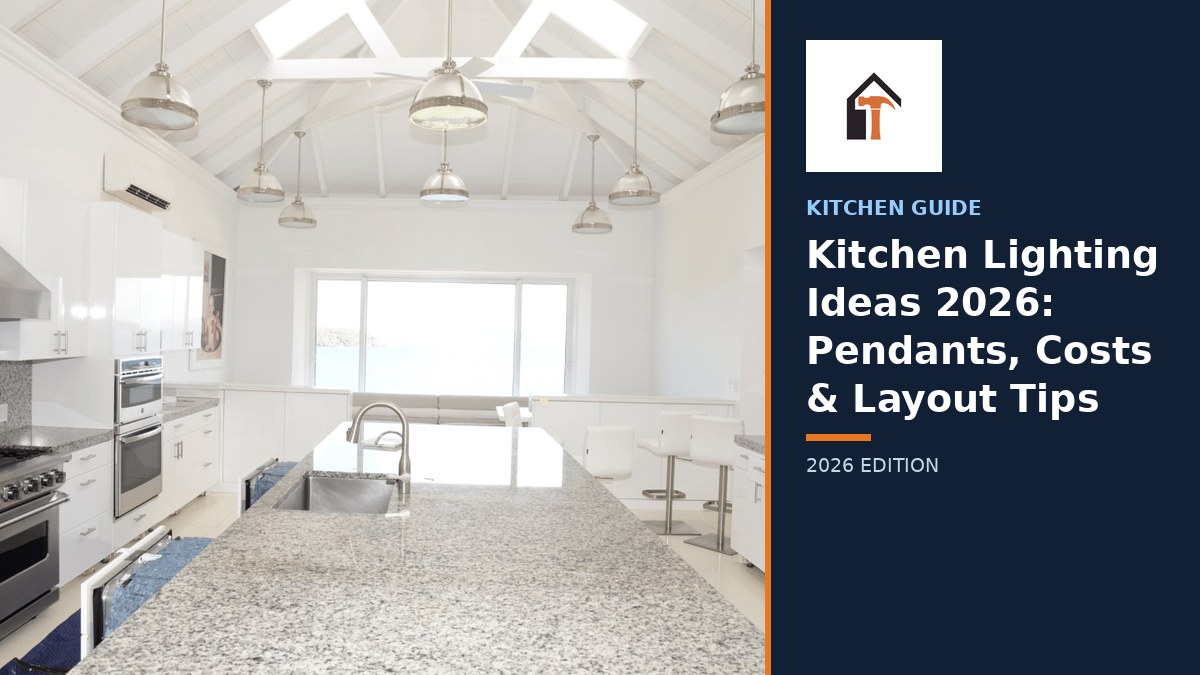
Kitchen lighting works best in three layers: ambient (general overhead light, usually recessed cans), task (bright focused light over counters and the island, usually pendants and under-cabinet strips), and accent (decorative touches like toe-kick or in-cabinet lighting). Plan on $1,500 to $4,500 total for a professionally lit mid-size kitchen in 2026, covering 6 to 10 recessed lights, 2 to 3 island pendants, and under-cabinet strips. Individual pieces run about $100 to $300 per recessed light installed, $100 to $300 per pendant installed, and $200 to $500 for a run of under-cabinet lighting. Every fixture should be dimmable and use warm-white LED bulbs (around 2700K) so one kitchen can shift from bright meal-prep mode to soft evening mode.
Lighting Type Comparison Table
| Type | Fixture Cost | Installed Cost (per unit) | Best For | Lifespan (LED) |
|---|---|---|---|---|
| Pendant lights | $50 – $250 (designer: $500+) | $100 – $300 | Island task + style focal point | 15-25 years |
| Under-cabinet strips/pucks | $20 – $80 per light | $200 – $500 per run | Countertop task lighting | 15-25 years |
| Recessed (can) lights | $15 – $150 per fixture | $100 – $300 per light | Ambient general illumination | 15-25 years |
| Chandelier / statement fixture | $150 – $1,500+ | $200 – $2,000+ | Dining nook, large islands | 15-25 years |
| Toe-kick / accent lighting | $30 – $100 per strip | $150 – $400 | Night lighting, floating-cabinet look | 15-25 years |
Cost by Type: Fixture + Installation Breakdown
Pendant Lights: $100 – $300 Installed Each
Pendants are the kitchen’s jewelry. A basic glass or metal pendant costs $50 to $150 at a home center; designer pieces from lighting showrooms run $250 to $1,000 or more. Professional installation adds roughly $100 to $150 per fixture when wiring already exists above the island. If your island has no junction box yet, expect $200 to $300 per pendant because the electrician must fish wire through the ceiling and add a box. Budget $400 to $900 for a trio of mid-range pendants, installed. Heavier pendants (stone, large glass globes) may need ceiling reinforcement, which adds $50 to $150.
Under-Cabinet Lighting: $200 – $500 Per Run
This is the single biggest functional upgrade per dollar in kitchen lighting. LED strip lights cost $20 to $50 per fixture at retail; premium brands like Kichler run $30 to $80 per light. A hardwired, dimmable run across 8 to 12 feet of uppers typically costs $200 to $500 installed, including a driver/transformer and a wall switch or smart control. Plug-in puck lights are the budget route at $30 to $80 for a 3-pack you stick on yourself, no electrician needed. Hardwired tape lights disappear under the cabinet lip and wash the countertop in shadow-free light, which is why designers prefer them over pucks.
Recessed Lighting: $100 – $300 Per Light Installed
Recessed cans provide the ambient layer. The fixture itself is cheap, $15 to $50 for a basic LED retrofit kit, $50 to $150 for adjustable or smart models. Labor is the real cost: cutting drywall, fishing wire, and fitting IC-rated housings (required wherever insulation sits above the ceiling) runs $80 to $165 per fixture in labor alone. A typical 10×12 kitchen needs 6 to 8 recessed lights, or $800 to $2,000 installed. Slim canless LED fixtures ($15 to $100 each) are popular in 2026 remodels because they fit shallow ceilings and skip the bulky housing.
Chandeliers and Statement Fixtures: $200 – $2,000+ Installed
Over a breakfast nook or a large island, a chandelier or oversized linear fixture makes the design statement. Installation ranges from $200 for a lightweight fixture on an existing box to $2,000+ for heavy pieces that need structural bracing and new wiring on high ceilings. The fixture itself is the wild card: $150 at a big-box store, $800 to $3,000 for designer showroom pieces.
Kitchen Lighting Ideas: 10 Looks for 2026
1. The Classic Glass Trio Over the Island
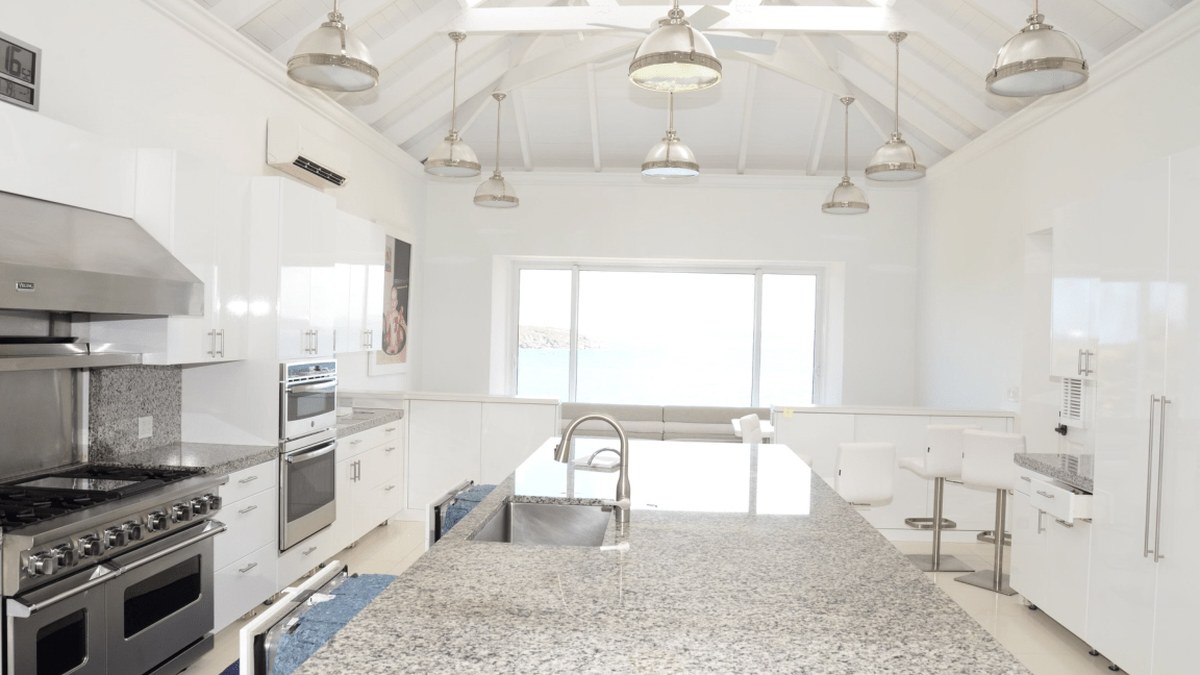
Three clear-glass globe pendants in a row, brass or matte-black stems, warm 2700K bulbs glowing inside. The transparency keeps sightlines open across the island while the metal stems tie into cabinet hardware. Cost: about $450 to $900 installed for the trio.
2. Oversized Drum Shade
One large linen or rattan drum pendant centered over a 6-foot island instead of three small ones. It reads calm and sculptural, and a single fixture means one junction box and lower install cost ($150 to $400 installed). Best for transitional and coastal kitchens.
3. Industrial Cage Pendants
Black metal cage shades with exposed Edison-style LED filaments over a butcher-block island. Casual, textured, and budget-friendly at $60 to $150 per fixture. Pair with a dimmer to tame the glare during dinner.
4. Invisible Under-Cabinet Wash
Warm-white LED tape tucked behind the cabinet lip so you see light, not fixtures. The countertop gets bright, shadow-free task light and the backsplash tile glows. The most functional dollar-for-dollar upgrade: $200 to $500 professionally installed.
5. Grid of Slim Recessed Cans
Canless LED recessed lights in a clean grid over the main work zones, 4 to 6 feet apart. No visible fixture, no ceiling clutter, just even ambient light. Plan $100 to $300 per light; a 10×12 kitchen takes 6 to 8.
6. Linear Suspension Over a Long Island
A single 48- to 60-inch linear LED bar or a row of small pendants on one long canopy over 8- to 10-foot islands. One electrical connection, one clean line, dramatic modern look. Fixtures run $300 to $1,200 plus $150 to $300 installation.
7. Toe-Kick Glow
LED strips under the base cabinets, casting a soft halo on the floor. It makes cabinets look like they float and doubles as night lighting so you never flip on the overheads for a midnight glass of water. Add $150 to $400 to any under-cabinet project.
8. In-Cabinet Display Lighting
Tiny puck or tape lights inside glass-front uppers, turning your dishware into a lit display. Battery or low-voltage, often a DIY add-on at $30 to $100 per cabinet.
9. Statement Chandelier in the Breakfast Nook
A woven rattan, beaded, or sculptural metal chandelier over the eat-in table, hung 30 to 36 inches above the tabletop. The one place in the kitchen where decoration beats task lighting. Budget $300 to $1,500 installed.
10. Smart Color-Tunable System
Smart recessed lights and strips that shift from bright 4000K daylight for cooking to warm 2200K candlelight for dinner, controlled by phone or voice. Adds $50 to $150 per fixture over standard LED; the flexibility replaces the need for separate fixtures in some kitchens.
Layout Rules: Spacing, Height, and Placement
Pendant Height Over the Island
Hang pendants so the bottom of the shade sits 30 to 36 inches above the countertop. At 30 inches the light feels intimate and dramatic; at 36 inches it feels open and airy. For ceilings over 9 feet, add about 3 inches of drop per extra foot of ceiling height. Always measure from the finished countertop, not the floor, and confirm the tallest person in the house can see under the shades.
Pendant Spacing and Count
Use two to three pendants over a standard island, spaced 24 to 30 inches apart center-to-center (roughly twice the pendant’s diameter). Keep the outermost pendants 6 to 18 inches in from the island ends. Size rule: the combined width of your pendants should be about one-half to two-thirds of the island’s length. A 6-foot island takes two pendants; an 8- to 10-foot island takes three. Undersized pendants are the most common mistake; fixtures that look big in the store often read small over a 7-foot island.
Recessed Light Layout
Space recessed lights 4 to 6 feet apart, and position them about 2 feet in from the walls so they wash the perimeter counters without creating harsh shadows. Place cans directly over work zones (sink, range, prep areas) rather than in a rigid grid that ignores the layout. Above the island, align recessed lights with the pendant positions or offset them slightly so the two layers do not compete. In insulated ceilings, every fixture must be IC-rated; non-IC housings against insulation are a fire-code violation.
Under-Cabinet Placement
Mount tape lights toward the front lip of the upper cabinets, not against the backsplash, so light washes forward across the full countertop depth. For counters deeper than 24 inches, a second run near the back eliminates the dark strip behind small appliances. Keep the driver/transformer accessible inside a cabinet for future replacement.
Color Temperature and Dimmers
Use 2700K to 3000K warm white everywhere in the kitchen for a flattering, cohesive glow; mixing 2700K pendants with 5000K daylight cans is the fastest way to make a kitchen feel disjointed. Put every layer on its own dimmer switch, or use smart dimmers, so task lighting can run full-bright while ambient light drops for evening.
DIY vs Pro: Electrical Work
| Task | DIY Feasible? | Typical Pro Cost | Notes |
|---|---|---|---|
| Swap an existing pendant (same box) | Yes | $100 – $150 | Turn off the breaker; 30-minute job |
| Plug-in under-cabinet pucks | Yes | N/A | Peel-and-stick, no wiring |
| New pendant where no box exists | No | $200 – $300 each | Requires fishing wire, new box |
| New recessed lights | Rarely | $100 – $300 each | Drywall cutting, IC-rating rules |
| Hardwired under-cabinet + switch | No | $200 – $500 per run | New circuit or switch leg |
| Dimmer switch swap | Yes (experienced) | $100 – $200 | Must match LED-compatible dimmer |
The honest rule: if it needs new wiring, hire a licensed electrician. Swapping a fixture on an existing box is a safe DIY job; adding boxes, circuits, or recessed cans is not. Electricians charge $50 to $100 per hour, and bundling all lighting work into one visit cuts the per-fixture cost. One more DIY trap: LED fixtures need LED-compatible dimmers; old dimmers cause flicker and buzzing.
FAQ
How much does it cost to light a whole kitchen in 2026?
A mid-size kitchen with 6 to 8 recessed lights, 3 island pendants, and under-cabinet strips runs $1,500 to $4,500 professionally installed. Budget refreshes using plug-in lighting and fixture swaps can land under $500; designer fixtures and smart systems push past $6,000.
How many recessed lights do I need in my kitchen?
Plan roughly one recessed light per 25 to 35 square feet of kitchen, spaced 4 to 6 feet apart. A 10×12 kitchen (120 sq ft) needs 6 to 8 cans. Always place them over work zones first, then fill in for even coverage.
Can I install pendant lights where no wiring exists?
Yes, but it is electrician work, not DIY. Running a new circuit or switch leg to an island typically costs $200 to $300 per pendant, more if the ceiling is finished and wire must be fished through joists. Get the wiring roughed in before drywall goes up in a remodel.
What color temperature is best for kitchen lighting?
2700K to 3000K warm white for the whole kitchen. It flatters food, skin tones, and wood cabinets. Reserve 3500K to 4000K only for a dedicated prep zone if you want cooler task light, and never mix temperatures in the same sightline.
Are under-cabinet lights worth it?
Yes. They are the highest-impact lighting upgrade per dollar: $200 to $500 installed for shadow-free countertop light that recessed cans alone cannot deliver. Hardwired LED tape on a dimmer is the version designers recommend; plug-in pucks are the renter-friendly alternative.
How We Estimated These Costs
Cost ranges in this guide are planning estimates drawn from 2026 US contractor pricing data published by Angi, retail fixture pricing from Home Depot, and installation guidance from This Old House, cross-checked against electrician rate surveys (typically $50 to $100 per hour nationally). Pendant install figures ($100 to $300 per fixture) and recessed figures ($100 to $300 per light) reflect standard single-story, accessible-ceiling jobs; two-story foyers, plaster ceilings, and long wire runs push costs higher. Regional labor rates vary 20 to 40 percent between low-cost and high-cost metros. These are budgeting ranges, not quotes. Get two to three written estimates from licensed electricians, confirm every fixture is dimmable and LED-compatible with your dimmers, and verify IC ratings wherever insulation sits above the ceiling.
By Renovation Guide HQ – October 2026